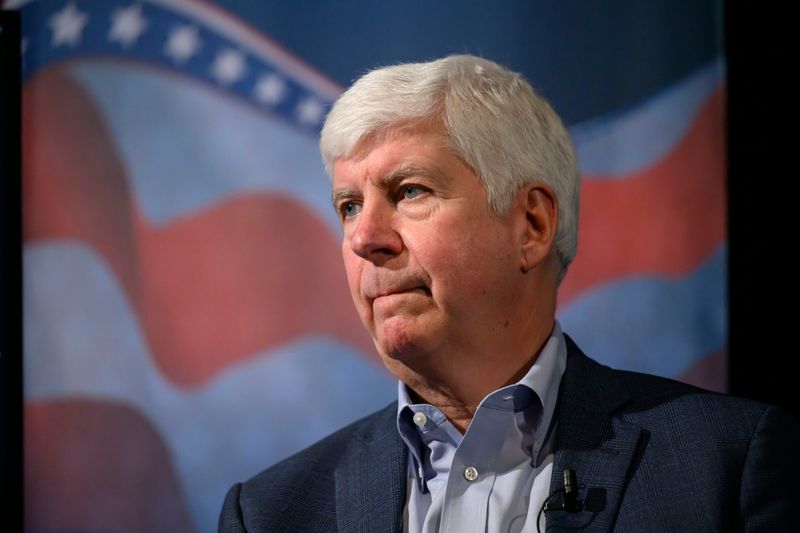
Mackinac Island — The rehabilitation of Rick Snyder’s image is part of the unofficial agenda this week during the Detroit Regional Chamber’s annual conference.
The former governor has spent most of the seven-plus years since he left office considered persona non grata in many circles, damaged irreparably, it seemed, by his role in the Flint water crisis.

He was shunned from places to which he envisioned he’d contribute when he was contemplating post-political life, including his beloved alma mater, the University of Michigan, which slammed the door on him after Flint.
“I was taken off the table in a lot of ways — from boards, organizations, even my university,” Snyder says. “I was sort of erased from memory.”
This week, though, the guy who once walked through the Grand Hotel with a comet’s tail of admirers streaming behind him, and then all but vanished, will take the stage at the conference for the first time since leaving office.
Snyder will unveil the Innovation Districts initiative he and veteran education reformer Doug Ross are leading. The idea is to apply cutting-edge techniques and technology to close Michigan’s learning gap.
Schools that buy in would offer customized learning plans for their students, who would advance through the project-based curriculum at their own pace. The districts would refigure rather than replace traditional public schools.
It’s the type of bold thinking Snyder was known for as governor, and helps explain why so many in Michigan welcome his return to grace.
“The board was looking for people who understand economic innovation and how to grow companies,” says Jeff Donofrio, CEO of Business Leaders for Michigan, which recently added Snyder to its board. “Rick fit the bill. He is a smart guy who is focused on what we can do to move the state forward.”
That was always Snyder’s strength. Over two terms, he aggressively dragged Michigan off the bottom of business rankings, improved its attractiveness to investors and job creators and set it on a course to be debt-free by 2035.
Then came Flint, which opened the door to complete Democratic control of the state. Gov. Gretchen Whitmer and the Democratic Legislature systematically dismantled his signature reforms, and Michigan has been steadily falling ever since.
Snyder’s predecessor, Gov. Jennifer Granholm, also is returning to the island this week for the first time. She, too, left office in ignominy, barely showed up for the conference at the end and was largely written off by the business community.
But she was never banished from public life as Snyder was. “It was disappointing,” he says. I thought I could contribute. It hurt. But there’s no value in being negative.”
So he started a cybersecurity firm and began consulting with others in that field.
“That’s a world that needs a lot of help,” he says. “And the people didn’t have the same concerns about me. People were asking for my advice; they just didn’t want anyone to know I was giving it.”
The comeback actually got its start two years ago when Snyder helped Republicans win the Michigan House. It has moved ahead gradually over the past 12 months. The Detroit Chamber added him to its board, and he appeared on a highly touted civility panel with Granholm and former Govs. Jim Blanchard and John Engler.
“Our view of Rick Snyder has never dimmed; it’s always been bright,” says Sandy Baruah, CEO of the chamber. “Michigan is a state that needs to deal with big issues, hard truths. A former governor with his track record has a lot to offer in terms of solutions.”
Baruah’s view is that Snyder was the target of a political witch hunt, and didn’t do enough to defend himself. That’s an opinion shared by Snyder’s former chief of staff, Dennis Muchmore, who says:
“Nobody ever understood what happened in Flint. Rick got treated unfairly, no question about it.”
That opinion is still far from universal. Snyder is not likely to ever be welcome in Flint, for example.
“As a pastor who watched what Rick Snyder did to my city in real time, I see bringing him back to the mainstream as criminal,” says Bishop Chris Martin of the Cathedral of Faith. “He has never been held accountable.”
Snyder has heard a lot of that sentiment over the past decade. He faced public heckling and harassment, often in front of his wife and children.
“People weren’t nice about it; they were saying derogatory things,” Snyder says. “My kids had to listen to them badmouth their father.”
Yet he never considered leaving Michigan. Snyder is the only living former governor who has lived full-time continuously in this state since leaving office.
“It’s a very interesting case study in the making,” says Matt Friedman, a crisis communications expert. “He could have moved away and retired as a private citizen. But he stayed here, started a business and wants to stay as active as possible in public service. He must feel like he has something more to give.”
And that’s exactly it, says Snyder.
“I just want to help Michigan.”
Nolan Finley’s columns appear in The Detroit News. Reach him at nfinley@detroitnews.com and follow him on X @NolanFinleyDN.
This article originally appeared on The Detroit News: Nolan Finley: Snyder makes comeback after Flint water crisis
Reporting by Nolan Finley, The Detroit News / The Detroit News
USA TODAY Network via Reuters Connect