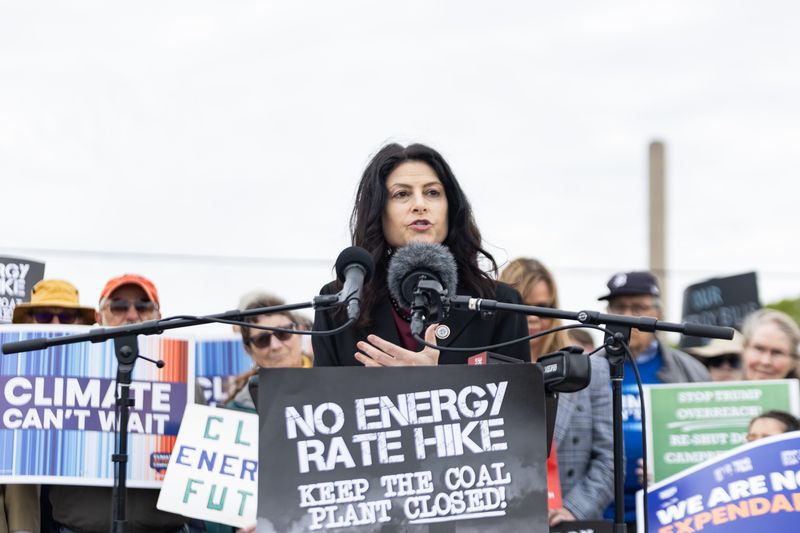
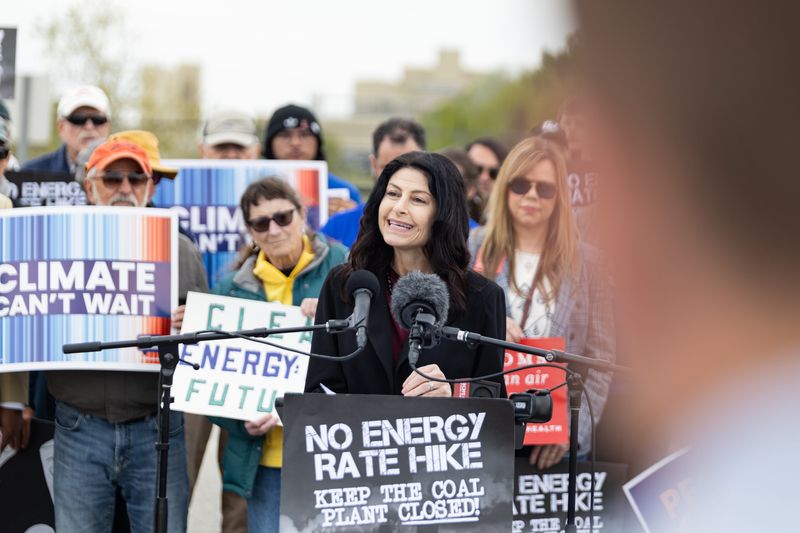
PORT SHELDON — Michigan Attorney General Dana Nessel visited a local park near the J.H. Campbell Power Plant to call for the site’s closure the same week a fifth emergency order from the U.S. Department of Energy was issued to mandate continued operations.
The order is expected to last though Aug. 16

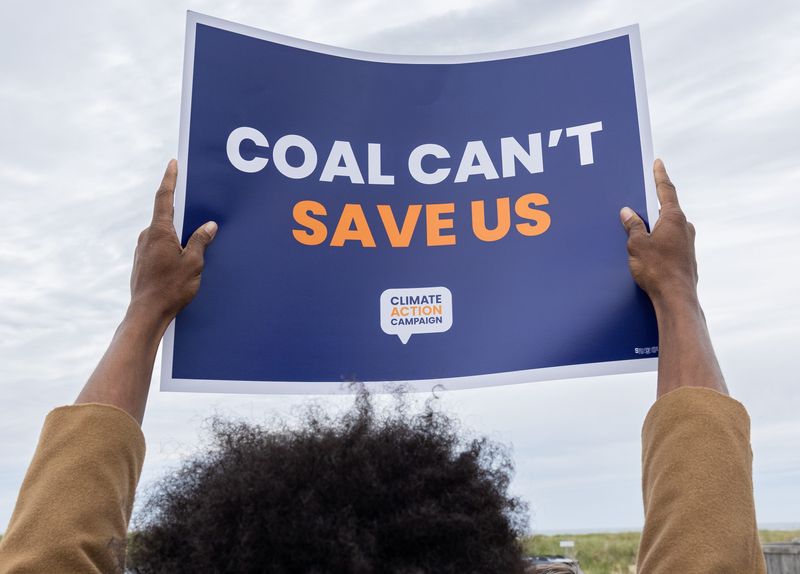
Nessel was joined by a number of environmental and public interest groups, including the Michigan League of Conservation Voters, NAACP Greater Grand Rapids, Community Collaboration on Climate Change, Sierra Club Michigan, Urban Core Collective and Earthjustice.
“The Trump (Administration) is crying wolf over a non-existent energy emergency while at the same time undermining every effort made to increase the efficiency, affordability and reliability of domestic energy markets,” Nessel said May 21.
The plant in Port Sheldon Township has run nearly one year past an intended closure date. Secretary of Energy Chris Wright issued the first 90-day order on May 23, 2025 — just days before Consumers Energy planned to cease production.
At the time, retirement and restoration of the property was expected to last until 2030. The decision to shutter the plant was spurred by Consumers’ Clean Energy Plan, which called for eliminating coal as an energy source in 2025. The plan was released in the wake of state law requiring Michigan to produce all energy from clean sources by 2040.
Consumers has indicated an expectation that emergency orders will continue for the foreseeable future, unless the court system intervenes.
The federal government has maintained the Midcontinent Independent System Operator, the grid on which the plant operates, would face an energy shortfall without continued production.
A financial filing from Consumers reported net losses of $135 million through Dec. 31, 2025, as a result of the orders. The provider has previously stated intentions for “cost recovery,” which could fall to ratepayers throughout MISO — including those in Michigan, Illinois, Indiana, Iowa, Kentucky, Minnesota, Montana, North Dakota, South Dakota and Wisconsin.
‘You’re actually killing people’
An effort to “Save the Campbell” in Ottawa County has been underway since Consumers announced the site was slated for an early retirement in 2021. Initially, at least one portion of the plant was meant to stay online until 2040.
“It’s voluntary for the Campbell Plant to be closing (this) early,” Ottawa County Commissioner Allison Miedema said in February 2025. “That was a voluntary decision. This wasn’t a mandate that was put on them.”
Commissioners passed a resolution making a “formal appeal” to the Michigan Public Service Commission to reconsider shutdown plan approval, but state and company officials said the decision was already made. The board voted against taking legal action in April 2025, noting the previous resolution had been shared with the federal government and could spur action.
“I don’t understand who you’re doing it on behalf of,” Nessel said in response to a question from The Sentinel about local officials’ support of the continued orders. “You aren’t doing it on behalf of the ratepayers … you aren’t doing it for people’s public health. What you’re doing is you’re actually killing people …”
“So, when you say there are local (electees) that want to keep this plant online, I ask you, ‘Whose interests are you serving?’ It’s not the people of the state of Michigan.”
Judges hear oral arguments in legal challenge
On May 15, the U.S. Court of Appeals for the D.C. Circuit heard oral arguments in a legal challenge against the original order issued in 2025. The lawsuit’s parties include the federal government, the state of Michigan, Consumers Energy and public interest groups represented by Earth Justice.
Critical for judges to determine is what defines an “emergency.” The answer could impact other orders made under Section 202(c) of the Federal Power Act.
Robert Stander, an attorney representing the DOE, argued Wright has the authority to label an emergency at his discretion, so long as there’s substantial evidence.
His argument hinges on a study by the North American Electric Reliability Corporation, which listed MISO as an “elevated risk” — meaning the grid has adequate resources, but analysis indicates that extreme weather conditions are likely to cause a shortfall in area reserves. MISO was previously listed as “high risk,” but that was corrected in July 2025.
Stander also noted established concerns with data centers coming live and straining the grid.
During a press conference following oral arguments, Sierra Club Attorney Greg Wannier said the study isn’t significant enough to issue an “emergency” order, adding such orders have had a “disruptive” effect on long-term planning efforts.
Consumers Energy, in fact, argued in court that retirement planning was a long-term process that began in 2022.
Nessel feels confident in her office’s ability to win the case.
“Because (the administration) keeps violating the law, we keep suing, and we keep winning in court,” she said to cheers May 21. “So yes … I think we’re going to win this case.”
— Cassidey Kavathas is the politics and court reporter at The Holland Sentinel. Contact her at ckavathas@hollandsentinel.com. Follow her on X @cassideykava.
This article originally appeared on The Holland Sentinel: Attorney General Nessel calls for closure of J.H. Campbell Power Plant
Reporting by Cassidey Kavathas, Holland Sentinel / The Holland Sentinel
USA TODAY Network via Reuters Connect