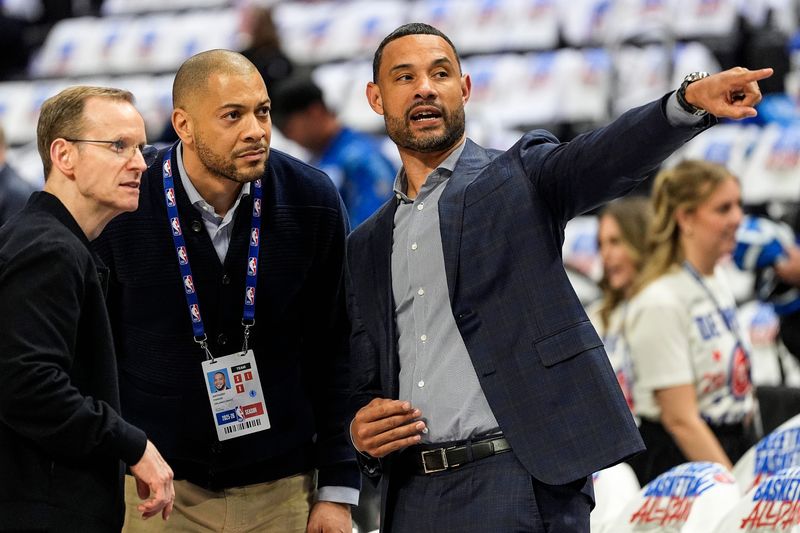
Detroit Pistons president of basketball operations Trajan Langdon was frank three months ago when asked about his team’s championship odds – he had no clue.
At the time, the Pistons were 39-13 and atop the Eastern Conference.

Yet, they hadn’t won a playoff series or even a home playoff game since 2008 and were only a year-and-a-half removed from 14 wins, the worst season in franchise history. Langdon knew his team was good. He needed more time to determine if they were championship-ready.
“I think we’ve shown we can beat those teams, but we also realized that we haven’t won a playoff series yet, either,” he said Feb. 11. “So although we’re having a good regular season thus far, the playoffs are a different monster and we don’t have a lot of experience there.”
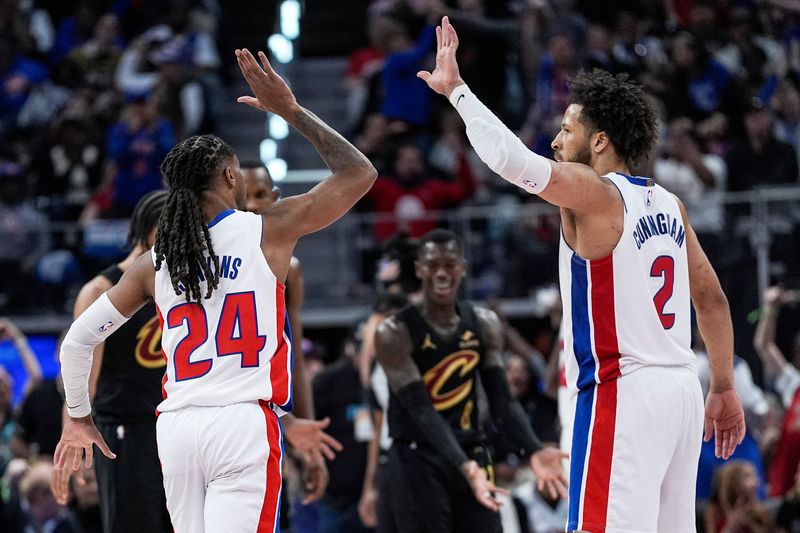
Three months later, the Pistons have answered a lot of questions. Not even a collapsed lung and 11-game absence for Cade Cunningham in March and April could knock them off their 60-win pace – they finished 60-22 and won the East by four games.
And they set a new playoff bar, winning five straight postseason games at Little Caesars Arena while coming back from a 3-1 deficit to beat the Orlando Magic in the first round, before blowing a 2-0 series lead in a seven-game defeat to the Cleveland Cavaliers to fall one win short of the Eastern Conference finals.
Some will argue their finish indicates Langdon should’ve went harder at the February trade deadline.
During his end-of-season press conference Tuesday, May 19, Langdon defended his logic to ride with the current roster.
In two years, the Pistons went from 14 win to 44 to 60. He was quick to remind that before the season, no one expected them to win the East and become only the third 60-win team in franchise history.
A year prior, it would’ve been shocking to hear that they would make a 30-game improvement and push the New York Knicks to six games.
Now, they enter the offseason with all of their assets in hand – up to five tradeable first-round picks and a trove of second-rounders in hand. They firmly are in control of their future.
It remains to be seen if the proverbial “big move” to add a second star next to Cade Cunningham will be made. But Langdon’s ambiguity regarding the Pistons’ plans is also a tell – he understands his team is ready to contend and that change will be necessary to achieve their championship goal.
Specifically, he pointed to ball-handling as the team’s biggest need along with shooting. And he acknowledged acquiring such things typically doesn’t come cheaply.
“The more ball-handling you can have on the floor, the better,” Langdon said Tuesday afternoon at the Pistons’ practice facility in midtown. “You see these teams that are successful have a lot of people that can whether it’s initiate, whether bringing the ball up or executing in the halfcourt in terms of getting paint touches or making decisions. I think the more guys like that you have, the more difficult it is to guard. We’ll look at some of those things. And spreading the floor and shooting helps. Everybody knew that was something we might struggle with a little bit.
“Addressing some of those things can help. But again, those things are hard to find and can be expensive. And sometimes other teams don’t want to part ways with them.”
The most frequent topic at Langdon’s press conference was whether or not the Pistons would go star-hunting this offseason.
It was widely speculated around the trade deadline that, despite their regular season success, they would fall short in the playoffs due to roster shortcomings. Teams that make deep runs typically have multiple players who can operate as offensive engines. The Pistons had, and have, just one in Cunningham, though Jalen Duren’s offensive and defensive leap also has been critical to their success.
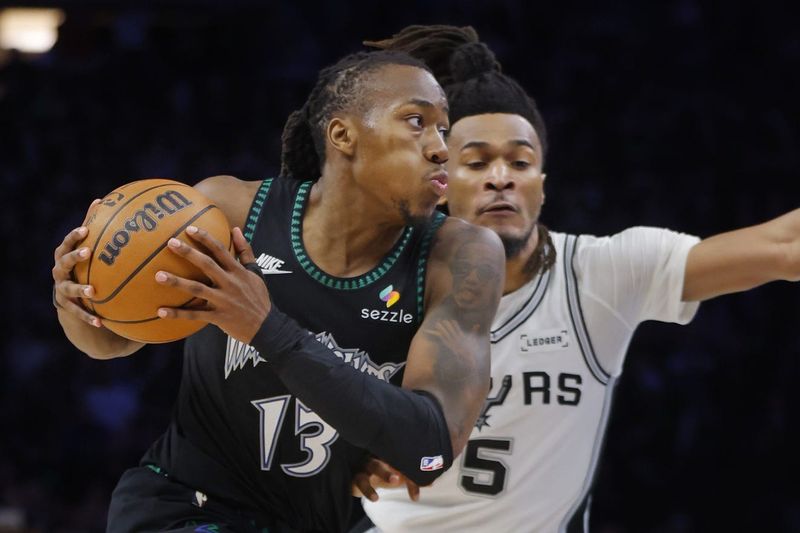
Langdon didn’t view the February deadline as a do-or-die moment for a young franchise, still new to success, with most of its core players on rookie contracts. It’s why he opted to make one smaller move by swapping Jaden Ivey for Chicago Bulls veteran wing Kevin Huerter and a pick swap with the Minnesota Timberwolves that ended up allowing the Pistons to move up from the No. 28 pick to No. 21 in this year’s draft.
Instead of going all-in on a playoff roster and adding more external help, he held onto his cards to see if his squad could continue overachieving as constructed. And the Pistons did, until they didn’t.
Sunday’s blowout loss at home in Game 7 will continue to sting, but it doesn’t retroactively make the season a failure. Rather, coming so close to making the conference finals affirms Langdon’s belief that sitting pat was the right choice. Their needs are undeniable, and they’re well-positioned to address them.
“One game winning or one game losing, I don’t think defines how you’re going to move forward,” he said. “We’ll take a holistic view of the roster. We’re still super young. All of our guys are going to iterate and get better. They’re going to all be better players next year than they were this year, just like we saw from last year to this season. We’ll take a deep dive, we’ll figure out what we need to add and we’ll step out, we’ll look at it at 35 thousand feet. We won’t look at us as a one seed. We look at us as how do we get better.”
Some will point out that even a smaller deadline move, such as for Timberwolves guard Ayo Dosunmu, could’ve made a difference in a playoff run often determined on the margins. Dosunmu was a playoff riser for the Timberwolves, who acquired him from Chicago in February along with reserve wing Julian Phillips in exchange for guard Rob Dillingham, wing Leonard Miller and four second-round picks.
Even though the Pistons could’ve matched or exceeded Minnesota’s four second-rounders, their unwillingness to shed significant draft capital or break up their core group changed the calculus.
Ivey, who had a down season after returning from October shin surgery, was waived by the Bulls in March, while injured, after making homophobic rants online.
As an asset, Ivey didn’t hold as much appeal as two young players on rookie contracts next season in Miller and Dillingham. And Dosunmu, an unrestricted free agent, can still sign with the team of his choosing this summer, though Timberwolves president of basketball operations Tim Connelly publicly said this week Dosunmu is “our most important free agent.”
The Pistons can still pursue a Dosunmu-level player this offseason, or even Dosunmu himself, if they wish to – though they would likely have to create cap space to chase Dosunmu by sacrificing Tobias Harris among other moves. If they stay over the cap, their ammo outside of a trade is the $15 million mid-level exception.
Langdon will evaluate their options, and is now fully aware of the team’s reality: They have grown up much faster than he expected when he took the job in 2024. And expectations, both internal and external, have been adjusted accordingly.
“We’re always going to feel like we can get better and that’s the goal, is to be a championship contender,” he said. “We didn’t think it would come this fast, these questions about being a championship contender after Year 2. We have to factor that into the equation as well. Two years ago when I took the job, nobody in here thought I’d be getting championship contender questions two years later. But here we are.
“I’ve always talked about skipping steps and we always take that into factor too. We don’t want to do that and I don’t think we have. We look forward to what steps to take to continue to get better. For our guys which is the most important thing is they’re thinking about a championship.”
[ MUST WATCH: Make “The Pistons Pulse” your go-to Pistons podcast, listen available anywhere you listen to podcasts (Apple, Spotify) or watch live on YouTube. ]
Contact Omari Sankofa II at osankofa@freepress.com. Follow him on X and/or Bluesky.
This article originally appeared on Detroit Free Press: Trajan Langdon didn’t make trade deadline swing, but now he’s ready
Reporting by Omari Sankofa II, Detroit Free Press / Detroit Free Press
USA TODAY Network via Reuters Connect