May 14 (Reuters) – In China, Elon Musk has been the object of love – and occasional loathing.
The Tesla boss has been both lauded as a visionary and criticised by Chinese regulators and the public for the alleged bungling of customer complaints.

In addition, the dominance of SpaceX and its Starlink satellite unit has raised the ire of the People’s Liberation Army. And as the gap between Tesla and its Chinese EV rivals narrows, Musk is at risk of losing prestige and influence.
Musk is now among a group of more than a dozen CEOs and top executives accompanying U.S. President Donald Trump to Beijing for a summit with Xi Jinping, along with Apple’s Tim Cook and Nvidia boss Jensen Huang. The delegation largely consists of executives seeking to resolve issues with Beijing and the world’s richest man is no stranger to the ups and downs of doing business with China.
Responding to reporters on his way out of the Great Hall of the People on Thursday, after a welcome ceremony where he stood behind Trump’s cabinet along with 13 other CEOs, Musk said he wants to accomplish “many good things” in China.
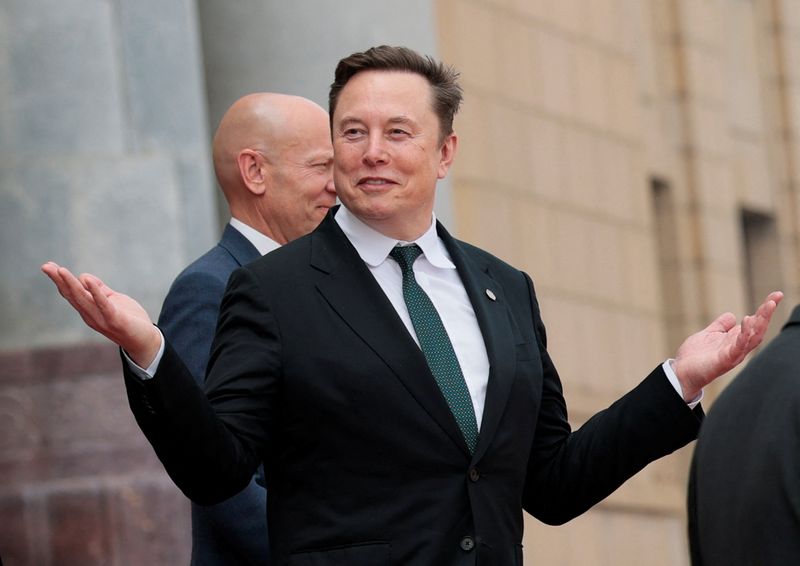
A few hours later, images of him spinning on the spot, phone in hand, before the ceremony began, presumably to get a 360-degree shot of the austere surroundings, went viral on Chinese social media as users praised his enthusiasm.
While Tesla is being hit by local electric vehicle makers on technology and price, the company – and Musk – remain influential in China. That is in part because Musk’s interests align with those of Beijing, said Kyle Chan, a fellow in Chinese technology at the Brookings Institution.
“When you look at Beijing’s tech priorities, many of them line up almost perfectly with Elon Musk’s,” Chan said, pointing to EVs, autonomous vehicles, AI and humanoid robots, as well as brain-computer interfaces and satellites.
Tesla’s self-driving technology is still considered the industry standard in China, Chan said.
EV maker Chery draws its inspiration from Tesla and Toyota, its chairman, Yin Tongyue, said in an interview with Reuters last month. Chery, which is now making inroads in Europe, aims to blend Tesla’s focus on innovation with Toyota’s obsession with quality, Yin said.
In 2018, Tesla became the first foreign car company allowed to set up an automaking operation in China without a local partner.
It sold around 626,000 cars in China last year, making it the country’s fifth-largest automaker in terms of sales of EVs and plug-in hybrids, according to the China Passenger Car Association, an industry group. China accounted for around a fifth of Tesla’s revenue last year, according to company data.
Tesla’s focus on designing cars around battery performance and software is “definitely one of the biggest inspirations for many Chinese carmakers,” said Felipe Munoz, a veteran auto analyst.
During the pandemic, while traditional automakers were dealing with lockdowns and a shortage of semiconductors, Chinese firms hunkered down to study Tesla’s cars and work out their own versions of them, Munoz said.
However, China’s military and diplomats have railed against other parts of Musk’s business empire. The near-monopoly that his SpaceX holds in lower-Earth orbit satellites, which provide cheaper and more reliable communications, and its importance in the ongoing conflict between Russia and Ukraine, has alarmed Beijing and spurred it to create domestic alternatives.
“The excellent performance of ‘Starlink’ satellites in this Russian-Ukrainian conflict will certainly prompt the U.S. and Western countries to use ‘Starlink’ extensively” in possible hostilities in Asia, said a September 2022 article co-written by researchers at an engineering university run by the People’s Liberation Army.
‘GLOBAL IDOL’
While his X social media platform is banned in China, Musk has 2.3 million followers on China’s Weibo and has been feted on local social media as “a pioneer,” “Brother Ma” and a “global idol” during some past trips. Even Musk’s mother has become something of a celebrity in China.
His visit this week comes as he is looking to buy $2.9 billion worth of equipment for manufacturing solar panels from Chinese suppliers, Reuters reported in March. That effort could now be complicated as China considers limiting exports of its most advanced technologies to the U.S.
Tesla is also seeking clearance from regulators to expand adoption of its Full Self-Driving assistance system.
Musk has maneuvered carefully in China, as the world’s largest auto market and its massive supply chains remain essential to support his broad business empire across EVs, solar power and space programme.
In 2021, Tesla was forced to apologise to Chinese consumers for failing to address a customer’s complaints in a timely manner. That came after an unhappy customer climbed atop a Tesla model at the Shanghai auto show to protest the company’s handling of her complaints about malfunctioning brakes, a moment that went viral on Chinese social media and sparked criticism in state media.
In 2021, Teslas were barred from entering military compounds due to security concerns over the cameras installed on the vehicles. That ban was only lifted after Musk visited China in 2024 and the auto industry association endorsed its data compliance.
Longer term, the biggest threat to Musk’s popularity in China could come from the continuing rise of its homegrown auto industry.
“As Chinese companies catch up or even overtake Elon Musk’s tech empire, his stature in China may start to dim,” said Chang Yan, the founder of Supercharged, a popular blog on Weibo focused on EVs.
“But he will likely remain an icon among China’s tech industry for what he’s accomplished.”
(Reporting by Zhang Yan in Shanghai, David Dolan in Tokyo; Additional reporting by Eduardo Baptista in Beijing; Editing by Miyoung Kim and Thomas Derpinghaus)