Michigan’s aging population is creating a looming crisis for local governments, forcing them to rethink how they deliver everything from housing to health care to public transportation.
Increasingly, that also means asking taxpayers for more money.

At least 14 municipalities in Metro Detroit now levy millages specifically dedicated to seniors’ needs, and experts say more may be needed as demographic trends show a so-called “gray wave” over the course of this decade.
The number of residents 65 years and older in the region is expected to grow by nearly 148,000 from 2020 to 2030, or 22%, according to projections by the Southeast Michigan Council of Governments based on U.S. census data. The region’s population as a whole is only projected to increase by 1% over that period.
Some municipalities will see especially sharp increases, such as New Haven in Macomb County, which is projected to see a 68% increase in those 65 and up, the sharpest uptick of any community in Macomb, Wayne and Oakland counties.
Washington Township, also in Macomb County, is projected to see a 56% uptick in people 65 and older and a 60% increase in those 85 and older.
Ronald Taylor, president and CEO of the Detroit Area Agency on Aging, said aging will have to be addressed from the perspectives of business, education, government and housing.
“That tsunami is upon us, and I would just say … that it’s going to provide some opportunities and also some challenges for all of us across what I’ll say is the entire continuum,” he said.
Many communities in Metro Detroit are already rethinking how they deliver services to older adults and what services they offer, from expanding senior centers and providing adult day programs to expanding programming and retooling some emergency response policies. At least 34 communities have already expanded or improved their senior centers, or are in the process of doing so, The Detroit News found.
Most counties in Michigan have senior millages, but Wayne, Macomb and Oakland do not. That means it’s up to individual cities, townships and villages to decide whether to seek them. More than a dozen communities in Metro Detroit now have dedicated millages for senior services, such as adult day care and Medicare assistance, ranging from 0.1979 mills in Royal Oak to 0.4829 mills in Pontiac, according to Detroit News research.
Taylor said city governments and health care systems will have to make “a number of adjustments” to address the region’s growing senior population.
“I think while our municipalities … they have … done a decent job as related to providing resources for our older adults, I really think that much more is going to need to be required if folks are going to be able to age in place,” he said.
He said city governments, for example, will need to make parks and other open spaces more age-friendly and accessible. Governments will also have to consider how to provide transportation services for an aging population and whether to offer tax benefits for seniors.
U.S. Census data show Michigan as a whole is aging faster than the rest of the nation. The median age in Michigan was 40.4 in 2024, 4.9 years older than it was in 2000. For the U.S. as a whole, the median age was 39.1 in 2024.
In 31 counties in Michigan, at least 1 in 4 people are 65 or older, said Kurt Metzger, the director emeritus of Data Driven Detroit. He said counties in the Upper Peninsula, except for a few exceptions, have high percentages of people 65 and older. The northern lower peninsula counties also have older populations.
Rural areas are the oldest areas of Michigan, followed by suburban areas, then cities, Metzger said. He said aging is “still a problem” in the state.
“In general, the state can’t continue to age at this rate, not refill the younger age groups, and continue to be kind of a competitor in terms of business and population attractions,” he said.
Metro Detroit is the eighth-oldest of the 50 largest metropolitan areas in the country, according to 2024 U.S. Census Bureau data. The region has a median age of 40.3, up from 39.1 in 2010 and 35.3 in 2000.
For cities, townships and villages in Metro Detroit, one of the main pressures of the region’s aging population is the growing need for senior services and programming.
New or upgraded senior centers are part of the solution in some communities. Livonia, for example, opened its new Senior Wellness Center on Five Mile last November, and Birmingham purchased a YMCA building in 2023 so it would serve as the permanent home for a nonprofit that provides senior services.
Some of those centers are standalone buildings, while others are part of a building that has other uses.
Of the at least 14 communities in Metro Detroit with dedicated senior millages, all but five are in Oakland County. The remaining communities are in Wayne County. The levies vary — a homeowner in Royal Oak whose property has a taxable value of $128,650, the average for residential properties in the city, pays $25 for the city’s senior services millage, for example. In Pontiac, a home with the city’s average residential taxable value of $30,749 pays around $15 for the city’s senior activities millage.
Voters in four of the Grosse Pointes and Harper Woods, for example, passed a 0.35-mill senior millage in November 2024, which will allow The Helm at the Boll Life Center, the area’s senior center, to continue and expand its programming. The millage is expected to generate $1.1 million per year, some of which will go to The Helm and some of which will go to Pointe Area Assisted Transportation Service, which provides transportation to seniors.
The millage is helping The Helm start an adult day program that will look after seniors who cannot be left alone at home and give their caregivers a break. It’s being piloted this spring and will be fully open by mid-summer.
Senior millages are often approved decisively, but not always. The millage for The Helm failed in Grosse Pointe Shores, one of the five Grosse Pointes, by 72 votes. Grosse Pointe Shores City Manager Stephen Poloni said he didn’t poll voters, but some residents felt that residents of the high-income community could pay for services at The Helm if they want to use them, rather than “taxing everyone.”
Krista Siddall, executive director of The Helm, said most seniors want to stay in their homes, and funding for senior services helps make that possible.
“People are living longer,” she said. “They’re retiring later. They want to be active. How do we improve their quality of life and improve their longevity? We do that by making sure that our communities act together with things like millages and funding — philanthropic funding — for senior services.”
Some local senior millages have been around for decades.
Rochester, Rochester Hills and Oakland Township voters have supported a millage for senior services and programs since the 1980s. It helps fund the OPC Social and Activity Center, a center for older adults in Rochester.
Renee Cortright, the executive director of the OPC, said local residents are willing to fund the center because they see firsthand “what a difference it makes for the community.” She added that seniors are individuals who “built the community.”
“They are the ones that moved in here,” she said. “They’ve supported all of the schools, and many of them built the churches, supported the civic organizations. And to me, it’s just valuing all of your population.”
Michael LaFaive, senior director of the Morey Fiscal Policy Initiative for the fiscally conservative Mackinac Center for Public Policy, said senior millages are providing services that could be “very useful and helpful to senior citizens.” But whether they are effective is unclear, he said.
“The question is: have any advocates for these millages done or pointed to dispassionate scholarship that has tried to measure the impact?” he said, adding that the existence of a millage that funds programs is “not necessarily evidence for the success” of the programs.
LaFaive said a senior millage comes with a cost ― a tax hike.
“And it’s important to understand whether or not the costs will outweigh the benefits derived from it,” he said.
Other communities pass or renew senior millages
Livonia has a millage that funds senior activities as well as cultural activities at Greenmead Historical Park. Northville Township has a millage for public safety, general operating, parks and recreation, and senior and youth services, which covers the overall operations of its senior services.
Some other communities have recreation millages that fund senior amenities, including Oak Park, Eastpointe, Roseville and Sterling Heights. Redford Township, for its part, has a senior transportation millage approved in August 2010 that will expire in 2031.
In the city of Birmingham, residents approved a 0.33-mill senior millage in November 2023 for a period of three years ― July 2024 through June 2027. The city purchased the YMCA building at 400 East Lincoln Street in Birmingham to serve as a permanent home for Next, a nonprofit organization that provides senior services for Birmingham, Beverly Hills, Bingham Farms and Franklin, said Assistant City Manager Mark Clemence.
He said the senior millage fund will finance renovations to 400 East Lincoln.
“Like many communities, Birmingham has an aging population,” he said. “Working with Next to provide a place for seniors to congregate for socialization, physical activity, lifelong learning and an older adult services center has been and will continue to be a City Commission goal for our community’s older population.”
The YMCA ceased most of its operations in Birmingham at the end of April. On Jan. 26, the Birmingham City Commission voted to proceed under the terms of a 2023 agreement between the city and Next, which supports Next moving into 400 East Lincoln in May 2027.
The city of Birmingham will rehab the building’s first floor for Next’s use and will consider other options for the building’s pool area, locker rooms and second floor at a later time, Clemence said.
Royal Oak’s senior service millage, which was first levied in December 2022, helps pay for staff at the Leo Mahany/Harold Meininger Senior Community Center and supports a wide variety of health and wellness programs, a transportation program and day trips tailored to seniors’ interests.
Nikki Hartley, a government affairs specialist for SEMCOG, said that senior millages help communities fill gaps in senior services. She said that every county in southeast Michigan funds senior services differently, so the gaps vary by community. Some examples include Meals on Wheels, home and community-based services, and senior recreation programming.
Taylor, president and CEO of the Detroit Area Agency on Aging, said that if the area wants to ensure continued and enhanced services for older adults, there will need to be “some investments that are provided at the local level.” Those may come in the form of city millages or county millages.
“I do believe that there’s going to have to be an exploration in regards to how can we augment and enhance the existing resources that we have,” he said.
He said it would be easier to address a millage from a county perspective, because it would cover the entire county community and would impact more individuals.
Michael Karson, president and CEO of Ageways, the area agency on aging for Livingston, Macomb, Monroe, Oakland, St. Clair and Washtenaw counties, said he thinks every county should have a senior millage so “they can support the services throughout the entire county.”
“With millages, city or county, the funds remain in the city or the county,” he said. “They can customize programs and services. They can be designed … to really meet the local needs of the population. And the other thing that’s really important as well is that those funds are not going to be interrupted from cutbacks at the state or federal level.”
Karson said Oakland County has been actively talking about a senior millage, but county spokesperson Bill Mullan said there is no discussion of a countywide senior millage. Monroe and St. Clair counties already have millages, and Washtenaw County passed one in 2024.
How aging is hitting Metro Detroit communities
Demographic statistics show that certain areas of Metro Detroit are aging faster than others.
The Southeast Michigan Council of Governments has projected what the population 65 years and older will be in each Metro Detroit community over the next few decades. All communities will see that age group increase from 2020 to 2030. The village of New Haven, which has a population of over 6,000 people, will see the fastest increase in its senior population in that timeframe, according to SEMCOG. The population is projected to rise by 68.4%, from 475 to 800.
Washington Township will see the second-highest percent increase in the population 65 and older (55.9%), followed by Keego Harbor (55.1%). The city of Northville will see the fourth-highest jump, followed by Richmond Township, Lyon Township, Holly, Woodhaven, Roseville and Farmington.
In Woodhaven in Wayne County, people 65 and older made up 19.6% of the city’s population in 2020. That number is projected to swell to nearly one-third of its population, or 29.1%, in 2030. City Administrator Jeff Harris said it surprises him “somewhat” that these numbers are “that large,” but he noted that the city recently added a senior living community, so that could be contributing to the increase.
He said Woodhaven has “a very vibrant” senior club, a group that has its own wing in the city’s community center. They have a monthly lunch, and they take trips to baseball games and other locations. The city also provides transportation for seniors and adults with disabilities.
“We do a lot,” Harris said of the city, “and so I don’t think a lot of them (seniors) really want to leave our area.”
Woodhaven has the eighth-highest percentage of people 65 and older in Metro Detroit as of 2023.
Many of the fastest aging communities are smaller municipalities. But larger Metro Detroit cities and townships are also seeing their populations age, albeit by lower percentage increases. Of communities with populations over 50,000 people, Warren, which is Michigan’s third largest city, is projected to see the highest percent increase in the 65-and-older age group from 2020 to 2030: 36.7%.
The number of city residents who are aging in place — which typically refers to people staying in their homes — doesn’t surprise Warren Mayor Lori Stone “at all.” She said many Warren residents bought homes years ago and decided to stay. She noted that their taxes are capped, which disincentivizes residents from relocating and selling their homes.
Stone said she sees the increase in the population 65 and older as “an opportunity.” She said the city is committed to making the community “more accessible overall,” including infrastructure and parks. Warren also offers affordable, income-based housing for seniors.
“I think that there’s a lot of investment that needs to be done, but I think we are well on our way. When you create a universal design for infrastructure, you create an age-friendly community,” she said, referring to infrastructure that is usable for all people.
In the list of the fastest-aging communities with populations greater than 50,000 people, Warren is followed by Macomb Township (36.2%), St. Clair Shores (34.7%), Shelby Township (30.4%), and Novi (30.3%). Four of those five communities are in Macomb County.
How one senior center uses millage money
For senior services organizations and local governments that serve aging populations, the “gray wave” has prompted an evaluation of what they offer and how they’ll pay for it.
One place where that is clear is at The Helm at the Boll Life Center, newly bolstered by the senior millage approved in 2024.
Located in a former 1930s nurses’ dormitory in Grosse Pointe Farms, it serves all of the Grosse Pointes and Harper Woods. Programs range from tai chi and fitness classes to language classes and film programs. One program, the Wise Guys Conservation Group, is specifically geared toward men, who get together for conversation and to discuss “guy things” while sharing experiences and information, according to The Helm’s website.
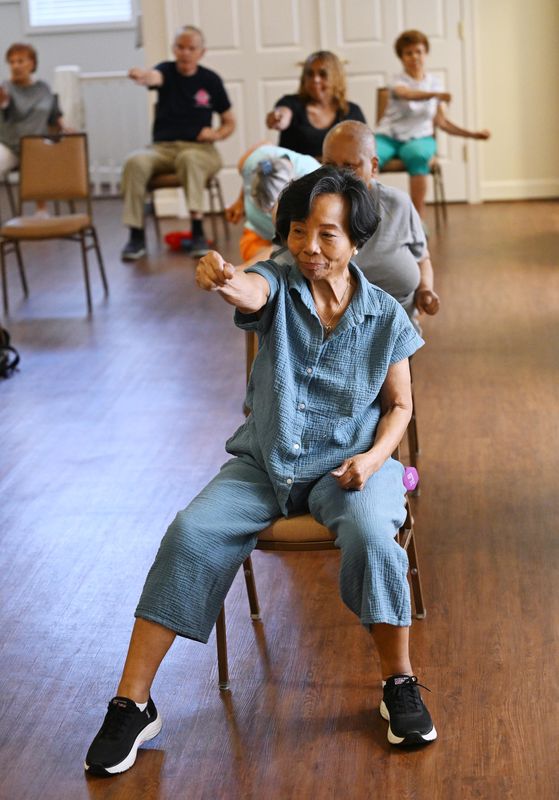
At a class last June at The Helm, 17 older adults, a mix of men and women, punched their arms forward one at a time — one in a leftward motion, the other in a rightward motion — as “I’m Coming Out” by Motown’s own Diana Ross blasted from a speaker. They were each sitting on chairs in a spacious room.
Extending their legs while sitting in chairs, Rosa Hunter, the instructor, guided them through a series of exercises to improve their balance, strength and core.
Hunter asked them to lift one arm up at a time. She then asked them to lift both arms up. She told them to wiggle their hands.
“You are ready for your massage,” Hunter said, causing one of the participants to chuckle.
Gemma Villanueva, 83, who was part of the class, said she has been coming to The Helm for five years and loves it.
“This one strengthens me,” she said of the class, which is called Enhance Fitness. “I feel much better coming.”
Villanueva has osteoporosis. She said that because of the class, she is stronger, and her walking is “much better.”
She lives with her eldest daughter’s family in Grosse Pointe Farms, one block from The Helm, so she can walk there.
Prior to the dedicated millage approved by voters in 2024, The Helm was funded by fundraising, events, grants, and state and federal dollars.
In Grosse Pointe Farms, a home with the city’s average taxable value of $241,746 pays $83 for the senior millage.
Siddall, the Helm’s executive director, said the millage is important because the area’s senior population is “growing so much,” and most senior services organizations rely on philanthropy and fundraising to provide much of their budget. She said The Helm’s budget grew from $1.4 million in fiscal year 2024 to $2.5 million in 2025 because of the millage.
“And as a business model, operating just on straight philanthropy is a little bit scary, because philanthropy in and of itself nationally is decreasing,” she added.
Siddall said the millage will pay for “quite a few” of The Helm’s essential services, such as Meals on Wheels, a home chore program and support groups for caregivers of people with Alzheimer’s Disease and Parkinson’s Disease. Another essential service is case coordination, in which a social worker helps older adults and their families with aging-related issues, like finding at-home care.
The millage is also allowing The Helm to start an adult day program, which will have half-day and full-day options.
Older adults who use senior services in Metro Detroit say they appreciate the opportunity to get out of the house.
Steve Presby, who lives in Bloomfield Township, said he supports his community’s senior millage. He said the township has “a huge variety of programs” aimed at older adults. He and his wife have gone on day trips with other seniors to the Detroit Princess Riverboat, the Pontiac Transportation Museum, and Sindbads Restaurant and Marina.
He believes senior services are a good use of tax money.
“There is … I’ll call it a hidden need in our community and really all communities,” he said. “We’re all getting older.”
asnabes@detroitnews.com
Staff Writer Ben Warren contributed.
Join us for a discussion about this series
Is your community ready for the “gray wave”? That’s the question Detroit News reporter Anne Snabes sought to answer when she embarked on a year-long look at how Metro Detroit is preparing for significant senior population growth in Michigan by 2030. In this three-part series, we examine the demographic trends driving communities’ tough budget decisions; how housing developers are seeking to accommodate older renters and buyers; and how a shortage of primary care physicians statewide puts elderly patients at risk.
To continue the conversation, The Detroit News is hosting a discussion on the Aging in Metro Detroit series at the OPC Social and Activity Center in Rochester on June 10 at 6 p.m. A panel of experts will discuss how Metro Detroit’s aging population will influence everything from city services and taxes to housing and health care. All readers are invited to attend the event. Please RSVP to Anne Snabes at asnabes@detroitnews.com by June 1.
This article originally appeared on The Detroit News: As Michigan ages, communities race to rethink services, millages. Is it enough?
Reporting by Anne Snabes, The Detroit News / The Detroit News
USA TODAY Network via Reuters Connect