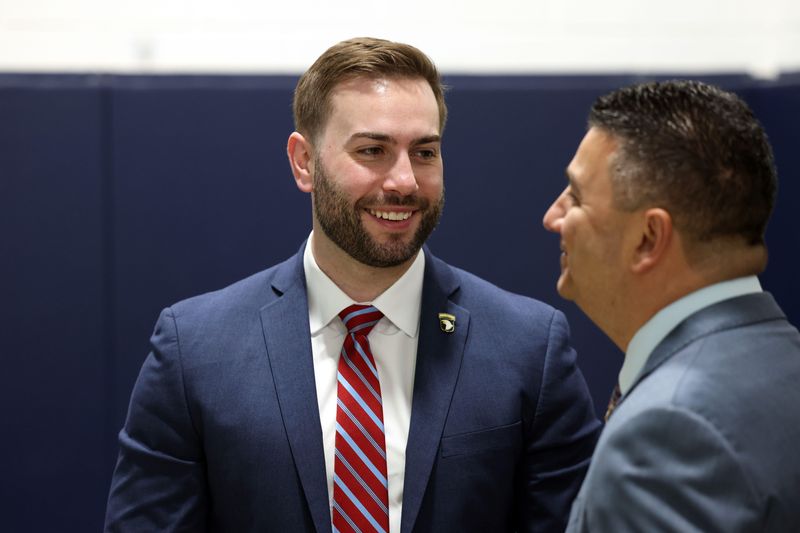
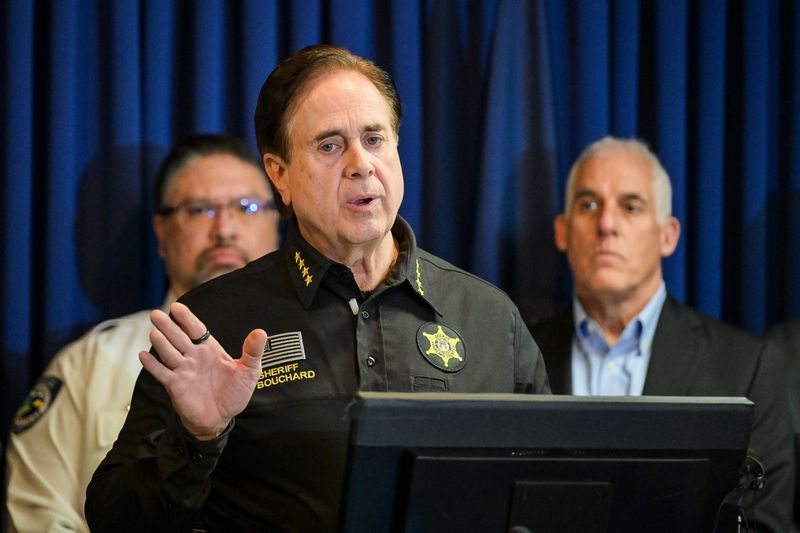
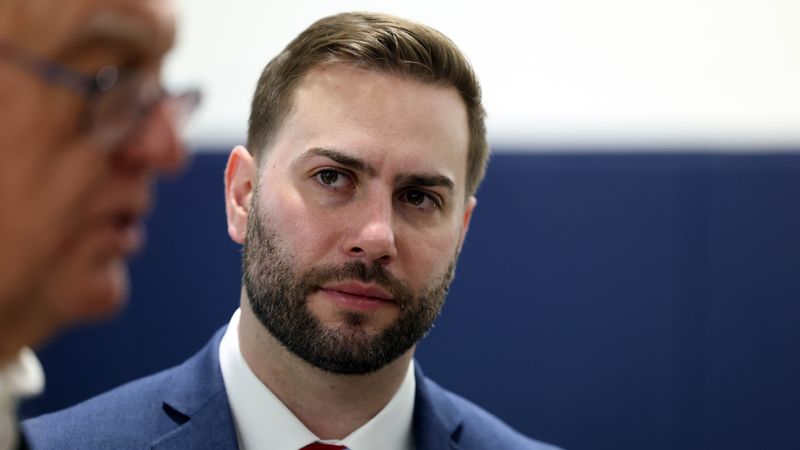
Washington — Republican congressional hopeful Michael Bouchard, similar to other second-comers in Michigan political lineages, has so far relied heavily on donors to his father’s past campaigns to fuel a 2026 run for a pivotal suburban Detroit U.S. House seat, a Detroit News analysis shows.
More than half of the traceable money flowing to Bouchard’s campaign and an outside group backing him has come from prior donors to his dad, the longtime Oakland County sheriff who shares a name with his 32-year-old son.

To the younger Michael Bouchard, that’s just the nature of tight-knit relationships formed over a lifetime. “I absolutely love the support my father and some of our lifelong friends have brought,” the Army paratrooper-turned-candidate said in an interview.
Seasoned observers and Michigan candidates with similar experiences — namely, Democratic U.S. Rep. Debbie Dingell of Ann Arbor and former Rep. Andy Levin of Bloomfield Township — said it’s not unusual in the relationship-driven world of politics for campaigning to become a family affair, though different campaigns have taken different approaches.
In this case, Bouchard’s rivals are seizing on his father’s campaign involvement as an unsavory emblem of the nepotism that often grants power and influence in Washington.
“I feel like I’m running against two Bouchards,” said primary rival Robert Lulgjuraj, a former Macomb County assistant prosecuting attorney. “I’m running against the son, and I’m running against the father.”
The dynamic in the highly competitive open race for Michigan’s Republican-leaning 10th District, which covers southern Macomb County and Rochester and Rochester Hills in Oakland County, has shed light on the pros and cons of running as a political legacy candidate.
The good: A built-in network of backers and advisers, plus the potential for easy name recognition and trust among voters. The bad: A potential backlash over being a “nepo baby” who doesn’t need to earn his or her spot.
“People don’t like legacies,” said Adrian Hemond, a Democrat and a Michigan political consultant with the firm Grassroots Midwest. “They tell pollsters, they tell other people they don’t like legacies. And I believe them when they say that, but that effect is swamped by the name ID effect.”
The veteran political consultant said Bouchard, because of his father’s political connections and the fact that they share both a first and last name, gets a “hell of a head start.”
“In a primary election, certainly you have to know who this person is to cast a vote for them, or at least have heard their name before,” Hemond said. “People’s antipathy towards legacies is sort of swamped by name ID.”
Prior Bouchard donors supply half of son’s fundraising support
The News conducted its analysis of crossover donors between the two Bouchards using public federal and state campaign records of itemized gifts, which show individual names and addresses. That information makes it possible to match donors across campaigns, though name or address changes make it difficult to track all donors over time.
For that reason, all figures presented from the analysis are likely underestimates. Only donations from individual people, rather than businesses or other candidate committees, are considered.
The elder Mike Bouchard, who has been Oakland County sheriff since 1999, ran unsuccessfully as a Republican for the U.S. Senate in 2006 and governor of Michigan in 2010. He also served in the Michigan Senate from 1991 to 1999.
Previous donors to Sheriff Bouchard’s two statewide campaigns have so far given at least $392,000 (or 43%) of the roughly $908,000 his son has raised from itemized donors in his bid for Congress through March 31.
Contributions to a pro-Bouchard group called Honor, Discipline & Duty PAC have tilted more heavily toward past donors. About $179,000 (or 77%) of the committee’s $232,000 in individual fundraising has come from past donors to the elder Bouchard.
Those sums together indicate that at least 50.1% of the money raised so far in the race to boost the younger Bouchard has come from past family donors.
“Any time you go into politics, the first people that you go to for support are the people you know well and you trust, right?” Bouchard said. “And so obviously those are going to be a lot of the same people that support my dad and that I’ve built up that trust with throughout my life.”
He added: “So I would say, yeah, 40% (excluding the super PAC) makes sense. But then I would also say the majority of our donors are new to supporting a Bouchard, and I think that’s because I’m the only one in this race with the experience that I bring to the table.”
How does Bouchard stack up against Dingell and Levin fundraising?
Bouchard’s crossover donor rate with his father is roughly in line with the last two legacy campaigners to win Michigan congressional seats after family members already had distinguished careers in Washington: Debbie Dingell and Andy Levin.
After Dingell’s husband, John — the longest serving congressman in U.S. history — announced his plans to retire in 2014, Debbie ran successfully for the seat. In that first campaign, she raised at least 45% of her itemized money (about $403,800 of $891,300) from donors who had given to John at any time since 1978.
The News’ analysis uses 1978 because it is the first year of digital records kept by the Federal Election Commission. John Dingell first took office over two decades earlier in 1955 after succeeding his father, John Sr., who entered Congress in 1933.
Debbie Dingell’s crossover rate in 2014 put her a tick above Michael Bouchard in reliance on past family donors, though the now sixth-term congresswoman said she made a concerted effort to avoid leaning on John.
“I want to be really clear: I had had my own life and my own career for 30 years. John and I had separate relationships and also joint relationships,” Dingell told The News. “But when I ran, it was very important that I run myself. I would not let John go to anything with me. I mean, he was really hurt about it, but I had to prove to people I was my own person.”
“We were a family. We were each other’s partners,” she added. “But John Dingell never made a phone call for me. I wouldn’t let him.”
Levin, who served in Congress from 2019 to 2023, had a different approach to his first campaign. Levin successfully ran to succeed his father, Sander, who held a Metro Detroit U.S. House seat for more than 35 years. Levin’s uncle, Carl, served in the U.S. Senate for 35 years, the longest of any Michiganian.
“My dad was involved in every one of my uncle’s campaigns. My uncle was involved in my dad’s campaigns. I was involved in my dad’s and my uncle’s campaigns,” the former congressman said. “We are a very, very close family.”
About 40% of Levin’s itemized fundraising in 2019 ($341,000 of $843,000) came from prior donors to his father. That puts the former congressman a few points below Bouchard’s benchmark.
Levin added that even with family help, he was “absolutely standing on my own two feet” in running his own race, with his own positions on issues and his own prior government experience working in Democratic former Gov. Jennifer Granholm’s administration.
“Sheriff Bouchard has been there for a long time, and he’s got, I think, a positive reputation,” Levin said, pondering the 10th District race. “This young Mr. Bouchard, he’s got a name. He’s got a very big name in Oakland County. But what does he know? What political base does he have?”
David Dulio, a political science professor at Oakland University, noted that family ties in politics are nothing new in Michigan or across the country.
“This is time-tested in American politics. We’ve seen political families have one generation pass to another. We’ve seen that almost since the founding,” Dulio said. “But having a famous or familiar name isn’t a silver bullet. You still have to be a good candidate with a good message to win. That holds in every campaign since the beginning of time.”
The political scientist pointed to John Adams, the second U.S. president, and his son John Quincy Adams, the sixth president. He also named the Kennedy and Bush families as other famous examples. The Bouchards, he said, are “just one local example of a wider phenomenon.”
He and other analysts listed other examples in Michigan, including former U.S. Rep. Carolyn Cheeks Kilpatrick and her son, former Detroit Mayor Kwame Kilpatrick; former U.S. Rep. Dale Kildee, who was succeeded by his nephew, Dan; and former Michigan Attorney General Bill Schuette and his son Bill, now a Michigan state representative.
Other forms of crossover, affinity giving in political fundraising
Shared family donors, notably, are not the only form of crossover or affinity giving in campaign finance. The News’ analysis found that more than a quarter (27.5%) of itemized fundraising for Democratic 10th District candidate Christina Hines of Warren has come from previous donors to Carl Marlinga, the party’s nominee in the district the past two cycles.
Marlinga has endorsed Hines in a field that includes former Pontiac Mayor Tim Greimel and former Commerce Department attorney Eric Chung of Sterling Heights. Greimel has gotten about 20% of his itemized financial support from past Marlinga donors, while Chung has less than 2% crossover with Marlinga.
On the GOP side, neither Bouchard nor his top rival, Robert Lulgjuraj, has tapped heavily into the House fundraising network of U.S. Rep. John James, the Shelby Township Republican who is running for governor of Michigan. James defeated Marlinga twice, by less than 1 percentage point in 2022 and about 5.5 points in 2024.
Bouchard has received about 3% of his itemized contributions from past donors to James’ House campaigns, though he has received significant support from backers of James’ statewide campaigns for U.S. Senate and governor. At least one-third of Bouchard’s supporters who donated $200 or more have given to James at any point.
Lulgjuraj (pronounced LOO-JER-EYE) has gotten less than 1% of his money from donors to James’ House bids and around 3% when considering all of James’ past or present campaigns. Instead of relying on established political donors, Lulgjuraj has largely tapped into his roots as the grandson of Albanian immigrants.
While ethnicity is not a data field available in federal campaign finance filings, surnames on itemized donations can be a helpful indicator.
Close to 60% of his donors through March had last names ending in -aj, a common marker of Albanian descent.
‘Nepo baby’ criticism of Bouchard comes as primary nears
Lulgjuraj of Sterling Heights has amped up criticism of the father-son dynamic as the Aug. 4 primary contest draws closer. He said in a phone interview that “Bouchard’s dad has been running his campaign for two years before he even came back (from military service overseas).”
The attorney has cast himself as the only authentic Macomb County candidate in the Republican primary and has repeatedly pointed out his family’s backstory as a “grassroots” contrast to Bouchard.
“My mom’s a waitress, my dad’s a maintenance man, so no political dynasty, no shortcuts, just hard work,” Lulgjuraj said. “These political families and career politicians, I feel like they’ve let us down. And the problem with them is they make politics their family business, and they keep passing the crown or baton down to their children. That’s wrong.”
Republican strategist Jason Cabel Roe, who is backing Lulgjuraj in the race, said the younger Bouchard’s campaign is “very much a Sheriff Mike Bouchard production.”
Roe, whose own father was previously executive director of the Michigan Republican Party, added that “probably more than any of the other patriarchs of political nepo babies, Mike really organized the entire thing. He went to Washington, met with the NRCC (Republicans’ national U.S. House campaign arm) and met with the White House while his son was overseas serving.”
Before the younger Bouchard launched his U.S. House bid in November, the elder Bouchard was part of a committee of elected leaders and businesspeople that sought to “draft” his son into the race.
“And it doesn’t mean that the younger Mike isn’t qualified, or any of that,” Roe said. “I just think that this is something that was arranged for him.
“If it weren’t for Sheriff Bouchard, there would be zero justification for Mike Bouchard’s candidacy on his own two feet,” he added. “… He’s got no connection to the actual district he’s running in, and I think that’s ultimately going to cost him the nomination.”
Bouchard said he is “just not putting a lot of stock” into the attacks on his father’s campaign role. “I’ve led hundreds of troops, managed budgets in excess of $400 million. Nobody else in this race can say that,” he said.
The candidate also acknowledged that his father sometimes attends and speaks at his campaign events, but he looks forward to those occasions.
“I mean, if we have the opportunity to, I just like to spend time with him,” the younger Bouchard said. “He’s an awesome dad.”
gschwab@detroitnews.com
@GrantSchwab
This article originally appeared on The Detroit News: GOP’s Bouchard leans on dad’s donors in key Macomb Co. U.S. House race
Reporting by Grant Schwab, The Detroit News / The Detroit News
USA TODAY Network via Reuters Connect