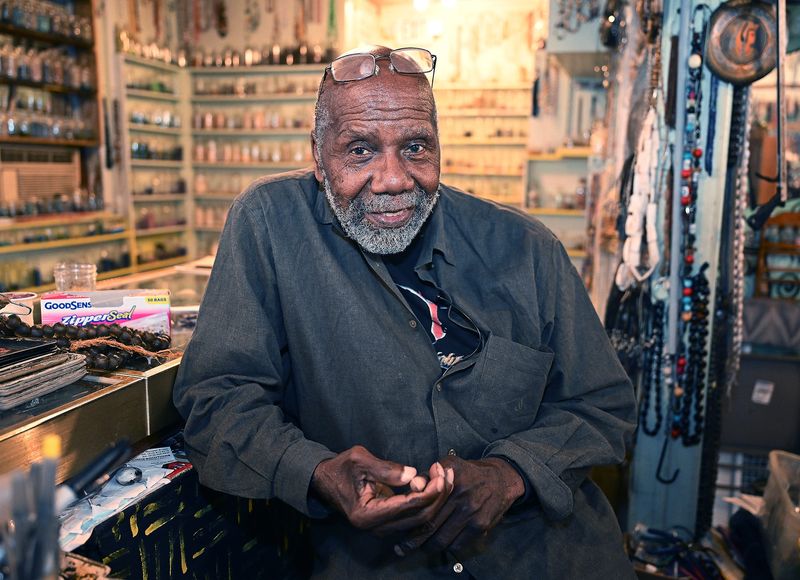
Detroit — Olayami Dabls, the 77-year-old Detroit artist, is having a unique moment in his decades-long career.
The first retrospective of his art, spanning 45 years, is on exhibit at the Museum of Contemporary Art Detroit, or MOCAD. He is currently featured in two national magazines. And he’s suing the city of Detroit for $5 million for razing an empty building featuring Dabls’ exterior art in 2024 that the city said was structurally unsound and a danger to the public.

Dabls accuses the city of violating the federal Visual Artists Rights Act, which protects artists’ work from destruction, mutilation or modification. The city has not yet responded to the suit filed last month.
He describes himself as a visual storyteller, placemaker, muralist, and educator, among other things. His work is rooted in African tradition, and his creations often include an assemblage of materials ranging from wood, rocks, beads, bits of mirror, and other objects, including found items such as paint cans, old cars and appliances.
A creator of thousands of works, he has produced highly acclaimed murals, paintings, outdoor art and installations. In 2022, he was awarded the prestigious Kresge Eminent Artist of the year.
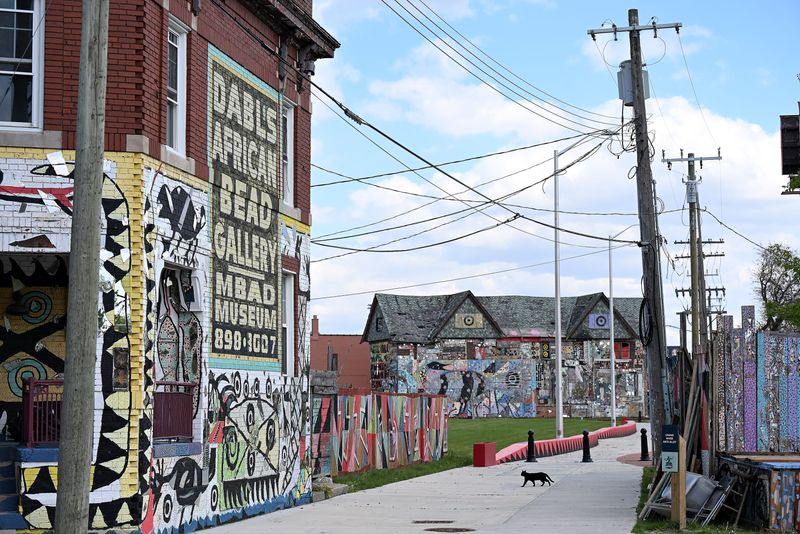
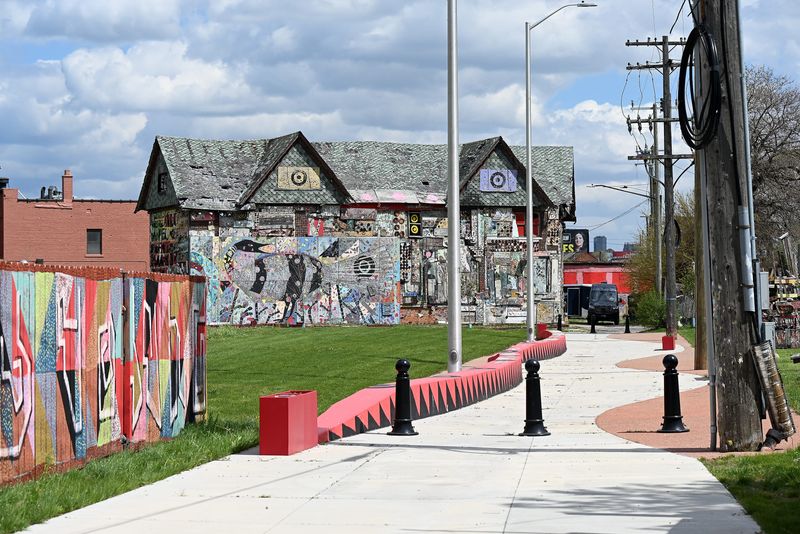
More than 25 years ago, he founded the DABLS Mbad African Bead Museum on the city’s west side, near the corner of Grand River Avenue and West Grand Boulevard. Occupying almost an entire block, the museum houses 18 outdoor installations as well as the African Bead Gallery, N’kisi House and African Language Wall.
Dabls talked to The Detroit News on Thursday about his MOCAD exhibit, the national media attention, and why his west side campus is his version of a museum, which includes a small retail shop that is filled with thousands of beads and necklaces.
Question: In the past month or so, the newly reopened MOCAD is featuring a retrospective, as they call it, of decades of your work. You are in Vogue magazine, with your work as an example of Detroit’s artistic resurgence. And you’ve sued the city. How would you describe these past few weeks?
Answer: It’s been quite interesting. Forbes also covered me. None of this was expected, especially the publications that featured me outside of my main discipline, which is history and art.
The lawsuit, I can’t talk on that one. Because why would you hire attorneys and don’t follow their advice?
…. There are some laws on the books for the city to be aware of, that once an artist puts it up, you can’t come in behind them and tear it down. You have to give them a chance to remove it. These laws are never publicized. But it’s something the attorneys representing you should know.
I’ve been here (the bead museum) since 1999. I’ve been leading this community art project. It’s here to see if it has some kind of influence on people.
I had no idea that this (bead museum) would go global. There’s probably been representatives of every country here to look at this installation. In the process, what I’ve learned is that beads have been around for 30,000 years.
The way the planet works, you go back at least five to 15 generations, you come across people where beads were part of their culture, there’s no exception to that. People came here to see the beads. That catapulted us. What was clear to me, we are more alike than not.
When I first started here, people were not coming here (to the bead museum). So, Lowe’s and Home Depot were running ads about their fertilizer and how it gave your place curb appeal. I looked around here, there was nothing but debris, trash and abandoned buildings. I put some art up to get some curb appeal. The thought process was based on me studying African material and culture.
This is the way African people search for beads. Just put them on the wall and you can see what you.
Now this installation, I titled this installation, Iron Teaching Rocks How to Rust.
Q: You are referring to something that is part of the MOCAD exhibit?
A: Yes, it’s a metaphor, and the metaphor is the relationship between Africans and Europeans for 500 years, told through iron, rocks, wood and mirrors.
None of us are interested in the past anymore. We’re more consumed about what’s going to happen to me in the future. Our ancestors were more concerned about what happened in the past, and how did we get here?
Why does history have to show the difference between two people and how bad one is? Most of Africa’s history is told through metaphors. And what is most important about the metaphor? It gives you a solution to a problem without using what the conflict is actually about. It’s really about two people having a difference, and they are trying to solve it.
This exhibit has been out there 26 years, and no one tries to attack it just because the exhibit is out there, accessible to everyone.
Q: OK, now we’re talking about your bead museum again?
A: Yes.
See, when I first started exposing myself to people who did public art, it was under a lot of attack by people who lived next door, saying, “I don’t want that here. You didn’t get my permission to do it.”
Now, I got about nine mirrors (public murals) in this city, all over the place, and no one is saying anything. I did that consciously. I knew if I use things that people are familiar with, and their ancestors had something to do with it, it would be accepted, because there’s a familiarity. That familiarity has to connect with where people were, and people have always been connected with iron, rocks, wood and mirrors and symbolism.
Symbolism is even more powerful. I use a lot of dots. Dots represent children, a circle and a dot represents the ancestors. A triangle represents the female.
All of those pieces are communicating universal information and universal laws, and no one has (gone) on the attack against them, and they all over the city.
I read somewhere that history is always written in pencil. And I realized why. Because it’s going to be changed the more you learn about a particular culture. So, what’s going on in the city of Detroit now has never happened before.
Q: What do you mean by that?
A: This thing with all this art in these various communities, these organizations, who seem to think art is the solution. Now, if you were here prior to the ’70s, none of that was here. You had a few satellite places doing art and few festivals, but it had not evolved into what it has now — as a part of mental health.
That’s how it’s suggested that you gotta have art. You don’t gotta have anything. You need things that people — not certain individuals at the top — but people decide what truly represents them.
Q: I read that you have created 15,000 pieces of original artwork.
A: Yeah.
Q: The number, it makes it seem like you’re working every day.
A: Well, it has more to do with me adapting my thought process to the materials that’s available. Just the idea that you’re using paint that’s going only be here for 20 years, and you put it outside, you might get five out of it. And you’re using rust cans that’s going to rust in maybe six or seven months. That alone would stop a lot of folks from using my approach. This idea of things last until the next generation. That goes beyond my scope. Nature has been allowed to stay, everything else just crumbles and falls.
Q: So, the artworks can include anything from a bead that you made, or a bead that you found, or a material that you found and placed it somewhere, knowing its value in a way it would communicate.
A: Here it is, 23 years later, and they get to see an exhibit of my work. There’s nothing in there under 10 years. There are paintings in there I did in the ’70s.
Q: And now we’re talking the MOCAD exhibit again.
A: There are just people on this planet who can produce a large body of work. I found out a long time ago that if you can produce art at a certain standard and maintain that standard, you don’t have anything to worry about. That’s what I started doing, not trying to make masterpieces, but just get my point across in what you see. And as I was amazed that that work still had that same energy that it did when I made it.
Q: Because you hadn’t looked at it in a while, in some cases?
A: I hadn’t seen my work rearranged in such a work way. It doesn’t look like when I took it off the canvas. I was looking at something that I had not seen in the same way it was presented.
Q: Well, now that you’re in Vogue and Forbes, maybe you will get offers from other places across the world.
A: No, my goal has never been to exhibit. I have an exhibit out there (referring to the bead museum and outdoor installations) that people see. We decided to make a museum the way I feel that a museum should be. See, there are beads in here … that range between 200, 300 years old. There are some in here that go back thousands of years, presented like this.
This would irritate a traditional museum. This is the way African people search for beads. Just put them on the wall and you can see what you.
Q: You mean the way it is arranged in here?
A: What’s not out there (are) captions and narratives, because everything out there comes from our ancestors, and they are familiar with it. So, when people see it, they’re not going to be hung up on what exactly it means. They will accept what they see and move on.
Q: What’s next, given all this recent attention?
A: This was meant to be at this time, I don’t know what’s coming next, or who’s coming next. It’s not the people I have to fear. It’s the people in charge.
Q: I see.
A: Everything has to be accepted or allowed into any system. This is operating outside of the system, only because the city of Detroit went bankrupt for a time. During that time, people were doing all kinds of things in the city to survive, and most of them have been reeled in.
I realized that I’m up against something that always runs the risk of being extinct. And I’ve been over here playing renegade with the acceptance of all the people around me and not being bothered by what they see. Because when you’re influenced by nature, what’s around you, it’s never coming from the surface. It’s coming from the memories that you have attached to the things that you see.
Q: I’m sensing ambivalence with your relationship with city officials. Obviously, there’s a lawsuit, but just overall.
A: What they’re trying to do is make something like when you go downtown, you feel like you’re in some futuristic city. And this thing (the Bead Museum campus) is reminding you of stuff from 300 years. So, it would cost, I would say, $3 million, just to redo everything here. It’s been weathered; the wood, the cans rusted. It has gone through change, through its natural life, its second life. But it still draws, connects people.
Q: Sure, yeah, the curb appeal, the wisdom of Home Depot and Lowe’s.
A: You learn from many things.
laguilar@detroitnews.com
This article originally appeared on The Detroit News: Q&A: Artist Olayami Dabls on his legacy, acclaim, dispute with Detroit
Reporting by Louis Aguilar, The Detroit News / The Detroit News
USA TODAY Network via Reuters Connect