By Max Hunder and Prasanta Kumar Dutta
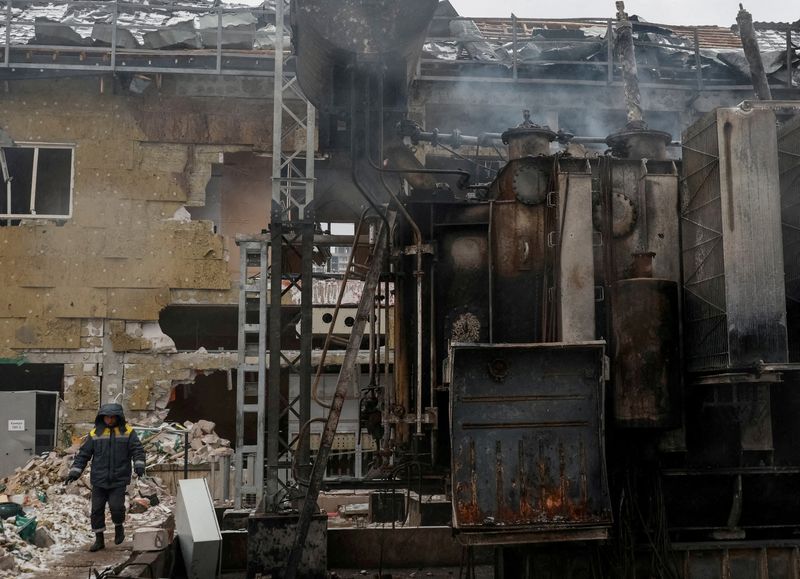
KYIV, May 8 (Reuters) – Russia has increasingly focused its aerial attacks on small Ukrainian power substations, with increased drone capacity allowing it to disrupt Ukraine’s grid over the past winter more than ever, data from a London-based research group shows.

The data, shared exclusively with Reuters by the Centre for Information Resilience, shows how Russia’s armed forces have used a rapid expansion in domestic drone production to diversify the facilities they target and step up the rate of fire.
It is one way in which frequent attacks, often involving hundreds of drones and dozens of missiles in a single wave, have been hammering Ukraine’s energy sector and disrupting power and heat for civilians, businesses and the military.
Russia’s defence ministry did not respond to a request for comment on the data. Russia denies targeting civilians as such, and says attacks on civil energy infrastructure are justified because they degrade Ukraine’s military capability. Kyiv says they are a war crime.
Although data from CIR does not classify what weapons were used in the strikes on the substations, Ukrainian officials say Russia mainly uses drones for this purpose, rather than costly missiles.
“Before 2025, it was necessary to partially stockpile the drones in order to amass sufficient volume to overwhelm air defence,” said Joshua Scriven, an investigator on CIR’s Eyes on Russia team, of the recent focus on small substations.
“But now, with the average day in Ukraine seeing over a hundred such drones fired into the country, Russian forces have more latitude in target selection.”
Ukraine struggles to protect such facilities, concentrating limited air defences instead on major assets including power plants.
Oleksandr Kharchenko, director of the Energy Research Centre in Kyiv, said that while there are 115–120 high-voltage substations in Ukraine to protect, there are more than 3,000 smaller transformers.
ESCALATING ATTACKS, EVOLVING TACTICS
Ukraine’s energy sector has suffered about $25 billion worth of damage as a result of Russia’s bombardment, according to World Bank estimates, with the total cost of the sector’s rebuilding and recovery estimated at over $90 billion.
Over the last few months, Russia launched its biggest winter campaign of attacks of the full-scale war, knocking out power for Ukrainians in major cities for up to 18 hours a day amid the coldest temperatures for years.
Between November 2025 and March 2026 Russia launched more than 1,000 missiles and 27,000 Shahed-type drones, according to Ukraine’s defence ministry.
CIR has mapped 270 strikes, using geolocated, verified videos by its researchers.
Its data shows attacks against Ukraine’s energy system rose sharply last winter compared to the previous year. And strikes on small substations accounted for 58% of all of those verified by CIR from October 2025-April 2026, up from 31% during the same months the previous year.
Russian attacks, often involving hundreds of drones interspersed with dozens of missiles, targeted both power generation and the transmission grid, Ukraine’s GUR defence intelligence agency told Reuters in a written comment.
According to CIR’s assessment of the data, while major strikes continued to target big facilities, smaller waves of drones sent on the days in between would frequently hit smaller substations, mainly used to distribute electricity to consumers.
“Striking distribution substations isn’t going to have a large-scale impact on the wider grid, but it can certainly cause issues at the local level,” said CIR’s Scriven, adding that tens of thousands of people could still be impacted.
(Additional reporting by Mike Collett-White; Editing by Mike Collett-White and Peter Graff)