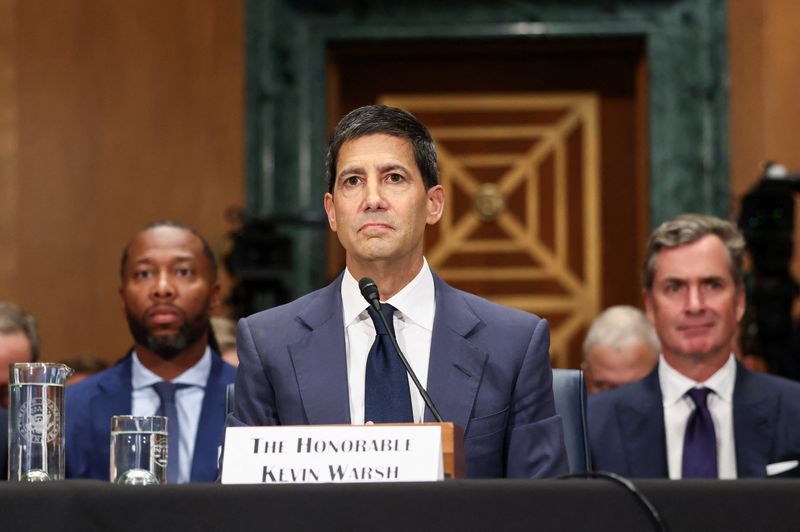
NEW YORK, April 21 (Reuters) – Kevin Warsh, tapped by President Donald Trump to lead the Federal Reserve, told a Senate panel on Tuesday he would work with the Treasury Department to help achieve his goal of a smaller Fed balance sheet, in an effort observers say would represent a long-term project for the central bank.
“Working with the Treasury Secretary, we’re going to have to find a way in which we can take the balance sheet and make it smaller,” he said as part of his confirmation hearing to succeed current Fed Chair Jerome Powell.

Warsh’s opposition to large-sized Fed holdings rests on a few fronts: He thinks it benefits Wall Street over Main Street, while forcing the Fed to keep higher short-term rates than would otherwise be the case. He also thinks that while using bond buying during the financial crisis nearly two decades ago was defensible, recent use cases aren’t.
“The big balance sheet has become an ordinary, recurring force” and “has been quite unhelpful, and is part of the reason why the Fed is in the business of politics,” Warsh said. If Fed holdings were smaller, “I think interest rates could be lower, inflation could be better, and the economy could be stronger,” he said.
Warsh remained largely aspirational on how he’d get Fed holdings down, but he said whatever the Fed would do under his command would be well communicated and done “slowly and deliberatively.”
Warsh’s comments on the central bank’s extensive holdings of cash, bonds and other assets are among his first of real substance on an issue that’s become core to central bank monetary policy making.
BIG BALANCE SHEET
Since the financial crisis, the Fed has used purchases of Treasury and mortgage bonds to help calm financial markets in times of high stress and to provide stimulus to the economy when the interest rate target is near zero and can be cut no further.
This system and the tools to achieve it have seen Fed holdings go from under a trillion dollars in the run-up to the financial crisis starting in 2007 to a peak of $9 trillion in 2022, as the Fed navigated the COVID-19 pandemic. Fed holdings now stand at $6.7 trillion and a recent New York Fed report projected that based on technical factors Fed holdings could hit $10 trillion by the end of 2035.
Most Fed officials are unconcerned by the size of Fed holdings. For them, the most critical issue is that the rate control system operated by the central bank works very well, while robust levels of liquidity in the financial system help protect against shocks.
The case against a large Fed balance sheet has centered on a few concerns. For one, large holdings have driven the Fed into a loss-making position it is still trying to dig out of, and while that does not affect Fed operations, there are concerns it could become a political problem for the central bank at some point.
Others worry large Fed holdings of bonds distort markets and make the central bank too big a player in what would normally be private markets.
If Warsh is confirmed as Fed chair, his efforts to cut Fed holdings would challenge an interest rate management toolkit that effectively limits how far the central bank can reduce its holdings and maintain strong control over its interest rate target.
COORDINATION ASPECT NOT YET CLEAR
Market participants said Warsh hasn’t yet made clear how the Fed and Treasury would work together on the balance sheet.
Derek Tang, an analyst at research firm LH Meyer, said he believes “Warsh would like Treasury and the Fed to communicate more clearly to each other what their respective plans” over Treasury debt issuance, and to better coordinate their respective positions.
Observers doubt however that Warsh would push the Fed to sell Treasury debt.
“Warsh certainly seemed to suggest a gradual approach to decreasing the balance sheet, which to me suggests that outright asset sales are unlikely,” said Gennadiy Goldberg, head of U.S. rates strategy at TD Securities.
FRAMEWORK FORMING
Over recent weeks an effort inside and outside the Fed has laid out a potential pathway to reduce the Fed’s balance sheet, and that emerging framework argues easing liquidity regulations and doing more to induce usage of central bank liquidity facilities would reduce demand for bank reserves, in turn allowing the Fed to hold fewer assets.
Some have also argued that a smaller Fed balance sheet would lead to higher long-term rates and that this increase in restraint would allow policymakers to cut their interest rate target to balance that out.
New York Fed President John Williams told reporters at the end of March that higher long-term rates resulting from a smaller Fed balance sheet theoretically opens the door to lower short-term rates to offset those headwinds, but he cautioned it is hard to measure in advance how much lower the central bank rate target could go.
(Reporting by Michael S. Derby, Editing by Franklin Paul and Andrea Ricci )