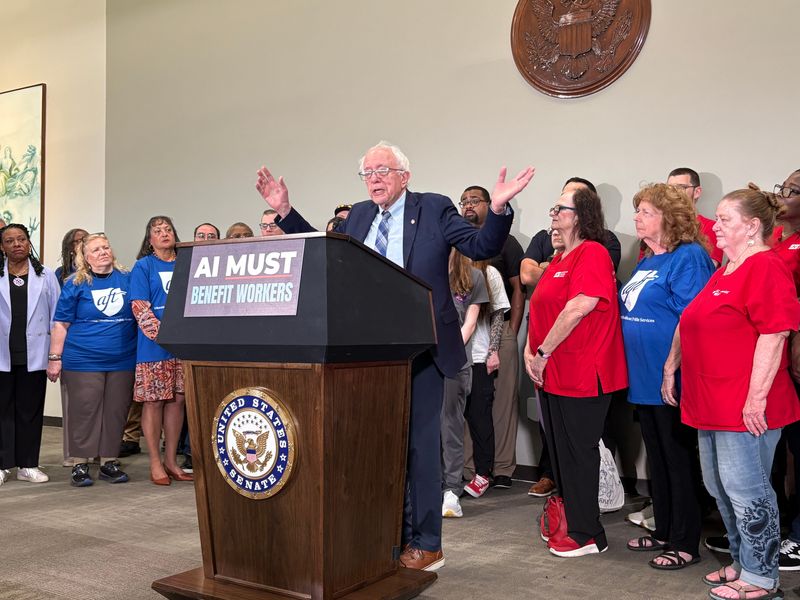
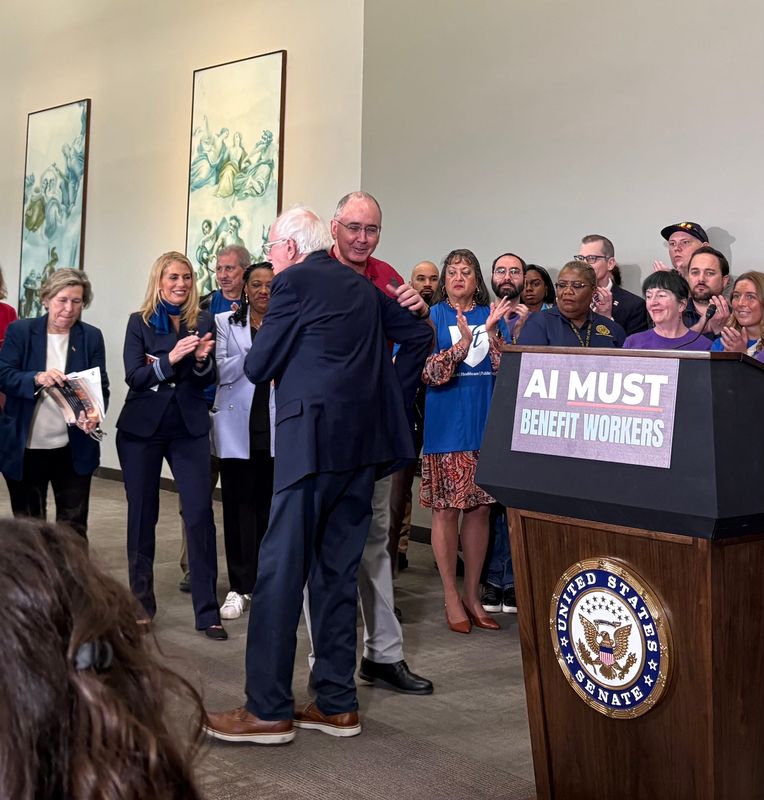
Washington — U.S. Sen. Bernie Sanders joined UAW President Shawn Fain and other labor leaders Thursday to warn of the risks artificial intelligence poses for American workers, a topic they said policymakers are not paying enough attention to.
“We are looking at the most consequential and significant technological revolution in the history of humanity,” Sanders, I-Vt., said during a Capitol Hill press conference.

“It doesn’t take a rocket scientist to figure out that, maybe, human beings and workers should benefit from this transition, rather than a handful of multi-billionaires,” he added. The senator, notably, won Michigan’s 2016 Democratic presidential primary in part thanks to his stances on labor issues.
Sanders suggested that AI could wipe out jobs in many areas of the economy, including blue-collar sectors like transportation and manufacturing, and white-collar sectors like engineering, accounting and law.
The United Auto Workers’ Fain compared the emergence of AI to the implementation of the North American Free Trade Agreement in the 1990s. He and other labor advocates, scholars and even President Donald Trump have long railed against NAFTA as a job killer in Michigan and elsewhere in the industrial Midwest while economic benefits accrued elsewhere.
“We’ve lived through the experience of millions of people, millions of jobs being destroyed on false promises of shared prosperity. It was called NAFTA,” Fain said. He spoke at a lectern adorned with the all-caps phrase “AI MUST BENEFIT WORKERS.”
The union leader continued: “The American working class was sold a bill of goods back then. We were told NAFTA would create millions of jobs and would lift the standard of people everywhere. We were also told we’d get retrained if that wasn’t the case.
“Instead of all that, we got millions of jobs and thousands of communities destroyed. We got the Rust Belt, and with that, we got an angry working class that is ready to burn it all down.
“The same greedy corporate power brokers today want us to believe that killing millions of jobs in the name of AI will be a good thing, and the working class knows better. If AI is just created to finish the job and completely wipe out the rest of the jobs that weren’t a casualty of NAFTA and bad trade deals, then it’s a nonstarter.”
Fain also cited the UAW constitution, which says that workers should never become “an adjunct to the tool, rather than its master,” and warned that unmitigated AI deployments could rob human workers of their dignity.
Liz Shuler, president of the AFL-CIO, urged workers to fight for AI and automation protections in union contracts and for lawmakers in Washington to develop comprehensive safeguards against a rapid overhaul of the economy that could quickly displace workers in many sectors.
“What we do right now is going to shape the next 20, 50, 100 years for working people (and) whether we have a future that belongs to us, all of us, or whether it belongs to the billionaires,” she said.
Sanders and U.S. Rep. Alexandria Ocasio-Cortez, D-N.Y., last month jointly introduced a bill meant to stop or slow the national buildout of AI data centers — warehouses storing computers that power AI platforms — while the country grapples with the economic, security and environmental concerns of the technology.
In the meantime, the private sector continues to deepen AI integration. Chrysler parent company Stellantis NV and computer giant Microsoft Inc., for example, announced a five-year deal on Thursday to partner on artificial intelligence initiatives for the next five years.
Randi Weingarten, president of the American Federation of Teachers, also raised concerns Thursday about the pace of AI developments.
“This is the most fundamental change that has happened in society, certainly in my lifetime, and maybe in all of history,” she said.
“And when you have this kind of fundamental change, you would think that the greatest country of the world would stop and say, ‘What do we do about this?’ and not just let five or 10 gazillionaires … have carte blanche to do whatever they want.”
gschwab@detroitnews.com
@GrantSchwab
This article originally appeared on The Detroit News: Sanders and Fain warn that AI, like NAFTA, could kill American jobs
Reporting by Grant Schwab, The Detroit News / The Detroit News
USA TODAY Network via Reuters Connect