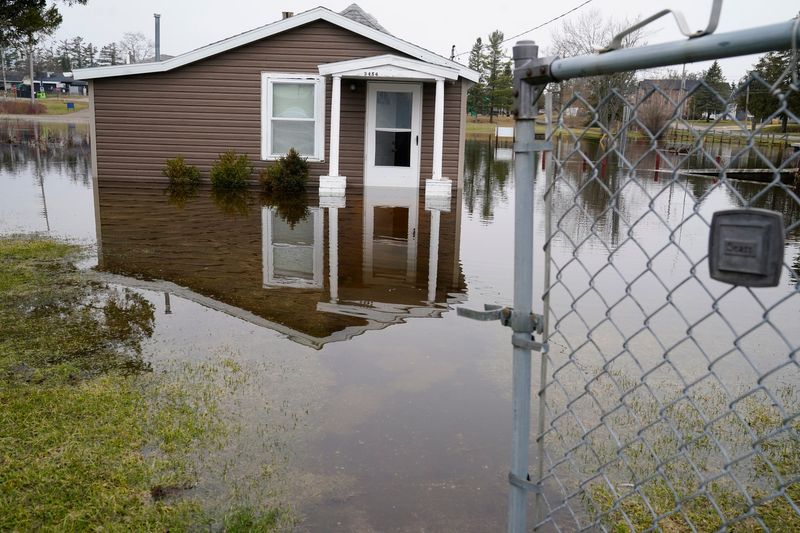
It was quiet in downtown Cheboygan early Wednesday, April 15 as businesses were closed in low-lying areas near the threatened Cheboygan Lock and Dam. The dam’s water level rose to 6.6 inches from the top as of 9 a.m. while responders worked to get as much water through it as as quickly as possible.
Concerns have mounted for dams across Michigan as melting snow and rain stress their infrastructure, including in Bellaire where residents and businesses on the Intermediate River downstream of the Bellaire Dam were preparing to evacuate Wednesday.

Here’s the latest on the Cheboygan dam and other dams and flooding across the state.
Whitmer declares state of emergency in 32 additional counties
Gov. Gretchen Whitmer declared a state of emergency for 32 additional Michigan counties Wednesday afternoon.
In a news release, Whitmer said she declared a state of emergency in additional counties as severe weather has damaged homes, roads and businesses.
“This emergency declaration will help the state deploy additional resources to help local officials and first responders protect Michiganders and their property,” she said in the release. “The state will continue to coordinate with local governments and monitor the situation. I encourage everyone to stay updated and follow guidance from your local emergency manager. We will get through this together.”
The counties include: Alcona, Allegan, Alpena, Antrim, Arenac, Barry, Benzie, Charlevoix, Clare, Crawford, Emmet, Grand Traverse, Gratiot, Iosco, Kalkaska, Lake, Leelanau, Manistee, Menominee, Missaukee, Montcalm, Montmorency, Newaygo, Oceana, Ogemaw, Oscoda, Osceola, Presque Isle, Roscommon, Saginaw, Shiawassee and Wexford.
On April 10, Whitmer declared a state of emergency for Cheboygan County due to due to the threat of overtopping at the Cheboygan Lock and Dam Complex. On Tuesday, April 14, Whitmer activated the State Emergency Operations Center and later declared an energy emergency “due to a disruption of gasoline supply at the U.S. Energy Cheboygan terminal on the Cheboygan River,” according to the news release.
Declaring a state of emergency authorizes the use of all available state resources to assist local response and recovery operations in the affected counties.
The Michigan State Police Emergency Management and Homeland Security Division is coordinating the state’s emergency response through the State Emergency Operations Center, according to the news release.
—Natalie Davies
Michigan dams under threat
Emergency management officials are watching at least seven northern Michigan dams that are being threatened by the gradually rising waters from storm downpours and snowmelt.
In addition to Cheboygan Dam – which was 6 about inches away from spilling over on Wednesday, April 15, – state officials identified six other northern Michigan dams as critical infrastructure under threat from the rising water.
They were: The Upper Hiawatha Dam in Montmorency County, Hillman Dam in Montmorency County, Homestead Dam in Benzie County, Union Street Dam in Grand Traverse County, Rugg Pond Dam in Kalkaska County and Bellaire Dam in Antrim County.
— Frank Witsil
Michigan counties under states of emergency as they deal with flooding
At least Michigan counties are under states of emergency because widespread flooding that has caused severe damage to public infrastructure — and threatens more.
Menominee, Benzie, Emmet, Grand Traverse and Alpena counties have all declared local states of emergency that allow local officials, first responders, law enforcement, and local government and community leaders to deal with current weather-related situations.
— Jalen Williams and Dan Basso
Noon: Cheboygan Lock & Dam water level goes down slightly
The water level at the Cheboygan Lock and Dam was 6.72 inches below the top as of noon Wednesday, a drop of 0.12 inches from 9 a.m.
Consumers Energy says its Michigan dams are safe, reliable
Consumers Energy said its 13 hydroelectric dams in Michigan are safe and reliable despite recent strain from rain and melting snow, according to a news release Wednesday.
“Heavy rains and melting snow and ice have put tremendous pressure on Michigan’s dams this week, but we want people to be sure to understand our 13 facilities are operating safely,” said Jean Kang, Consumers Energy’s vice president of generation operations. “They are structurally sound and can withstand this week’s intense weather.”
Evacuation order lifted for Little Black River Watershed
The evacuation order issued Tuesday, April 14 for the Little Black River Watershed in Cheboygan has been lifted, according to the Cheboygan County Sheriff’s Office. Residents may return to the area as safe to do so, but should continue to avoid flood waters.
Homestead Dam on Betsie River under threat from high water
Northwest Michigan officials have declared a local state of emergency as they work to stabilize Benzie County’s Homestead Dam.
The Homestead Dam, a Michigan Department of Natural Resources-owned dam on the Betsie River, is at risk for overflowing as severe thunderstorms and snowmelt raise water levels, according to the Benzie County Office of Emergency Management and National Weather Service forecasts.
— Jenna Prestininzi
10:16 a.m.: Black Lake Area residents told to prepare for water influx
The Cheboygan County Sheriff’s Office is strongly urging residents of the Black Lake area to begin preparing for a potential rise in water levels.
Residents should secure any valuables, outdoor items or debris that could be damaged or carried away by water.
According to the sheriff department’s Facebook post, “We have received information indicating that there may be a significant influx of water is expected to enter Black Lake within the next 24–48 hours.”
The sheriff’s office later added that rainfall over the past few days is expected to cause the Black Lake water level to continue to rise and may lead to additional flooding in low-lying areas.
The agency also said the Kleber Dam, located in the Black River at Klieber Road, was stable, being closely monitored by officials and had not been compromised
— Jillian Fellows
9:45 a.m.: Water creeps closer to Cheboygan dam’s top
The Michigan State Police Emergency Operations Center reported on the michigan.gov/cheboygandam site Wednesday, April 15 that as of 9 a.m., water levels behind the threatened Cheboygan Lock and Dam had risen to 6.6 inches from the top − an increase of almost an inch-and-a-half from Tuesday.
State, Cheboygan County and local responders are attempting multiple efforts to flow as much water through the dam as quickly as possible, including removing gates from its spillway and attempting to restart a dormant hydroelectric turbine that would allow more water passage.
Sheriff’s officials earlier said that if water levels reached the 6-inch threshold from overtopping the dam that they would move their “ready, set, go” evacuation protocol to “set,” meaning those in the suspected flooding area downriver of the dam should prepare by packing and preparing their family, pets and vehicle for potential evacuation.
Cheboygan County Sheriff Todd Ross said the potentially affected area from a dam breach is confined to near the river’s banks, with few residents in the area. The sheriff’s department has been in dialogue with those in the potential flood area, he said.
-Keith Matheny
In Cheboygan, residents evacuate
Much of downtown Cheboygan was closed and quiet as residents evacuated from low-lying areas due to a levee breach in the Little Black River Watershed remain in effect. The levee breach, however, was unrelated to rising water at the dam, which was still a concern.
Meanwhile, Cheboygan Area Schools canceled classes.
And many of the businesses in the evacuation zone also were closed.
Officials had urged evacuating residents to tie a cloth to the door handle that was visible from the street, so first responders would know that the house was empty. Those unable to evacuate should dial 911 for help.
— Jillian Fellows
Bellaire residents ready to evacuate
Bellaire residents and businesses on the Intermediate River downstream of the Bellaire Dam should prepare to evacuate, officials are urging as water levels behind the more-than 100-year-old dam surge.
The are now within 12 inches of the top, triggering the “Ready””stage protocol in preparation for potential failure, which means get everything together and ready to depart, according to the Antrim County Operator of Dams
“A go-bag should include medications and any important documents,” the Antrim County Operator of Dams said in a news release. “Also recommended: securing outdoor items and moving valuables to higher levels.”
Bellaire is between Traverse City and Charlevoix.
The dam is on the Intermediate River between Intermediate Lake and Lake Bellaire.
— Jalen Williams
More rain coming to Michigan
Michigan, a state surrounded by water, began to feel like a state under water, as the governor placed the entire state under an energy emergency, flood-prone communities began evacuations, and roads washed out as rivers and reservoirs kept rising.
By about 6:30 a.m., Wednesday, April 15, much of the state was still under a flood watch. The state was so soaked that emergency officials were trying everything to mitigate the torrent of water. Still, more storms were forecasted: another 1-2 or even up to 3 more inches of rain over the next two days.
“Oh yeah,” said meteorologist Dave Kook at the National Weather Service in White Lake Township, which covers the lower half of the state. “We’ll have multiple rounds of rain and thunderstorms today and tonight, and more storms possible on Thursday, especially in the Detroit area.”
In addition to the Cheboygan Dam, which was about 8 inches away from spilling over as of 5:30 p.m. Tuesday, state officials identified at least six other northern Michigan dams as critical infrastructure under threat from the rising water.
Officials are watching the Upper Hiawatha Dam in Montmorency County, Hillman Dam in Montmorency County, Homestead Dam in Benzie County, Union Street Dam in Grand Traverse County, Rugg Pond Dam in Kalkaska County and Bellaire Dam in Antrim County.
“Many areas of Michigan are currently experiencing severe flooding as melting snow and rain have caused rivers to breach their banks,” Michigan State Police had warned on Tuesday, April 14. “Conditions could worsen in flooded areas and result in additional areas of flooding and even flash flooding.”
At one point late Tuesday, the entire state was under a flood watch, and the National Weather Service warned that up to four inches or more of rain overnight in some places.
And in northern Michigan, where some areas were being evacuated, facing flooding and even being rescued, weather forecasters started referring to storms as the “S” word.
To expedite aid, Gov. Gretchen Whitmer’s executive order declaring a statewide energy emergency — following an emergency just in Cheboygan County on Friday — suspended some regulations to allow faster responses.
Whitmer said that “with already high water levels across the state and more rain in the forecast,” she was temporarily halting motor carrier regulations for driver hours to stabilize fuel supplies in key areas. “We will keep monitoring the situation and supporting local communities with the resources they need.”
Storms and wind damage Yost Arena
Overnight thunderstorms and strong winds sweeping southeastern Michigan toppled trees, took down powerlines and even flipped a vehicle on its side, according to news and social media reports.
They also damaged the University of Michigan’s Yost Ice Arena.
“It’s been quite a spring,” Sara Schultz, with the National Weather Service in White Lake Township, said Wednesday, April 15, warning that more storms are expected. “The whole state has been under a flood watch.”
An estimated 1½-2 ½ rain fell overnight.
The worst of it, however, may still be coming: More storms and rain are forecasted this week, with another 1-2 or even up to 3 more inches of rain in the southern part of Michigan expected over the next two days.
The weather in northern Michigan is even more challenging, Schultz said, with a half-dozen dams at risk of bursting, because there, in addition to rain, snow is melting, causing water levels to rise and serious flooding.
Meanwhile, the weather service sent investigators to various locations where there was damage to determine whether any tornadoes had touched down, which would not have been possible to spot in the dark, but could be confirmed, in part, by damage reports.
And as of 9 a.m., more than 17,000 people were without power, according to DTE Energy.
‘Great Lakes State’ to ‘Great Lake State’
Overnight, metro Detroiters in their homes could hear the rain pounding away.
In the dark, it was hard to see how bad the danger and damage might be, but the rains kept coming. In the morning officials and emergency crews would be trying to get a better handle on it and triaging where to go and what to do next.
But as one Michigander put it on a clever Facebook post: “Our beloved ‘Great Lakes State’ is about to become the ‘Great Lake State’ “ with all of Michigan’s 83 counties under a flood watch, rivers overflowing, dam failures seeming imminent and more rain to come.
Near Cheboygan, residents were urged to evacuate the area Tuesday afternoon after a levee was breached, and storms continued to sweep across the state. Crews had tried to shore up the Cheboygan Dam with giant sandbags, nicknamed super sacks.
The swollen river threatened to overwhelm the lock and dam.
“We’re working from all different angles of this,” said Mike Janisse, leader of the Michigan Department of Natural Resources’ Incident Management Team deployed to Cheboygan said. “We have many cooperators and everyone is putting forth a strong effort.”
Two, 24-inch pumps were installed to help moved water around the dam.
— Frank Witsil
Evacuations urged, roads washed out
In Alpena, the Alpena News reported targeted evacuations had begun.
The county’s emergency manager, Nick Modrzynski said first responders’ had to rescue residents in Long Rapids with an air boat. He was surprised, he said, how treacherous the water had become.
Moreover, some as roads became unpassable.
Modrzynski warned that no one should assume how deep flowing water is and avoid it as best as they can. He urged residents to avoid trying to enter moving water, urging them “not take that chance.”
There also were evacuations in Emmet County.
Grand Traverse County Emergency Management declared a state of emergency, 9and10news.com reported. And in Traverse City, a sinkhole opened up next to the Boardman River. The hole was about the size of a car.
Emergency officials offered a long list of concerns that included injury from floating debris, power outages, road washouts, damage and contamination to drinking water and other health concerns and mental stress and fatigue from the storms and cleanup, which, in many areas, hadn’t even begun.
— Frank Witsil
What is the ‘ready, set, go’ plan?
Officials are promoting the “ready, set, go” safety approach when it comes to flood emergencies. It includes these steps:
—Jalen Williams
Where is the Cheboygan Dam? How large is the dam?
The Cheboygan Lock and Dam Complex is comprised of the Cheboygan Lock and Dam, as well as a privately owned hydroelectric facility, the DNR noted. The complex is regulated by the Federal Energy Regulatory Commission.
Here are some key details on the Cheboygan Dam, according to Dams of the World:
—Sarah Moore
This article originally appeared on Detroit Free Press: Cheboygan dam water level increases, inches closer to top: Updates
Reporting by Frank Witsil and Tanya Wildt, Detroit Free Press / Detroit Free Press
USA TODAY Network via Reuters Connect