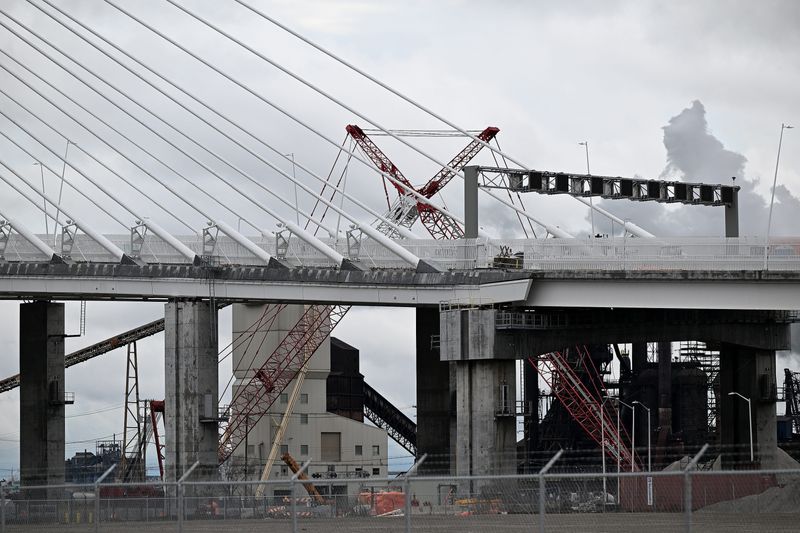
Detroit — A Canadian man with multiple felony convictions breached security last week and walked across the Gordie Howe International Bridge.
The incident happened March 6, when U.S. Customs and Border Protection officers encountered the 28-year-old Canadian citizen walking on the bridge. CBP officials said the man was apprehended on the U.S. side of the bridge, which is nearing completion after eight years of construction.

“Officers took the man into custody and determined through an initial investigation that he had crossed the bridge on foot from Canada,” U.S. Customs and Border Protection said in a statement. “The man, who has a criminal history including prior sexual assault and theft convictions, was returned to Canada and barred from re-entry into the United States.
“The integrity of our international crossings is vital to our nation’s security,” the release said. “CBP officers work diligently every day to protect our borders, and this incident is another example of their commitment to safeguarding the homeland.”
U.S. and Canadian officials didn’t identify the man and have been mum about exactly how this breach occurred.
When asked how it happened, Customs and Border Protection officials referred questions to the Canadian authorities. Rebecca Purdy, spokesperson for the Canada Border Services Agency, referred questions to the Detroit-Windsor Bridge Authority, which did not return emails seeking comment. Detroit Police Department officials referred questions to the CBP.
In addition to the Detroit-Windsor Tunnel, three bridges in Michigan span to Canada: the Ambassador Bridge connecting Detroit to Windsor; the Blue Water Bridge, connecting Port Huron and Sarnia; and the Sault Ste. Marie International Bridge, which connects Sault Ste. Marie in both Michigan and Ontario.
More criminal activity is expected at the northern border, expert says
“When you share a bridge like that, the Americans and Canadians have to be on the same page,” said University of Detroit Mercy Criminal Justice Professor Emeritus Daniel Kennedy. “There are all sorts of questions about who is responsible for which part of the bridge, and international law.”
Canadian and U.S. officials generally get along, Kennedy said, “although the relationship runs hot and cold. Right now, it’s running a little cold.”
With heavy enforcement at the southern border with Mexico, more criminal activity is expected at the northern border, including the 721-mile border Michigan shares with the Canadian province of Ontario, Kennedy said.
“There’s something called crime displacement theory, and one form of that is geographical displacement,” he said. “Basically, that means if you suppress crime in one place, it’ll surface somewhere else. If criminals can’t get in the southern border and they don’t want their boats blown up, they’ll hit the next-best place they think they can get away with it, and that’s the northern border.”
Kennedy said the U.S. military action in Iran makes border security especially crucial.
“There’s always a concern about sleeper cells entering the country, and the northern border has always been seen as being easier to get into than the southern border,” he said.
More terror watchlist people were encountered at northern border in 2023, congressman says
U.S. Rep. Mike Kelly, a Pennsylvania Republican and co-chair of the Northern Border Security Caucus, testified before the House Judiciary Committee in 2023 that 429 of the 505 people on the terror watchlist that CPB encountered that year came at the northern border.
In 2024, there were 52 encounters at the southern border of people on the terror watchlist and 358 at the northern border, according to CBP statistics.
But in 2025, after President Donald Trump took office, there were 3,704 terror-related encounters at the southern border and 307 at the northern border, with total encounters jumping from 410 in 2024 to 4,011 in 2025.
The number of people CBP apprehended near the northern border more than tripled from 2019 to 2024, according to a February report by the U.S. Government Accountability Office.
“In this same period, CBP increased the use of surveillance technology along the northern border,” the report said. “Specialists are responsible for monitoring this technology, such as by observing video feeds from camera towers. But CBP has faced challenges in staffing this specialist position along the northern border. We recommend that CBP develop and implement a plan to address workforce gaps in this position.”
Last year, Trump imposed tariffs that he said were a response to Canada’s failure to secure the northern border, especially against fentanyl smuggling.
“On February 1, 2025, I determined that the failure of Canada to arrest, seize, detain, or otherwise intercept drug trafficking organizations, other drug and human traffickers, criminals at large, and illicit drugs constitutes an unusual and extraordinary threat, which has its source in substantial part outside the United States, to the national security, foreign policy, and economy of the United States,” Trump wrote. ” To address that threat, I invoked my authority under section 1702(a)(1)(B) of IEEPA to impose ad valorem tariffs on articles that are products of Canada.”
In March 2025, Trump imposed more tariffs because he said Canadian officials were allowing too many drugs to be smuggled into the U.S. Then-Canadian Prime Minister Justin Trudeau called it a “completely bogus” rationale, noting in a statement that Canada has “worked relentlessly to address this scourge,” even though it makes up less than 1% of the fentanyl intercepted at the border, and noted that Canada had spent over $1 billion on new security measures along the border.
Regular northern border security assessments sought in Congress
Last year, 23 Republican U.S. House members, including Rep. Bill Huizenga, R-Holland, introduced the Northern Border Security Enhancement and Review Act, which would add provisions to the 2016 Northern Border Security Review Act that mandated regular security assessments. The bill would require the U.S. Department of Homeland Security to submit a threat analysis of the northern border every two years, beginning Sept. 2, 2026. The bill was referred in September to the House Committee on Homeland Security.
A companion bill, the Integrated Cross Border Law Enforcement Operations Expansion Act, would “direct the Secretary of Homeland Security to negotiate an agreement with the Government of Canada for integrated cross-border aerial, land, and maritime law enforcement operations, and for other purposes.” The bill has not been referred to a committee.
The Windsor-Detroit Bridge Authority on Wednesday announced toll rates for the new six-lane Gordie Howe Bridge, which will compete with the privately owned Ambassador Bridge, although officials didn’t say when the bridge will open.
In February, Trump publicly threatened to block the bridge’s opening, demanding that Canada treat the U.S. with “fairness and respect.”
The president said Ontario won’t allow American alcoholic products on its shelves, and that Canadian Prime Minister Mark Carney was trying to work with China on a trade deal. Carney told Trump the Canadians spent $4.7 billion to build the whole bridge using steel and workers from both countries.
“I will not allow this bridge to open until the United States is fully compensated for everything we have given them, and also, importantly, Canada treats the United States with the Fairness and Respect that we deserve,” Trump wrote on Truth Social.
ghunter@detroitnews.com
(313) 222-2134
@GeorgeHunter_DN
This article originally appeared on The Detroit News: Canadian felon crosses Gordie Howe bridge. But how did he do it?
Reporting by George Hunter, The Detroit News / The Detroit News
USA TODAY Network via Reuters Connect