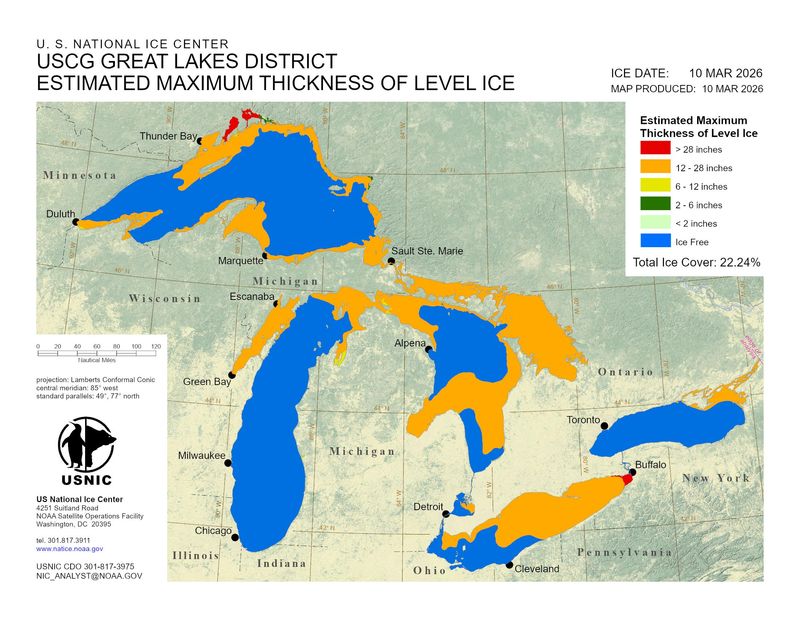
Ice coverage on the Great Lakes dropped significantly in recent days as temperatures have been consistently above 32 degrees Fahrenheit.
The Great Lakes were at 19.13% coverage as of Thursday, March 12, a decrease from March 10 when coverage was still 21.02%, according to the Great Lakes Environmental Research Laboratory, a National Oceanic Atmospheric Administration program.

Lake Ontario ice coverage was at 6.29% on Thursday while Lake Michigan was at 11.11% and Lake Superior was at 13.96%, according to GLERL.
According to the National Weather Service, many cities in Michigan broke daily temperature highs this week. Detroit reported 75 degrees on March 10, surpassing its previous record of 70 degrees set in 1925.
On Friday, March 13, a low pressure system is forecast to chill temperatures and produce snow statewide, according to the NWS in Detroit. This will likely to boost ice creation over the weekend.
At this point in the 2025-26 ice season, all of the Great Lakes have retreated from their peak ice coverage, but ice can linger as late as May. In 2025, the latest observation of ice was on Lake Superior on May 11.
This season has also been mostly above-average compared to the historical average, but this week’s warmth has reduced ice to below average.
As the 2025-26 ice season continues, researchers will track ice percentages daily. To track the progression, the U.S. National Ice Center posts ice charts every Tuesday and Wednesday.
Here’s how much ice is on each of the Great Lakes:
How much ice is on the Great Lakes today?
On March 12, the Great Lakes total ice coverage is 19.13%, according to GLERL and U.S. National Ice Center.
How much of Lake Superior is frozen over?
As of March 12, 13.96% of Lake Superior was frozen over.
Is Lake St. Clair still frozen over?
No, as of March 12, Lake St. Clair was 26.16% frozen.
How much ice has melted on Lake Erie?
As of March 12, Lake Erie’s ice coverage was 41.54%.
How much ice covers Lake Huron?
As of March 12, 29.69% of Lake Huron was covered in ice.
What is the ice cover on Lake Michigan?
No. As of March 12, only 11.11% of Lake Michigan was frozen over.
Is Lake Ontario ice free?
No. As of March 12, 6.22% of Lake Ontario is covered in ice.
Is it rare for the Great Lakes to freeze over completely?
Yes, it is rare for the entire lake system to freeze over, though ice coverage can still reach 90% or more.
According to GLERL’s records, two lakes have frozen over completely: Lake Superior in 1973 and 1996; and Lake Erie in 1978, 1979 and 1996.
Lake Superior almost froze over — at 92-96% ice coverage — during the 2013-14 ice season, according to Northern Michigan History.
What are the record high ice coverages on the Great Lakes?
The overall highest percentage of ice coverage for all the Great Lakes took place in 1979, when they were 94.7% covered, NOAA said.
When does ice develop on average on Michigan’s Great Lakes?
According to the NOAA’s GLERL, here is 2025 data:
Lake Michigan
Lake Huron
Lake Superior
Lake Erie
Lake Ontario
Which Great Lake gets the most ice during winter?
Historically, Lake Erie freezes and thaws the quickest due to its shallow depth, the shallowest among the Great Lakes.
The average depth of Lake Erie is about 62 feet, 210 feet, maximum — with 871 miles of shoreline, the Great Lakes Commission said.
How deep are the Great Lakes?
Here are the other average depths for the Great Lakes, from deepest to shallowest from the U.S. Environmental Protection Agency:
Contact Sarah Moore @ smoore@lsj.com
This article originally appeared on Lansing State Journal: Is ice gone from Great Lakes? How much is left
Reporting by Sarah Moore, Lansing State Journal / Lansing State Journal
USA TODAY Network via Reuters Connect