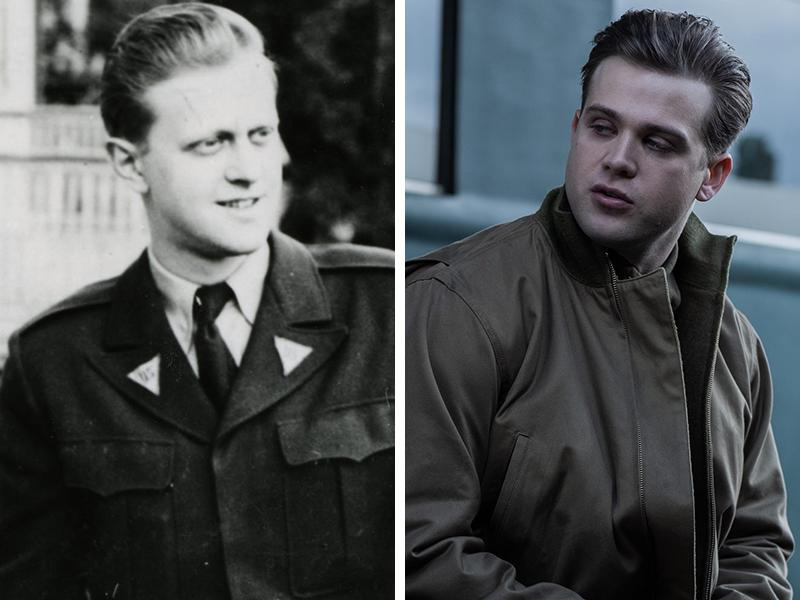
When viewers meet Howie Triest in 2025’s “Nuremberg,” he is wearing a Detroit Tigers baseball cap.
Triest (who’s played by British actor Leo Woodall) is a young U.S. sergeant working as a translator during the Nuremberg trials held just after World War II to prosecute the Nazi high command for crimes against humanity.

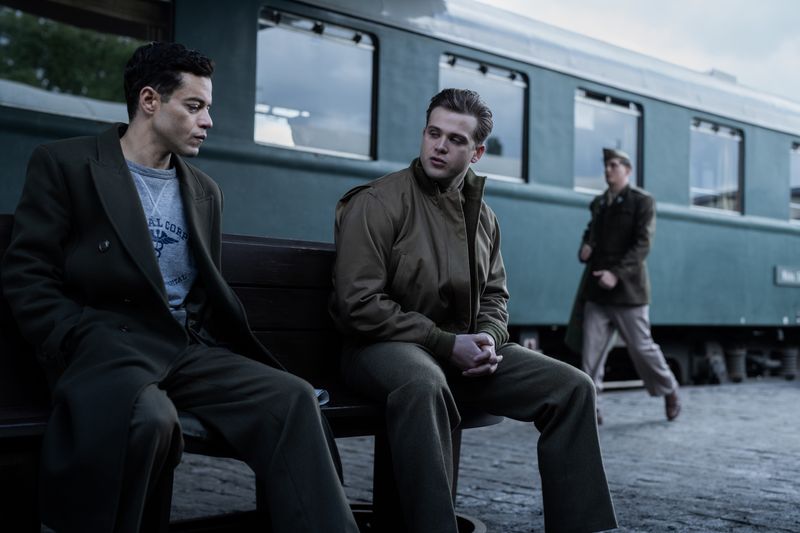
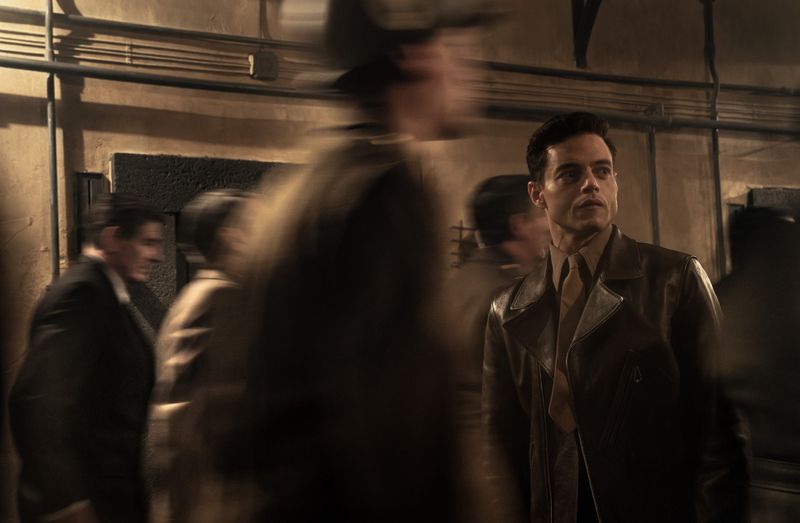
During what’s probably the key scene of the movie, Triest sits at a train station with psychiatrist Douglas Kelley (Oscar winner Rami Malek), who has been studying the nature of evil by interviewing defendant Hermann Göring (Russell Crowe), Hitler’s second-in-command.
Triest reveals to Kelley that he is a Jewish German, born and raised in Munich, who has a personal connection to the horrors perpetrated by the Nazis. Though he was able to leave Europe and flee to Michigan, his parents died at the Auschwitz concentration camp.
“Do you know why it happened here?” says Triest of the Holocaust. “Because people let it happen. They didn’t stand up until it was too late.”
It’s a searing speech delivered movingly by Woodall, who told USA Today that he was careful not to overdo it “because at the end of the day, the story is heartbreaking, so you just need to tell it.”
“Nuremberg” is being talked about as a contender for a best picture Oscar nomination and could earn acting nods for Woodall and Crowe. It takes a different approach from the 1961 classic “Judgment at Nuremberg” with Spencer Tracy, which used fictional characters in its script. In this telling, “Nuremberg” director-writer James Vanderbilt sticks to portraying the the real-life figures who were there.
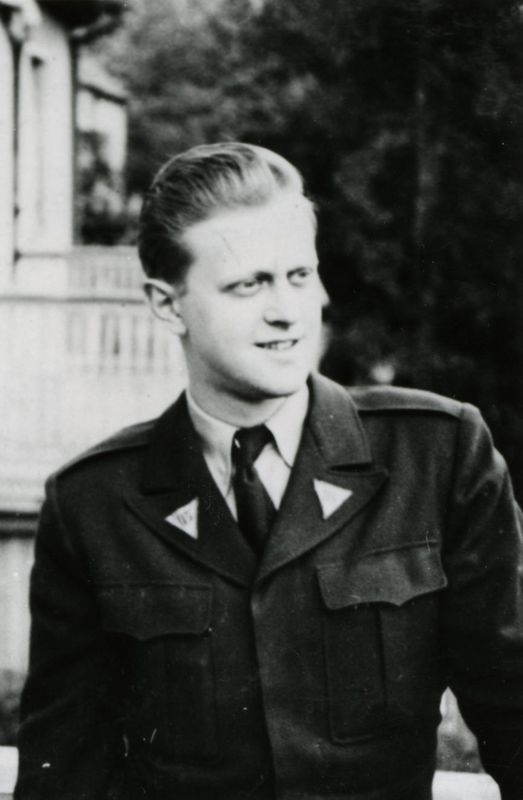
Triest, who died in 2016 at age 93, is among them. He returned to Detroit after his military duties ended and married the love of his life, Anita (who died in 2022). They raised two sons in the suburb of Oak Park and had four grandchildren and four great-grandchildren.
The filmmakers didn’t contact Triest’s family before or during the production. In fact, the first time that Triest’s two children, Brent Triest and Glenn Triest, saw the movie was at a Nov. 4 preview event at the Berman Center for the Performing Arts in West Bloomfield, just a few days before it opened in theaters. Both men still live in the Detroit area.
Although they understandably were nervous before the screening, the brothers say they are pleased with Woodall’s strong, sensitive performance as their father.
”They portrayed him as a good person with a sense of moral straightness, and I think my father was (that), always. My father was a really nice man,” says Brent.
He describes the screening as an emotional experience for the brothers, in part because their father didn’t live to watch it with them.
“I think he would have been happy with it,” he says. “I think he probably would have cracked a few dry jokes about how they portrayed him, but that he would be glad to have that portrayal.”
‘It’s an epic story’
Movies take liberties with true stories, both to condense history down to a manageable running time and to move along the narrative. The real Howard Triest wasn’t called “Howie” and, unlike today’s boomers and Gen Xers, he wasn’t in the habit of wearing baseball caps.
There are other, more significant aspects to Howard’s story arc in the film that are fictionalized. But, overall, his sons are relieved and glad that “Nuremberg” captures their dad’s essential decency and his dedication to the extremely difficult job he had as a translator.
Not only did Howard have to interact with the Nazis on trial but he also had to keep his Jewish identity hidden from them. Otherwise, he wouldn’t have been able to aid the historic journey that resulted in them being found guilty and many of them being hanged.
Says Brent, 73: ”He knew that he couldn’t function in the role he was asked to function in if he disclosed he was Jewish because they wouldn’t speak to him. That was always in his mind.”
His younger brother, Glenn, 65, notes, “He often said he was able to do that because of the fact that in the evening when he was done with his job at the jail, he was able to walk out of the cells and the defendants were not.”
To encourage people to find out more about their dad, the Triest family has created a website, HowardTriest.com, that allows visitors to view a 2006 documentary about his life titled “Journey to Justice.”
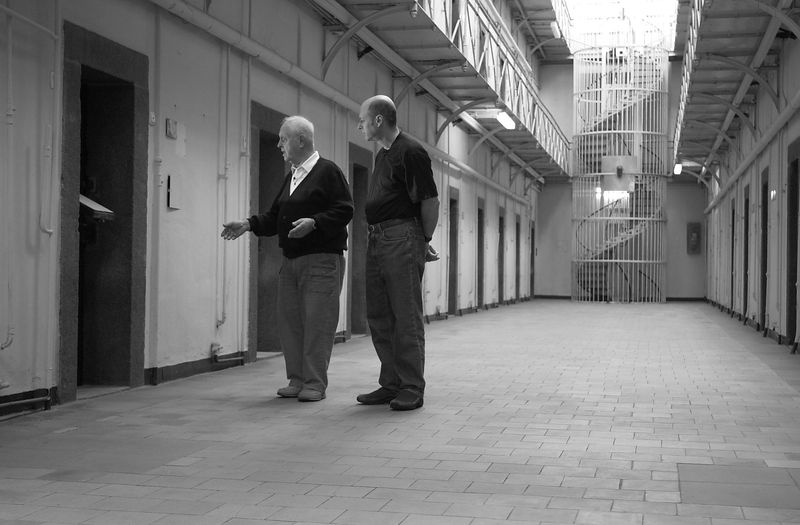
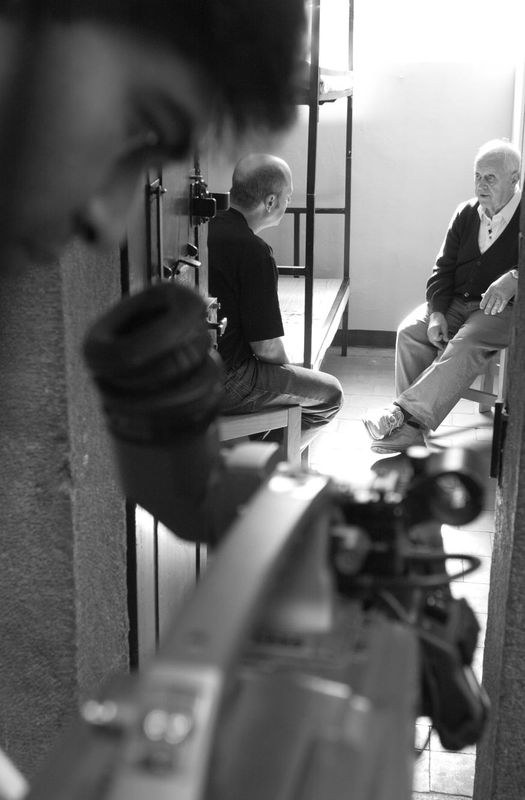
Directed by Detroit area documentary filmmaker Steve Palackdharry, it follows Howard and son Brent as they return to Munich, Nuremberg and other places that had an impact on Howard’s life. Brent does the narration. Glenn, a veteran professional photographer, provided the still photography.
According to Glenn, the first footage was shot on the day his father turned 80.
Palackdharry says he grew close to Howard during the three years he spent planning and traveling for the project and remains grateful to the Triest family for trusting him with the project. “It’s an epic story. … We went places I never thought I’d have the opportunity to go.”
He says the production received extraordinary cooperation from the governments that had to approve filming at places like the Buchenwald concentration camp and the actual Nuremberg courtroom, along with the prison that housed Göring and the other defendants.
He also did an interview with Howard’s sister, Margot (now deceased), who survived the Holocaust by finding shelter at a French rescue mission and later leading 10 children at night to Switzerland. The director says Margot and Howard felt they embodied their mother’s strength and “made an existential vow to carry on that strength …. to live and celebrate life.”
Brent says his father, a talented photographer and cinematographer who made a film in 1947 about Munich’s postwar ruins, shared his experiences in Germany with his sons when they were old enough to understand.
“It was not something my father didn’t speak about. … To my father, it wasn’t an historical moment in his life. It was just his life,” explains Brent.
During those discussions, Brent says his father made one point very clear. “When I was younger, he’d be telling about the story and I’d say, ‘It couldn’t happen here in America.’… His response was, ‘It could happen anywhere.’”
Where “Nuremberg” covers Howard’s unique role at Nuremberg, “Journey to Justice” offers a full portrait of someone who was present at so many landmark events before, during and after World War II that his granddaughter Katie would tell friends that her papa was like Forrest Gump.
Howard grew up in a happy, tight-knit family in Munich, where his father owned a men’s clothing factory. There, as a young boy, he saw the rise of the Nazis and lived through the terror of Kristallnacht, the Night of Broken Glass, when crowds rioted and burned Jewish synagogues and shops.
In the film, Howard explains that his parents could only afford to send one family member to safety and his sister was too young to travel alone. In real life, the entire family was supposed to sail to America, but the timing of the Nazi takeover of the Netherlands and Belgium kept his parents and sister in Europe. Howard, who took the trip alone at age 16, arrived in New York and moved to Detroit, where one of his uncles lived.
Drafted by the Army a few years after reaching Detroit, Howard landed on Normandy’s Omaha Beach one day after D-Day. His original assignment was to be a replacement machine gunner, a job that was said to come with a 15-minute lifespan for the person filling it. When officers found out that Howard spoke fluent German, he was reassigned to military intelligence.
Howard was there at the liberation of Buchenwald and the linking up of U.S. and Soviet Union troops at Torgau, Germany, before the fall of Berlin. After his stint at Nuremberg, he supervised the de-Nazification of cities and villages near Munich.
In the documentary, Brent describes what it must have been like for his dad at Nuremberg. “My father was locked inside with perpetrators of evil who represented the sins of a nation that he once loved. He was 22 years old, standing at a decisive crossroad in history,” he narrates.
The film explores how Howard had to spend time with Nazi defendant Julius Streicher, who claimed “he could smell a Jew from a mile away.” Howard kept his composure around the hate-spewing Streicher, who once told him, “I know that you are a pure Aryan and that your people must have come from a Nordic country.”
“Journey to Justice” is dedicated to Howard’s mother and father, Ly and Berthold Triest.
The documentary was screened at a Munich film festival, where it sold out for multiple showings and garnered “incredible attention,” says Palackdharry. Famed Hollywood director Barry Levinson (“Rain Man,” “The Natural”) attended the first screening, which got Palackdharry to thinking Howard’s story would make a great feature film.
“I always thought it would get done,” he says.
A granddaughter’s discovery
It was Katie Triest, who first told her family that a film called “Nuremberg” was being made that would depict her grandfather. She found out a couple of years ago when a friend of hers was searching online for “Journey to Justice” and stumbled across an article about Leo Woodall being cast as Howard Triest.
Katie happens to live in Telluride, Colorado, the site of the annual Telluride Film Festival. During this year’s festival in late August, she says, she asked Google whether Woodall would ever come there. That’s how she found out Woodall was appearing in Telluride for a screening of “Tuner,” an upcoming crime thriller featuring him and Dustin Hoffman.
“That was at 11 p.m., and by 11:30 the next morning, I found him,” she recalls.
With Telluride being what she calls a small town, Katie went to a location where she thought Woodall might be. She spotted him and introduced herself.
“I said: ‘This is crazy because I live here. My name is Katie Triest. You’re playing my grandfather in ‘Nuremberg.’ He just started to tear up. We were hugging. His girlfriend was saying, ‘I have goosebumps.’”
Katie and Woodall walked along a river trail and talked for about 30 minutes. She discovered that he had seen “Journey to Justice” for research (and she eventually confirmed that some “Nuremberg” producers had, too). Woodall invited Katie and her brother Jonathan to the Toronto International Film Festival the following week to see “Nuremberg” there.
Katie praises Woodall for his kindness. When the cast was onstage at the Toronto screening, he pointed out Katie and Jonathan in the audience. “It was very sweet. The whole crowd gasped when he said we were in the audience,” she recalls.
As for her review of Woodall’s performance, she says, “Honestly, I loved it.”
Her voice filled with pride and love, Katie continues: “At the end (of the film), when my papa does that monologue, or when, sorry, Leo does that monologue, I feel my grandfather would have gotten a real kick out of it.”
She adds, “In my opinion, but I’m biased obviously, it was one of the best parts of the movie.”
Contact Detroit Free Press pop culture critic Julie Hinds at jhinds@freepress.com.
‘Nuremberg’
Rated PG-13; violent content involving the Holocaust, disturbing images, suicide, language, smoking, brief drug content
2 hours, 28 minutes
In theaters
This article originally appeared on Detroit Free Press: ‘Nuremberg’ film depicts remarkable life of metro Detroit soldier and translator
Reporting by Julie Hinds, Detroit Free Press / Detroit Free Press
USA TODAY Network via Reuters Connect