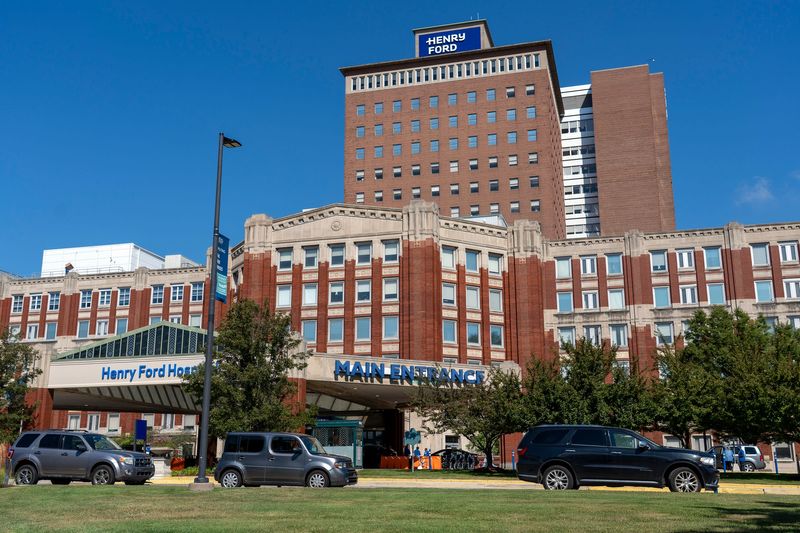
Henry Ford Health issued a cease-and-desist letter to a Texas-based anti-vaccine nonprofit organization over claims that the Informed Consent Action Network is spreading “false, misleading, and defamatory statements … that violate Michigan and federal law” about its research.
The network, known as ICAN, posted a trailer for a film called “An Inconvenient Study” to its website. Set to premiere Oct. 12 at the Malibu Film Festival, the film alleges the Detroit-based health system conducted research from 2017-20 that suggests vaccinated children develop chronic diseases at a higher rate than unvaccinated children. The film also alleges Henry Ford Health refused to publish the outcome of its research as part of a conspiracy to cover up the data.

However, Henry Ford leaders told the Detroit Free Press, the allegations ICAN made — in the film, on its website and social media accounts, as well as in testimony from its attorney, Aaron Siri, in September before a U.S. Senate subcommittee — are “totally false.”
In the cease-and-desist letter, Henry Ford set a deadline of 5 p.m. Sept. 25 for ICAN to remove the information the health system deems false from all sources of content and publish a retraction.
Henry Ford warned that ICAN is “liable for damage and reputational harm inflicted upon HFH” and that if the organization doesn’t take down the information, the health system “reserves all rights to seek court intervention to compel you to take such actions, and to seek appropriate remedies to compensate HFH for the harms caused by your conduct.” It also alleged ICAN used, “without permission, HFH trademarks in connection with these disparaging falsehoods.”
As of Oct. 6, ICAN continued to claim Henry Ford was involved in a cover-up on its website and in promotional materials. It also continued to tout its upoming premiere of “An Inconvenient Study” with a trailer on its website, and was selling “An Inconvenient Study” T-shirts for $28 apiece and hats for $24.
ICAN did not respond to multiple messages from the Detroit Free Press seeking comment.
Dr. Adnan Munkarah, president of the clinical enterprise and chief physician executive at Henry Ford Health, said the way the research project was designed was “fatally flawed,” and it doesn’t even qualify as a study because the data didn’t survive even the earliest internal review process.
It was led by “someone who had no training at epidemiology,” said Christine Cole Johnson, chair of public health science at Henry Ford Health, who also is an epidemiologist with a Ph.D. and a master’s of public health degree.
When Johnson and other epidemiologists and statisticians at Henry Ford began vetting the draft of the observational, retrospective research paper in 2020, they found multiple problems with the design.
“One of the authors … came to me with a draft of this report and she had concerns,” Johnson said. “That happens when you’re a coauthor or you’re a part of a project and you think there’s some issues. … Everything we do, every grant, every paper we write, we share with others, and we try to share with people who … might not be biased because they wrote it or … have certain prejudices.”
Johnson called it among the “worst studies I’ve ever seen.”
The Free Press attempted to reach out to all four of the researchers involved in the draft paper.
Among the flaws in the research, which included 18,000 children born between 2000 and 2016 who had insurance coverage through Henry Ford’s Health Alliance Plan (HAP): The sample of unvaccinated patients was vastly different than the sample of vaccinated patients. It included more white, male children who were born with less prematurity and less respiratory distress in the unvaccinated sample.
The number of unvaccinated children was very small compared with the vaccinated sample.
The most glaring problem, Johnson said, was a substantial discrepancy in the amount of time researchers had to evaluate the onset of chronic disease in the unvaccinated patients. One quarter of the unvaccinated patients were observed only until 6 months of age. And 75% were observed only until age 3, which is before doctors can confidently diagnose many chronic pediatric diseases.
Ordinarily, when major concerns about a project’s methodology are identified, Munkarah said researchers have two options: They can either start over and reconstruct the framework of the research so it properly analyzes data and qualifies for peer review as a scientifically sound study or they can allow the research to die.
Johnson added: “If this had been submitted to a journal of any credibility, they would have laughed it off.”
Five years after it was discarded, the research resurfaced when Siri spoke before the Senate Homeland Security and Governmental Affairs subcommittee Sept. 9.
Munkarah said Henry Ford Health’s leaders were “extremely surprised.”
“When you have a draft … that has not been submitted for publication or reviewed … from a scientific, ethical perspective, we should not be sharing it with people and leaking it,” Munkarah said.
“Even now, we don’t have any trust in the integrity of what has been submitted, who has submitted it, who has leaked it. This is what is very disturbing.”
The day of the Senate hearing was the first time Henry Ford Health leaders heard anything about the resurrected draft of the discarded research. Although ICAN had Siri representing the data, Henry Ford was not invited to refute it.
“Somebody leaking it and making it sound (like) we are trying to bury science is very disturbing to us,” Munkarah said. “We stand by science. … We have no prejudice about the outcome. As scientific minds, we want to create and do the research that gives us the answers. Whether we like the answer or not is irrelevant.
“We did not bury information. We buried flawed data and a draft of a paper that has no science in it.”
Contact Kristen Shamus: kshamus@freepress.com. Subscribe to the Detroit Free Press.
This article originally appeared on Detroit Free Press: Henry Ford Health warns anti-vaccine group to stop using info from ‘fatally flawed’ project
Reporting by Kristen Jordan Shamus, Detroit Free Press / Detroit Free Press
USA TODAY Network via Reuters Connect