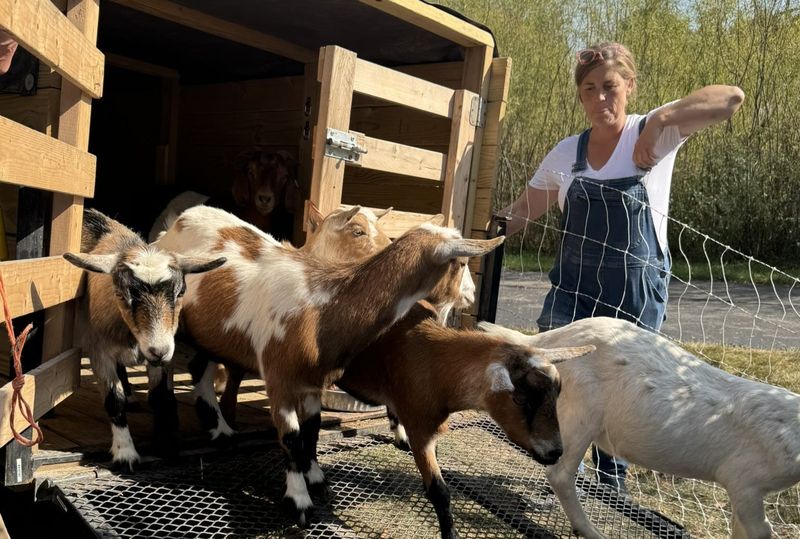
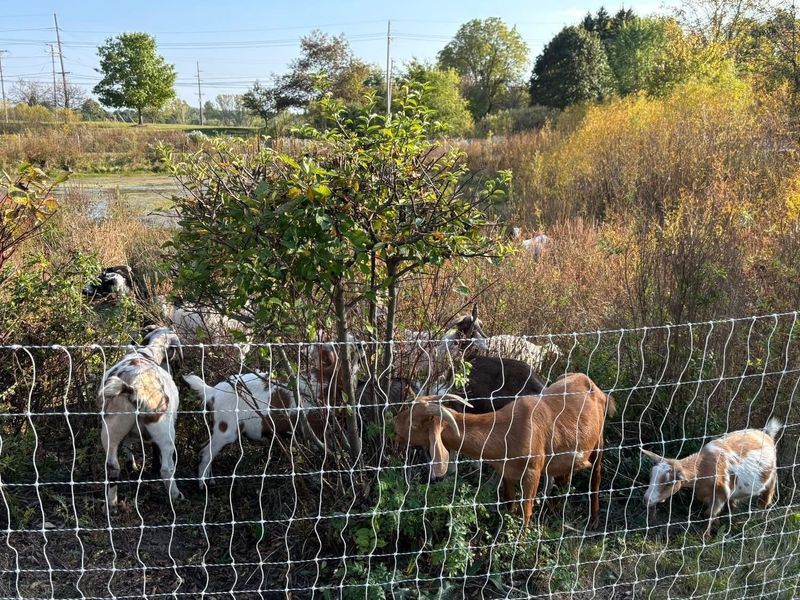
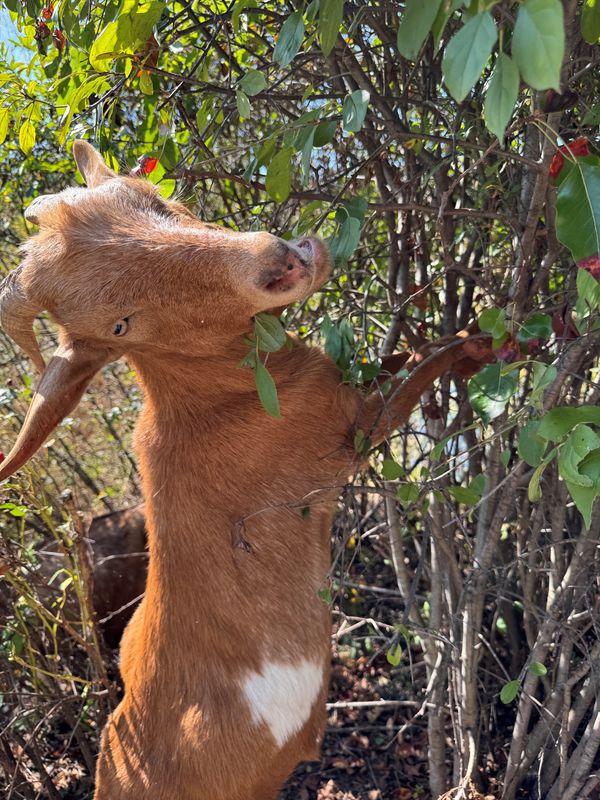
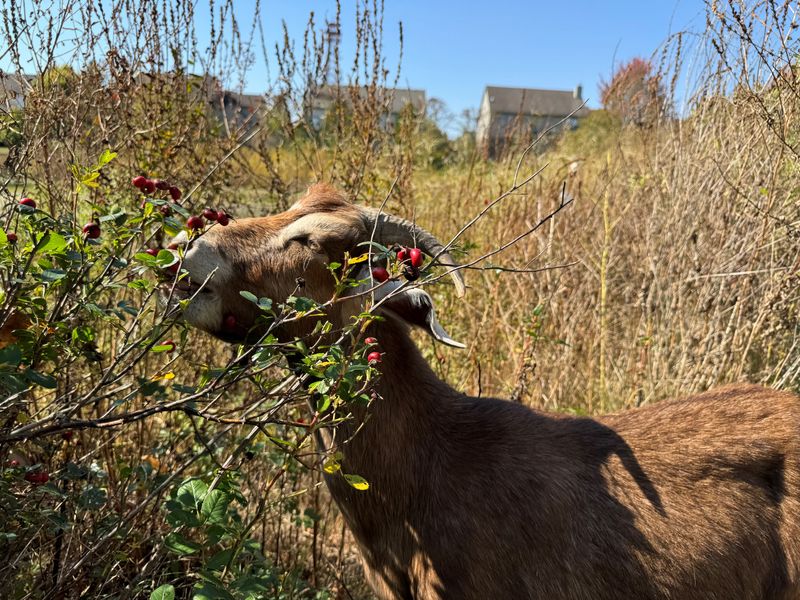
PLYMOUTH TWP. — When the trailer doors swung open, the herd didn’t hesitate. Two dozen goats clattered down the ramp, shook off their travels, and went straight to work munching through thick brush along the stormwater detention ponds at the Huntington Park subdivision.

It was exactly what the homeowner’s association hoped for. The four-legged cleanup crew arrived Oct. 3 to mow through acres of invasive vegetation, a job that would otherwise require costly equipment and risky manual labor.
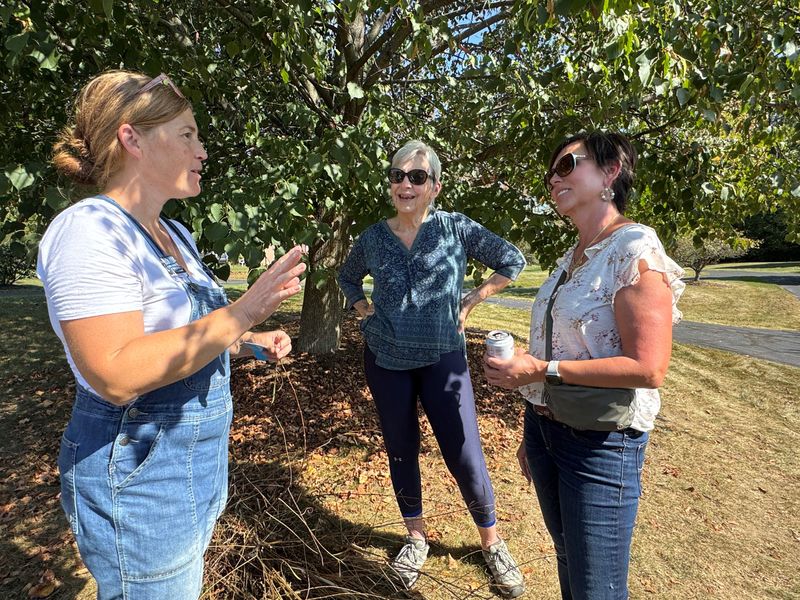
“We were getting quotes of more than $10,000 to bring in landscapers and heavy equipment,” said Jessica Gilbert, HOA president, noting the group is legally required to maintain the three detention ponds. “The goats give us an environmentally friendly option at a fraction of the cost.”
Michigoat got started last year after Jessica and Joe Scavo of Washington Township experimented with goats in the woods of their own property, then piloted a grazing program with DTE Energy.
Since, their herd has cleared brush at utility sites, municipal grounds, and now, for the first time, a homeowners association.
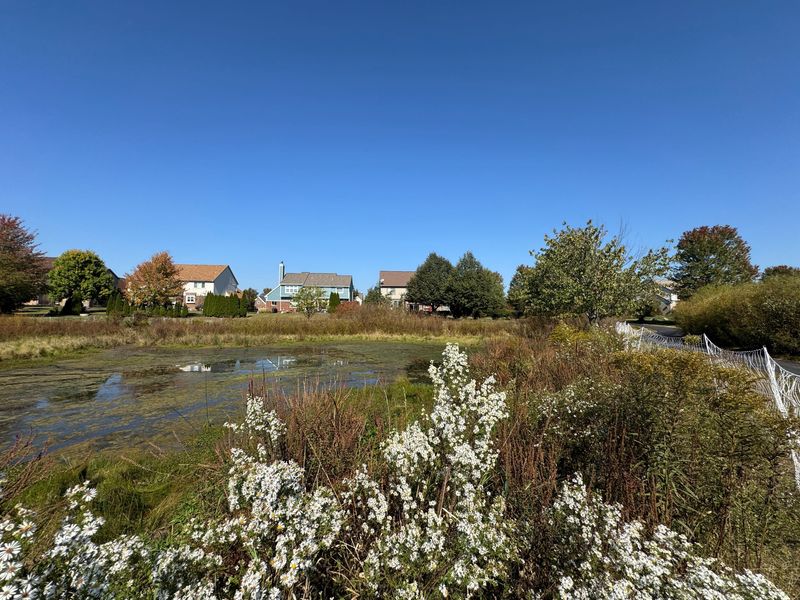
At Huntington Park, invasive species growing around the banks – including willow, purple loosestrife, buckthorn and more – have become rampant since the subdivision was built in the late 1990s.
Gilbert said the overgrowth has created a chain reaction of problems: root systems creep into storm drains and cause backups that could flood nearby yards, and vegetation falls into the ponds, decomposing into muck that only fed more algae.
The usual fixes, she said, carried their own risks: heavy equipment was unsafe on the muddy banks and wasn’t covered by the HOA’s liability insurance, while hauling brush away often spread invasive seeds to new areas.
‘I think we’re onto something’
The idea of bringing in goats first came from Huntington Park resident Laura Fuciarelli, who joined the HOA’s pond committee this year.
Having once lived on 10 acres with a pond she and her husband worked hard to maintain, she knew firsthand how challenging pond maintenance could be.
“We were just trying to figure out what to do this year and make some headway,” Fuciarelli said. “We were trying to do something that’s not invasive, that’s not going to be harmful for the ponds, or the fish in the ponds. And so I came up with goats.”
Gilbert was initially skeptical, but decided to dive into the research.
“I said, ‘Let me look into it a little bit,” she said. “The more I looked into it, the more I thought, ‘I think we’re onto something here.’”
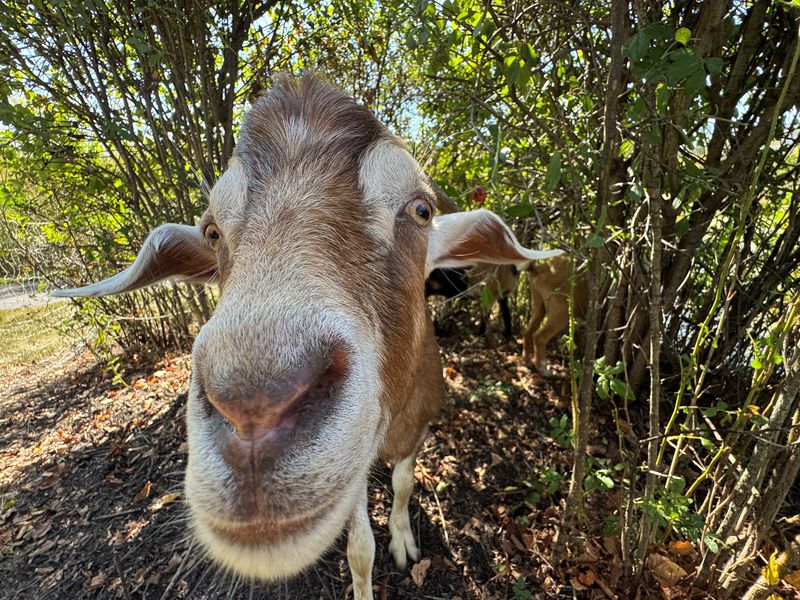
The Michigoat herd, Jessica Scavo said, includes a mix of Nigerian Dwarfs, Boer goats, and Kikos.
To her, they’re not just workers – the goats are individuals with distinct needs, personalities and names – like Lorenzo and Vincenzo, Prima and Vera, Bianca and Luce and even Chicho, nicknamed “Frank Sinatra” for his striking blue eyes.
At the top of the pecking order is Julia, the alpha female who keeps the rest of the herd in line.
Scavo said she did not want to divulge specifics on pricing, noting costs can vary significantly with each project depending on circumstances.
The goats will stay in the neighborhood for five to seven days, moving from pond to pond behind temporary fencing.
Plymouth Township follows suit
Gilbert said Plymouth Township Supervisor Chuck Curmi praised the project after she called the township to ask about any required permits.
“He told me he wanted to commend us for out-of-the-box thinking,” Gilbert said. “There are so many HOAs dealing with the same problems, and he wants to use our effort as an educational tool.”
And Curmi said he’s following Huntington Park’s lead by bringing goats to tackle the township’s own pond problems.
The township, he said, has contracted Michigoat to clear overgrown vegetation from a detention pond on township hall property, located along Haggerty Road just north of the fire station.
“It’s been neglected for 19 years,” Curmi said. “The cost to dredge it is more than $100,000, so we want to prevent organic matter from filling up the pond as it dies. This is an experiment to see if goats can help us stay ahead of the problem.”
Curmi said the township tried hiring a company to cut the growth last winter while the pond was frozen, but the work never got done.
The goats, he noted, offer a greener, more reliable alternative.
“I’m hoping that they will clean up much better than using a mower or some other type of machine,” he said. “Hopefully they’ll go after the invasives and let the cattails start rejuvenating.”
More work ahead
At Huntington Park, the work won’t be over once the goats finish grazing. Their visit will strip back the invasive growth and give native plants a chance to rebound, but the roots will still need attention.
“Whether we did it with equipment or whether we did it with goats, you’re still going to have roots that are going to need to be addressed,” Gilbert said, noting the goats provide a strong head start but not a permanent fix.
Unlike machinery, though, the animals don’t drag and spread invasive seeds.
In fact, she said, their digestive systems render the seeds nonviable and their droppings fertilize the soil, giving healthier vegetation a chance to return.
And the grazing is one piece of a larger plan the HOA is piecing together.
Gilbert said future steps include installing aerators and fountains to keep water moving, adding beneficial bacteria systems to break down muck, planting more native vegetation, and eventually reintroducing rocks around the banks to provide habitat for healthy bacteria.
Scavo, meanwhile, said the business is growing quickly.
“Everywhere we go, people are interested,” she said, noting just one of her larger goats can plow through five to seven pounds of brush per day. “They love to eat the stuff nobody else wants – poison ivy, autumn olive, invasive vines. People are always like, ‘Bring them over to clear my yard.’”
If all goes as planned, the HOA hopes to repeat the experiment next year – and maybe even make it a community event.
To learn more, contact Michigoat at mymichigoat@gmail.com.
Contact reporter Laura Colvin: lcolvin@hometownlife.com
This article originally appeared on Hometownlife.com: No kidding: Two dozen goats clear brush at Plymouth Township ponds
Reporting by Laura Colvin, Hometownlife.com / Hometownlife.com
USA TODAY Network via Reuters Connect