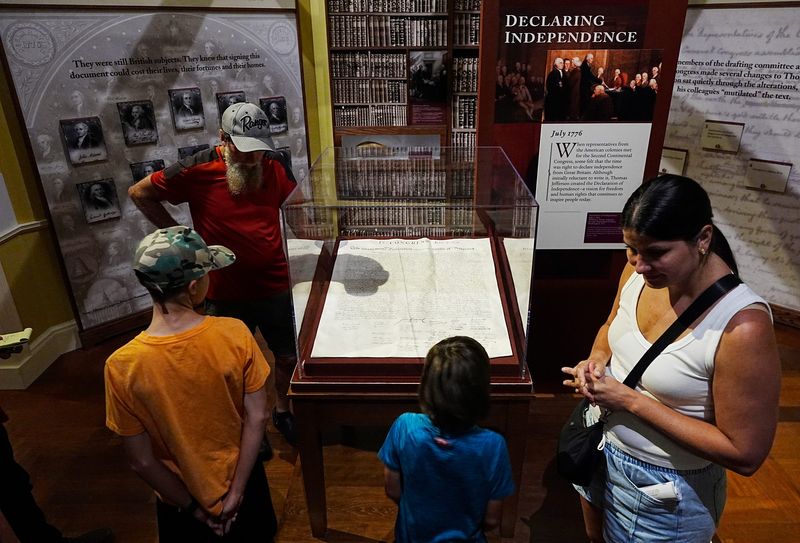
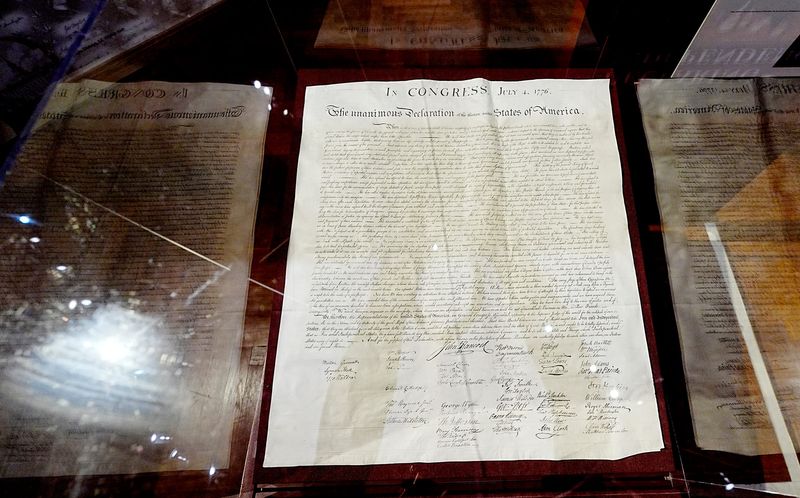
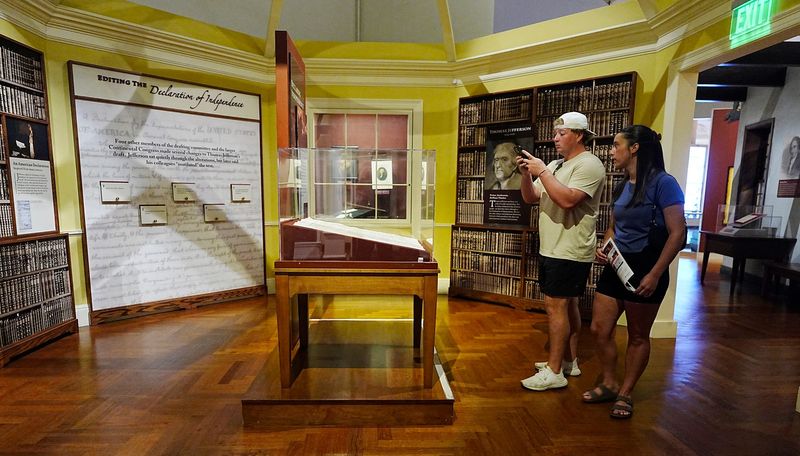
Lauren Milliman peered through the display glass, admiring not just what the words on the parchment said, but also the way they looked, with flowing loops and flourishes.
“I’m looking at how pretty it is,” Milliman, 40, said, taking a step back as her husband, Zak Milliman, 39, also moved in to study the rare, surviving copy of the Declaration of Independence at The Henry Ford Museum in Dearborn. He added: “Even though we’ve seen it before, it’s cool to come back and see American history, what started everything.”

By everything, he meant the birth of the United States.
The Declaration, dated at the top in big letters, “July 4, 1776,” is the reason we celebrate Independence Day. And in simpler terms, it is America’s birth certificate, with all sorts of copies, old and modern, in museums, libraries, schools and textbooks.
The document announced to the world that the British colonies in the New World would no longer be subject to British rule, and henceforth, they would be independent as the “united States,” which, over time, became the United States.
And yet the Declaration — and its various copies — also still holds a few mysteries of its own, including how a version that was found in a records office in Chichester, England, got there, and how a different copy ended up at The Henry Ford in Michigan. More research, experts said, may yield more clues — and answers.
Earlier this year, the Declaration received some extra attention when President Donald Trump hung a copy in the White House behind heavy curtains, presumably to shield it from sunlight, just steps away from the Resolute desk in the Oval Office.
This week, all sorts of Independence Day events are unfolding across America.
In Michigan, one of the largest is at Greenfield Village, part of The Henry Ford experience. There, the Salute to America, which runs through Saturday, is showcasing music, including the “1812 Overture” performed by the Detroit Symphony Orchestra, and a fireworks finale.
Next year, during America’s 250th birthday, the document will take center stage at America250, which has been in the works for a decade and will take place in various cities across the nation, including Philadelphia, where the document was signed.
The event celebrates the nation’s semiquincentennial, a sophisticated way of saying the halfway mark to its 500th birthday. Yet, the document, like the new nation it declared, has been hailed and criticized.
Equality for all?
To the Millimans, and many others of the estimated 1.7 million annual visitors to The Henry Ford attraction, the document is worth seeing — a special copy of it, anyway — with their own eyes.
It also, they said, is something Americans can cherish.
The Riverview couple said they went to the museum to get out of the heat and, for a little while, enjoy some time together away from their two kids to celebrate their wedding anniversary.
Michael Warren, a law professor and Oakland County judge, makes the case in an essay published by the educational nonprofit Constituting America that, aside from religious writings, the Declaration “may be the most important document in human history.”
“It established for the first time in world history, a new nation based on the first principles of the rule of law, unalienable rights, limited government, the social compact, equality, and the right to alter or abolish oppressive government,” he wrote, adding that it “totally upended the prevailing orthodoxy about government and has led to momentous changes across time and the world.”
The signers concluded the document by pledging to those principles and each other their lives, fortunes and sacred honor.
The document’s language, especially one passage, is often quoted.
“We hold these truths to be self-evident, that all men are created equal, that they are endowed by their Creator with certain unalienable Rights, that among these are Life, Liberty and the pursuit of Happiness.”
And yet, this one line also raises more questions.
“The Declaration of Independence is vital to our American identity and embodies a lot of the promises of the American Revolution,” Nick DiPucchio, an Oakland University assistant professor, said, adding. “It contains some of its problems, too.”
While the document made the case for self-rule and independence, it also complained that the British were inciting raids from “merciless Indian Savages,” raising questions about how much the colonists, and later Americans, considered the rights of indigenous people.
The document also mentioned equality, yet omitted draft references condemning slavery.
Unity and disagreement
In a sense, the Declaration formalized something that was already unfolding.
Colonists, in 1775, had taken up arms against the British crown, and the colonies had formed an army to fight. Earlier this year, the nation commemorated the famous “shot heard round the world” in Concord, Massachusetts, and the Army’s birthday.
However, by declaring itself a country, America could seek alliances and support from other powers, such as France. It also could show that the individual and separate colonies were now speaking — through Congress — with one voice.
And for all the document’s unity, there were still disagreements.
John Adams, who became America’s second president, believed Independence Day should be held on July 2, according to the National Constitution Center. That was the day the Continental Congress voted to proclaim independence.
Congress, however, didn’t approve a written declaration, primarily authored by Thomas Jefferson, until July 4. And it wasn’t until July 19, that Timothy Matlack — the mostly forgotten scribe in the Pennsylvania State House — inked with quill pens the now-faded version in the National Archives in Washington, D.C.
Many members of Congress didn’t even sign the document until Aug. 2. And Independence Day didn’t become a federal holiday until 1870, almost 40 years after the last surviving signer had died.
Just after the July 4 vote, Congress sent the document to John Dunlap, the new nation’s printer, who typeset and published about 200 copies. They were sent to governmental authorities and military commanders and the British Crown in London.
The Declaration also was read aloud in Philadelphia; Eaton, Pennsylvania, and Trenton, New Jersey.
But Dunlap’s copies, printed in block letters, didn’t capture the handwritten flair Matlack later gave the document or the 56 signatures. In addition, most of the copies were printed on paper, which is more fragile than parchment, and deteriorated.
By the mid-1810s, after the War of 1812 — which kicked off a new sense of national patriotism — two men, John Binns and Benjamin Owen Tyler, figured they could profit off selling large-print copies of the Declaration.
The entrepreneurs, according to the National Archives, “engaged in a bitter and public competition to be the first to publish and sell their engravings with the official text of the Declaration.”
They each sought attestations that their version was “correct and true.”
Their feud played out in newspapers, with the men accusing each other of stealing ideas and plagiarizing work. All the politicking, some researchers now speculate, may have influenced the government to step in.
And that brings us to the copy of the document at The Henry Ford Museum.
Loops and flourishes
To possibly prevent more squabbling and preserve the original Declaration’s look, John Quincy Adams, then secretary of state and a future president, commissioned William Stone, an engraver, to produce an official facsimile on copperplate.
Doing so also made sure the document’s calligraphy — the loops and flourishes Milliman took note of — and signatures didn’t just fade away. It’s unknown what process Stone used: hand tracing or wetting the original and lifting some of the ink.
What is known, according to the National Park Service, is that the process took three years.
When finished, 200 copies were distributed.
The last three surviving signers — Jefferson, John Adams, and Charles Carroll — as well as President James Monroe and Vice President Daniel Thompkins each received two copies. Former President James Madison and Marquis de Lafayette received the same.
Government departments received 12 copies. The Senate and House split 20 copies. The rest went to the White House, Supreme Court, governors, state and territory legislatures and universities and colleges.
Of the 200 parchment copies, by the government’s count, only 31 copies have been located, and of those, only 23 are in the hands of public institutions, including The Henry Ford Museum.
“What’s interesting about our copy is that it is rare to find one, and find one on public display,” said Cynthia Jones, the museum’s director of experiences and engagement. “To be able to find one in Michigan and be able to see it is incredibly important.”
However, exactly how the museum got the copy of the Declaration — one of more than 26 million artifacts spanning 300 years of American history in the attraction’s collection — is still a bit of a mystery, with little to document its provenance.
A museum mystery
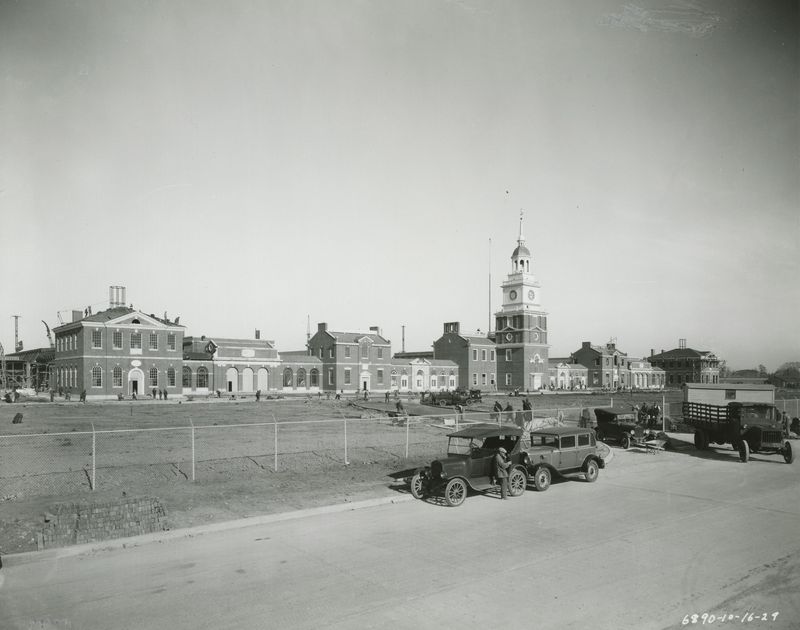
Museum records, Jones said, indicate that Michael Seip — a doctor from Easton, Pennsylvania — donated the copy to the museum in late October 1929, days after Henry Ford hosted the Light’s Golden Jubilee, a 50th anniversary of the invention of the incandescent lamp.
There’s no known record of why Seip gifted the engraving or where he got it from. But there is speculation.
In addition to a commemoration, the jubilee also served as the official dedication of what Ford called the Edison Institute of Technology, which would later become The Henry Ford Museum of American Innovation and Greenfield Village.
Then-President Herbert Hoover was on hand. The front page of the Free Press the next day described an event with flags, confetti and “thousands upon thousands” of people who jammed the streets, even in the rain, to celebrate.
In a way, Edison — Ford’s hero — had been the inspiration for the museum, which started as a small collection of items associated with Thomas Edison that Ford — a Michigan farm boy turned wealthy industrialist — had begun accumulating and displaying, according to the museum website.
Over time, Ford added all sorts of things to his collection, including dozens of historic structures — including homes, mills, and shops — that he had moved and reconstructed in an outdoor space set up like a village.
Ford also built a massive structure to house the collection of Americana. Its facade was designed to be a detailed replica of Philadelphia’s Independence Hall, where the Continental Congress deliberated the Declaration.
But the design and gift may be just a coincidence.
And remember Easton, one of the cities where the Declaration was read on July 8, 1776?
Well, that’s where Seip’s forebearers had an inn and tavern dating to 1760. Whether that is related to how the doctor ended up with the copy also is unknown, in part, because the engravings were not individually identified.
“There are all sorts of open questions for us today,” Jones said, adding that the Free Press inquiries have prompted the museum to do more research. “This is one of the joys of history. Even today, there are questions and things to search.”
Starting a conversation
For now, the museum’s copy of the Declaration is part of the “With Liberty and Justice for All” exhibit that traces the American struggle to define and actually achieve “liberty and justice for all,” the concluding phrase to the Pledge of Allegiance.
The exhibit also includes George Washington’s camp chest, the chair that Abraham Lincoln was sitting in when he was assassinated, an automobile hood ornament urging “Votes for Women,” and the restored Alabama bus on which Rosa Parks refused to give up her seat.
More artifacts, Jones said, could be added when the exhibit is updated and refreshed.
The museum also corrected an error on its website that noted the copy is printed on paper, instead of parchment, which would make it a more recent printing. The museum copy is, a museum official confirmed to the Free Press, indeed one of the older ones.
For many visitors — like the Millimans and a three-generation family who, as their summer vacation, also visited the museum — the best part of the experience of seeing history may be making a little of their own.
They are creating memories and amusing stories to be retold at family gatherings.
Byron Fritz, 72, and his wife, Kay, from Hamburg, Pennsylvania — not too far from Philadelphia — strolled through the museum, for example, with their daughter and son-in-law, who live in Michigan’s Upper Peninsula, and two sets of grandkids.
They marveled at many of the artifacts, including the copy of the Declaration, and as they looked at images of various people involved, one of the youngsters asked his grandpa whether he had known any of the nation’s forefathers.
“Nooo,” Fritz replied, amused by how a child perceives time. “I’d be 300 years old!”
Those moments, Jones said, are other reasons why museums exist.
“The real heart of this is the chance for families, for people of different generations, to come out, and to experience American history firsthand,” Jones said. “It’s one thing to read about history in a book. It’s another thing to see it right in front of you.”
And, she added, hopefully that inspires a conversation.
“What does this mean to you?” she asked as one of the many questions to ponder. “What do you think this has meant over time? And most importantly, what will you do with this information? How will you take action? How will you make history?”
Contact Frank Witsil: 313-222-5022 or fwitsil@freepress.com.
This article originally appeared on Detroit Free Press: How a rare copy of Declaration of Independence ended up in a Michigan museum
Reporting by Frank Witsil, Detroit Free Press / Detroit Free Press
USA TODAY Network via Reuters Connect