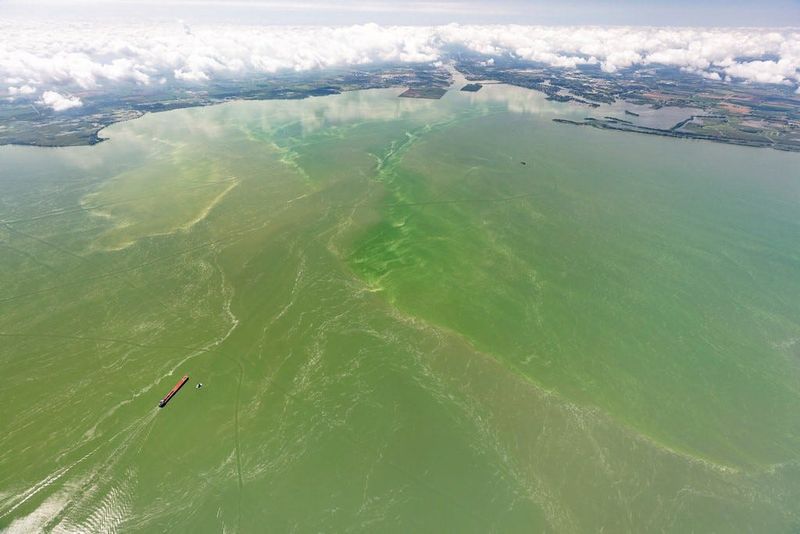
Summer is in full bloom, and unfortunately, Lake Erie’s blue-green algae is about to do the same.

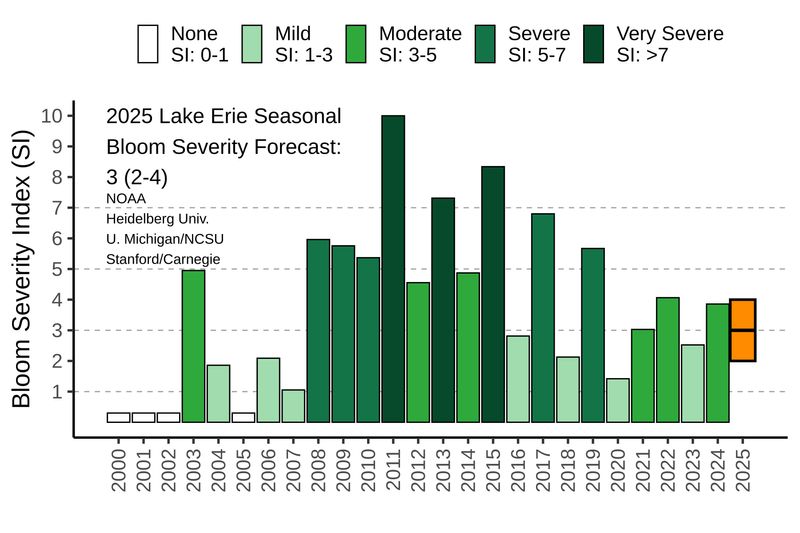
The National Oceanic and Atmospheric Administration released its forecast for the harmful algal bloom season, which this year looks mild to moderate.
“Harmful algal bloom forecasts are critically important for communities around Lake Erie to plan and prepare, and are a key part of NOAA’s scientific service to the nation,” Nicole LeBoeuf, director of NOAA’s National Ocean Service, said in a prepared statement. “The Great Lakes are a driver of economic activity throughout the region and environmental outlooks can help ensure the hazards of toxic algae are well understood to protect public health.”
The bloom primarily affects Lake Erie’s western basin, but it can shift around.
“The central basin of the lake is usually unaffected until later in the season, although localized blooms may occur around some of the rivers after summer rainstorms,” the administration said in a prepared statement.
Here’s what to know about the upcoming harmful algal bloom season:
What are harmful algal blooms?
Harmful algal blooms involve cyanobacteria, commonly known as blue-green algae, gathering in a body of water and releasing harmful toxins.
“Many species of cyanobacteria produce toxins that can cause harm to people and animals,” the Ohio Department of Health said in a prepared statement. “Harmful algal blooms often occur when there is a shallow body of fresh water, warm temperatures, sunlight, and large amounts of nutrients (phosphorus and nitrogen) in the water.”
Harmful algal blooms can pose a danger to humans when contaminated water makes contact with skin or is ingested, leading to several potential impacts. Some toxins can also travel in the air.
“Such blooms can lead cities and local governments to add more treatment to drinking water and close beaches,” the National Oceanic and Atmospheric Administration said in a prepared statement. “HABs also harm local economies by preventing people from fishing, swimming, boating and visiting the shoreline, with annual economic impacts estimated at over $70 million for the Lake Erie region.”
What causes harmful algal blooms?
Harmful algal blooms when algae grows out of control, wreaking havoc on the ecosystem.
“This occurs when nutrients (mainly phosphorus, nitrogen, and carbon) from sources such as lawns and farmlands flow downriver to the sea and build up at a rate that ‘overfeeds’ the algae that exist normally in the environment,” according to the NOAA website. “Some (harmful algal blooms) have also been reported in the aftermath of natural phenomena like sluggish water circulation, unusually high water temperatures, and extreme weather events such as hurricanes, floods, and drought.”
Toxins that harmful algal blooms can cause illnesses, respiratory issues and in rare cases death.
“People often get sick by eating shellfish containing toxins produced by these algae,” according to the NOAA. “Airborne HAB toxins may also cause breathing problems and, in some cases, trigger asthma attacks in susceptible individuals.”
In 2014, a harmful algal bloom contaminated the water supply in Toledo. As a result, around half a million residents were ordered not to drink or touch their drinking water for almost three days.
How does this year’s harmful algal bloom forecast compare to last year?
Last year, Lake Erie had a moderately severe harmful algal bloom, around a 4 out of 10 on the National Oceanic and Atmospheric Administration’s scale. This year’s mild to moderate forecast is scored around a three, an average of the extended range of two to four.
“We’re looking at phosphorous around 230, 240 metric tons, and that’s a bit lower than 2024 overall,” said Rick Stumpf of the National Centers for Coastal Ocean Science.
When will the harmful algal bloom peak?
Forecasters expect peak conditions toward the latter half of the summer.
“It’ll likely peak in August, which, that’s (also) what we’ve been seeing the last few years,” Stumpf said.
How long will the harmful algal bloom last?
The bloom has yet to begin, Stumpf said, but it could appear in early July.
“We have not detected a bloom yet in the area so far,” he said. “I would say by July 10, there should be something noticeable, but it won’t be the whole lake.”
Stumpf emphasized that when the bloom begins, it will expand gradually, as opposed to rapidly changing conditions on Lake Erie.
“It doesn’t suddenly appear as this huge blob that eats the western basin. It starts smaller,” he said.
From there, conditions could persist into the early fall.
“Our current best guess is it may continue well into September,” Stumpf said. “But we don’t have any particularly good skill on how long the bloom will last. That is another topic we’re working on. … That depends on the fronts coming through in September as to when it does.”
Have harmful algal blooms improved over time on Lake Erie?
Stumpf said blooms observed in recent years have been less severe than in the past.
“The blooms now are less severe than they were during 2008 to 2015,” he said. “Most of this difference is caused by less river flow, simply less water, turning stuff into the lake. … But the bioavailable has decreased somewhat.”
Stumpf said though there has been some improvement, more action is needed to continue to mitigate the bloom season.
“If we get wet springs next year, there will be more bloom,” he said. “We’re in the right progress on reducing the phosphorus, but we can’t control the rain and the runoff, so we have to keep making progress on getting the phosphorous down.”
Where will the bloom be located on Lake Erie?
The bloom will move around during the season, Stumpf said, often impacted by conditions on the lake.
“The bloom is not everywhere. When it occurs, that’s often an impression,” he said. “It moves around a lot with the wind. It can be in the middle of the lake. It can be pushed to Ohio, and then a few days later be pushed towards Michigan, and then pushed back around. So please, check our forecast. (We’re) trying to let you know so you can boat well.”
This article originally appeared on Farmers Advance: How bad will the algal blooms be in Lake Erie this year? NOAA makes annual prediction
Reporting by Janson McNair / Farmers Advance
USA TODAY Network via Reuters Connect