

By Jim Bloch

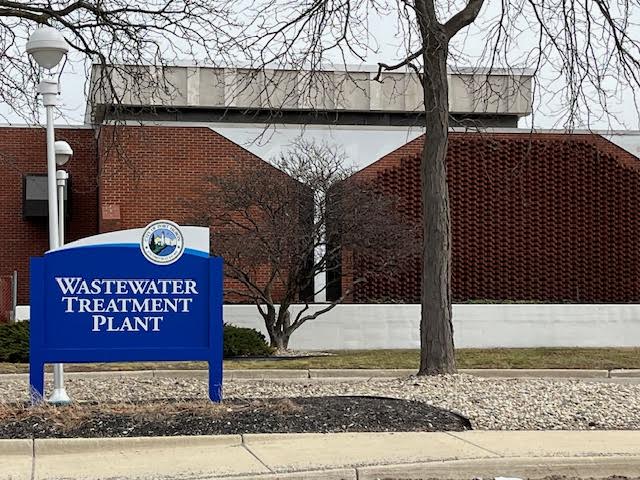
It’s expensive to maintain a wastewater treatment plant, as city council members and residents were reminded at the council’s regular meeting May 27. The plant is tightly regulated by the Michigan Department of the Environment, Great Lakes and Energy to ensure its discharges into the St. Clair River do not pollute the waterway.
The council voted 6-0 to spend $260,000 to repair screw pump #1 at the wastewater treatment plant. Mayor Pro Tem Sherry Archibald was absent.

Titus Welding Co., Inc., of Farmington was the lone bidder.
The plant relies on three screw pumps, which were installed in 1975, to move wastewater – after the solids have settled out – to tanks for secondary treatment. The pumps are 84-inches in diameter and capable of moving 33 million gallons of waste a day each, said City Manager James Freed in his memo to the city council about the work.
“At times of heavy rainfall, two screw pumps may be put in service,” Freed wrote. “The third pump is for redundancy in the event one pump fails or is in need of service. In May 2024, it was discovered during maintenance and inspection the upper and lower bearings on screw pump #1 needed to be replaced. The removal and replacement of the bearings requires removal of the 200-horsepower pump and is beyond the capabilities of the
maintenance staff.”
The city advertised the project on its website and on the Michigan Intergovernmental Trade Network.
Titus Welding Co., Inc. “specializes in this type of work and submitted a quality technical and cost proposal,” Freed said.
Freed presented a quick overview of the plant.
“The WWTP was built in 1951 and expanded in the mid-70’s to provide secondary treatment capability and solids handling,” he said.
The sewer pant serves around 55,000 customers and processes roughly nine million gallons of raw waste per day.
“The treatment of wastewater consists of three main processes: primary treatment, secondary treatment and solids handling,” said Freed. “Primary treatment consists of influent wastewater flowing past a bar screen to catch big debris, flowing through a channel for grit (metals and sand) removal, and then to settling tanks for separation of solids and liquid, or clarification. The wastewater from the primary clarifier tanks (eight tanks in total) then dumps into a wet well and is pumped by one of three spiral lift screw pumps up to an elevation to then gravity flow to the aeration tanks for the start of secondary treatment.”
The cost of the repair will be spread among the city and the three townships that rely on the sewer plant.
“The townships are responsible for their percentage of costs for the city to operate and maintain the WWTP,” said Freed.
Port Huron Township accounts from 13.35 percent of the plant’s capacity and will pick up $34,710 of the cost. Kimball Township uses 5.41 percent of the capacity and will pay $14,066. Fort Gratiot Township will be responsible for 13.83 percent of the total or $35,958. That will leave the city with a cost of $175,266.
In February, the city paid a total of $609,560 for chemicals used by the WWTP and the water plant.
A glance at the city’s five-year capital expenditure plan, adopted May 27, suggests how expensive it is to responsibly treat human waste. The plant is looking at a number of costly projects in the coming fiscal year, which begins July 1, including: Rebuilding he lime silo dust collector, $50,000; replacing the make-up air units, $600,000; rehabbing the splitter box, scum tank, scum pump, pipe galley and stairs, $1,980,000; rehabbing the final clarifiers, $6.46 million; rehabbing the primary tanks, $1.1 million; buying a lawn mower, $15,000; replacing the odor control system (engineering, $550,000; construction, $3 million); installing new stairs, $342,000; buying a snow plow tractor, $35,000; installing a new overhead door in the screw pump room, $95,000; installing a new access hatch, $50,000; paying for a new secondary roof, $2 million; buying a new thickening rake arm, $1 million; enhancing standby power, $350,000; purchasing a bar screen and screening washer, $300,000; and replacing the office floor in the solids handling area, $150,000.
The new budget, adopted May 27, contained an estimate of $200,000 for the new screw.
The work at the plant and the painting of the pickleball courts both appeared on the agenda under “From the City Manager.” But Freed left the meeting to attend a town hall before either were considered.
Jim Bloch is a freelance writer based in St. Clair, Michigan. Contact him at bloch.jim@gmail.com.
