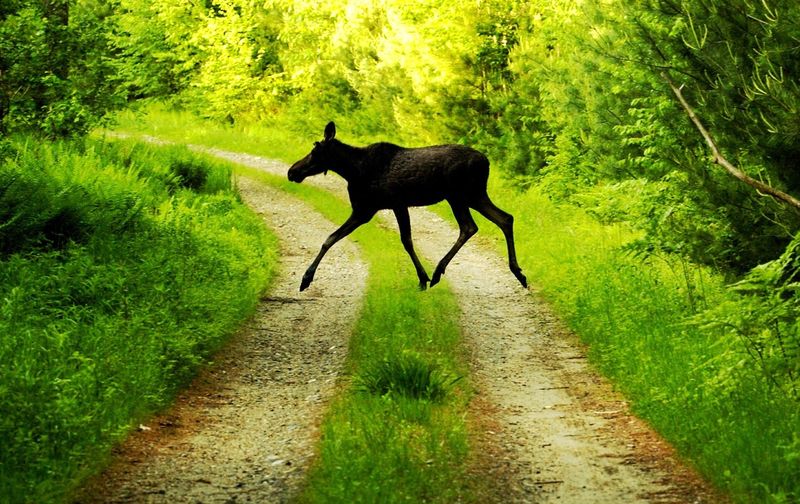
A nonprofit group dedicated to studying moose-wolf interactions at Isle Royale National Park is looking for volunteers to hike the archipelago to find bones and study the large animals.
“Moosewatch Expeditions are an incredible opportunity for you to be a part of the wolf-moose research project,” the Wolf-Moose Project’s website says. “Each expedition involves a week-long trek though the boreal forests of Isle Royale.”

Each expedition team carefully searches as much area as possible for moose bones and records observations and other data, according to the Wolf-Moose Project, which receives support from Michigan Technological University, the National Park Service, and the National Science Foundation.
The group is currently seeking volunteers for four expeditions in 2026 that will take place from May to August.
“The Wolf-Moose Project of Isle Royale is the longest running study of any predator-prey system in the world. The project will celebrate its 68th anniversary in 2026,” the group said.
Here’s what to know about the project and volunteer opportunities.
What is Moosewatch?
The main objective of Moosewatch is to hike and search as much area as possible for moose bones, according to the Wolf-Moose Project.
“The bones of moose provide a great deal of information: cause of death, age at time of death, year of death, and the condition of the moose at the time death,” the group said. “More that 5,300 Isle Royale moose have been discovered and examined. The project curates the world’s largest collection of moose bones. A great deal of what we know about Isle Royale’s moose come from these bones.”
Other objectives of Moosewatch expeditions vary, and include observing moose to estimating spring-time hair loss (which is an indication of ticks having impacted moose), collecting wolf scat for DNA analysis, and recording information about island flora, the group explained.
When are Moosewatch expeditions in 2026?
There are four planned expeditions in 2026:
For one week, participants will explore the backcountry in search of moose bones with a team leader. On the eighth day, there will be a debrief, data will be recorded, participants will be able to shower and enjoy a celebratory banquet. On the final morning, participants board a ferry back to the mainland.
Are the expeditions physically demanding?
Yes, the expeditions require experienced backpackers who can hike 16 kilometers a day and carry a pack that may weigh more than 50 pounds.
“From a single adult moose skeleton, Moosewatchers may pack up to 15 additional pounds of bones,” the group said. “Most daylight hours will be spent moving through the forest or swamp, following animal trails and examining areas where moose skeletons are expected to be found.”
In addition, participants should expect:
How can I apply for an expedition?
The Wolf-Moose Project says those who wish to volunteer should donate a minimum of $500 toward the program
A review of applications will begin in late 2025 and continue until teams have filled. Returning volunteers will receive priority consideration throughout December 2025.
Being accepted as a participant is contingent on:
Shortly after your application is approved, Moosewatch will send more detailed information about the expedition and information about how to make a voluntary tax-deductible donation to support the research program.
Will I see wolves on the expeditions?
Maybe, but that’s not the objective, and leaders try to avoid the animals.
“It is very important that you understand that Moosewatch is not intended to be an opportunity to observe wolves,” the group said. “We go out of our way to avoid any kind of interaction with wolves. Isle Royale wolves face a daily struggle in summer to raise growing pups and to stay alive themselves. For these and other reasons, human contact is not desired.”
Are there other study opportunities?
Yes, there are opportunities for interns and educators.
Internships are 4-5 weeks in May and June.
Applications must be received by March 10, 2026. Potential candidates will be asked for a phone interview by March 20.
Opportunities for educators are from June 15-22, 2026.
Educators will receive the technical instruction needed to participate as a member of a backcountry research team.
Michigan teachers may earn up to 35 State Continuing Education Clock Hours (SCECH) for participation in the workshop.
This article originally appeared on Lansing State Journal: Tracking moose on Isle Royale. How to volunteer for Moosewatch
Reporting by Dan Basso, Lansing State Journal / Lansing State Journal
USA TODAY Network via Reuters Connect