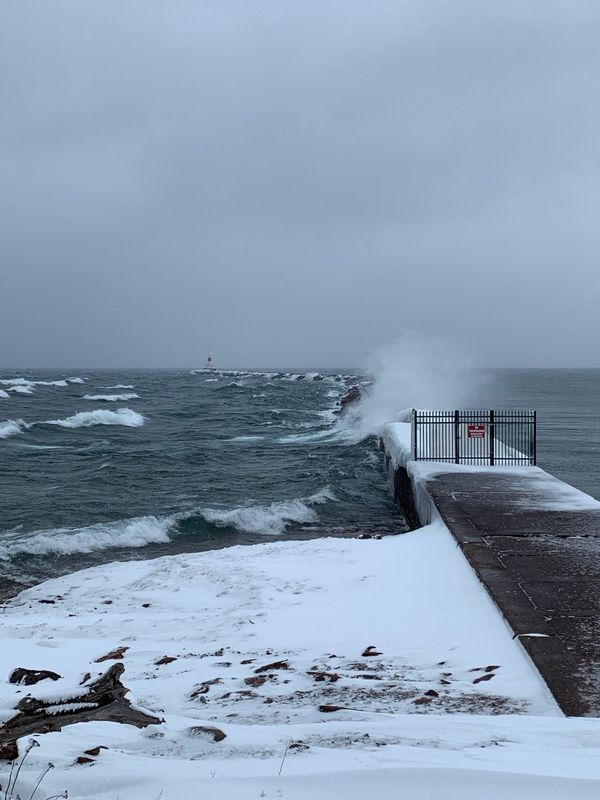
A potent winter storm sweeping across the Upper Midwest and Great Lakes is expected to produce substantial waves on Lake Superior — potentially breaking the Great Lakes’ current record by half a foot.
The National Weather Service in Marquette reported that a rapidly deepening low-pressure system over Lake Huron is moving into Quebec, Canada, on Monday, Dec. 29, while a strong high-pressure system expands across the Great Plains, creating a powerful pressure gradient over the lake.

The storm is part of a larger mid-latitude cyclone affecting much of the eastern U.S., bringing blizzard conditions to the Midwest and Great Lakes, freezing rain across New England and strong winds across much of the country. Temperatures across the central U.S. are expected to drop 30-40 degrees below recent highs as Arctic air surges south.
“A major winter storm continues to impact the Upper Peninsula through this evening,” the National Weather Service office in Marquette states. “Heavy snow and high winds are resulting in widespread blizzard conditions, with visibility near zero at times. Blizzard warnings remain in effect for most of the UP through this evening.”
How high will waves get in the Great Lakes?
Early Monday morning, Dec. 29, storm-force winds of 60 knots — about 69 mph — were reported both west and east of Marquette, generating waves averaging 22 to 27 feet with forecasts for occasional waves reaching 34 feet in ice-free areas.
Waves on Lake Superior north of Munising were running 25-28 feet at 8:45 a.m. Monday, according to the National Weather Service Great Lakes Portal.
For comparison, the previous record high wave recorded on the Great Lakes was 34 feet, between Marquette and Munising on Oct. 25, 2017.
The towering waves on Dec. 29 would surpass those seen during the 1975 “Edmund Fitzgerald storm,” one of the most infamous storms in Great Lakes history.
“Ship observations during the November 1975 storm showed sustained wind speeds of 30 to 45 knots (up to 75 mph) from the northeast, east, or southeast prior to the low pressure system crossing the lake,” the National Weather Service office in Marquette wrote of the storm. “As the low crossed the lake, winds shifted to the northwest and increased. Wind speeds of 50 knots were recorded over the eastern part of the lake. Ship observations indicated waves of 16 to 18 feet during the height of the storm. Keep in mind that the rare peak waves could have been one-and-a-half to two times that height.”
Which areas on Lake Superior will see highest waves?
To the west and east of Marquette, beyond 5 nautical miles from shore, are forecast to see storm-force winds of 60 knots and waves averaging 22 to 27 feet, with occasional waves up to 34 feet, according to the National Weather Service.
Other parts of Lake Superior, like west of Manitou Island to Marquette and east of Manitou Island to the US/Canadian border, were also forecast to see occasional waves reaching 34 feet in ice-free areas.
Current Michigan weather warnings, watches, advisories
Michigan Upper Peninsula Doppler radar
Stay informed. Get weather alerts via text
Brandi D. Addison covers weather across the United States as the Weather Connect Reporter for the USA TODAY Network. She can be reached at baddison@gannett.com. Find her on Facebook here.
This article originally appeared on Detroit Free Press: Blizzard may drive 34-foot waves on Lake Superior. Here’s where
Reporting by Brandi D. Addison, USA TODAY NETWORK / Detroit Free Press
USA TODAY Network via Reuters Connect