By Richard Cowan
WASHINGTON, Dec 3 (Reuters) – A bipartisan coalition in the U.S. Congress is seeking action to ban lawmakers from buying and selling individual stocks, a practice that has long raised ethics questions and is stoking infighting among lawmakers over how deeply to regulate their personal finances.

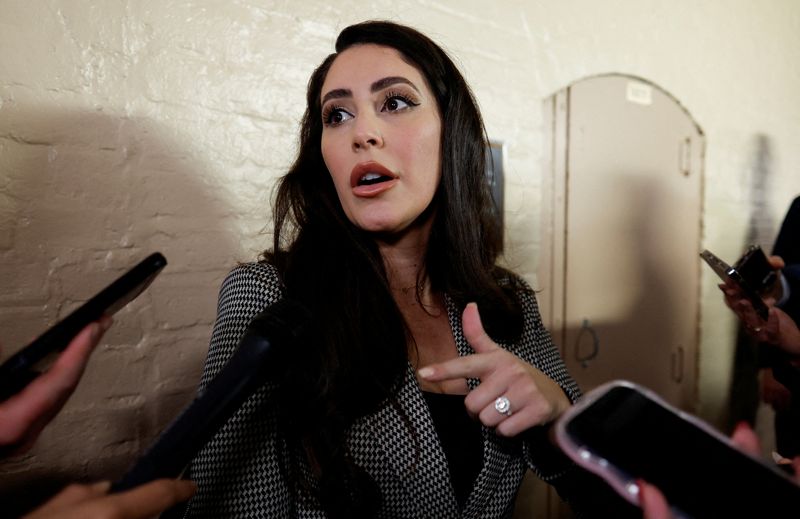
Republican Representative Anna Paulina Luna of Florida late on Tuesday kicked off a drive to force votes in the House of Representatives on a bipartisan bill with more than 100 co-sponsors.
If Luna can manage to get 218 House of Representatives members, a simple majority, to sign her “discharge petition” for releasing the legislation from the control of the House Administration Committee, backers can then orchestrate a rebellion against House Speaker Mike Johnson and demand prompt votes on passing the bill, sending it to the Senate where its fate is unclear.
Supporters of the bill fear that Johnson has not given a green light to advance the legislation to the full House for debate and votes. Aides for Johnson declined to comment to Reuters.
A similar move last month allowed the House to buck Johnson and President Donald Trump to pass legislation demanding full release of documents in the Jeffrey Epstein sex trafficking case, after lengthy delaying tactics by Republican leadership.
“The clock is now running. If leadership does not move quickly to put forward a strong ban on congressional stock trading, the members of the body will act,” said Republican Representative Chip Roy of Texas, the sponsor of the measure, and Democratic Representative Seth Magaziner of Rhode Island, a co-sponsor, in a statement.
The issue of stock trading by lawmakers has been festering for years.
Under the bill, lawmakers no longer could buy or sell individual company stocks and would have to divest holdings. Their portfolios could be transferred into mutual funds, for example.
“Across the country…the American people agree on one thing: Members of Congress should not be enriching themselves with insider knowledge” that lawmakers can gain in closed briefings with other government officials or in meetings with lobbyists, Luna said in a statement.
Representative Elise Stefanik of New York, a member of the House Republican leadership who has been engaged in a tussle with Johnson over unrelated legislation, said in a statement that she has signed onto the discharge effort.
Millions of dollars in trades by lawmakers occur despite the 2012 enactment of the Stop Trading on Congressional Knowledge Act, a disclosure law that many lawmakers and watchdog groups see as ineffective.
At a September press conference, Roy said 113 members of Congress made 9,261 trades involving 706 million shares during 2024 alone.
Roy, one of the most conservative members of the House, on September 3 unveiled the bill to ban stock trades flanked by bipartisan fellow lawmakers, many of whom rarely see eye-to-eye on any issue. Roy in the past has engaged in a limited number of stock trades.
Progressive stalwarts, such as Representatives Alexandria Ocasio-Cortez of New York and Pramila Jayapal of Washington state attended the unveiling alongside conservatives, including Scott Perry of Pennsylvania, a former head of the hardline House Freedom Caucus.
Similar legislation was approved in July in the Senate Homeland Security and Governmental Affairs Committee, but with the support of only one Republican: Josh Hawley of Missouri.
(Reporting by Richard Cowan; additional reporting by Chuck Mikolajczak in New York; editing by Scott Malone and Leslie Adler)