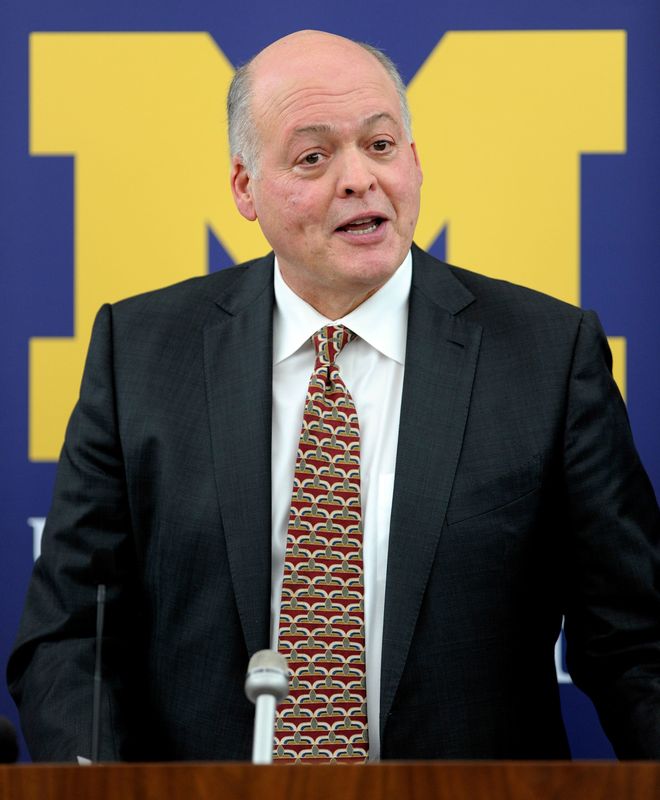
Jim Hackett, the former president and CEO of Ford Motor Company and CEO of Steelcase, also spent time at Michigan, his alma mater, as interim athletic director for nearly two years and hired Jim Harbaugh as head football coach and negotiated then the largest college athletics apparel deal with Nike.
Hackett, 71, remains busy as he participates on State Farm’s Board of Directors and is a partner in a venture capital firm working on AI. Michigan, where he played on the offensive line in the late 1970s, remains dear to him, and he has watched much play out on the athletics and university level since his departure March 11, 2016.

Most recently, Warde Manuel, who succeeded Hackett as athletic director, announced he will step down Dec. 31 after more than a decade. He is leaving after a nearly $12 million independent culture investigation into the athletic department and will, according to his separation agreement, receive a $7.14 million lump-sum buyout.
Also, this week the Michigan Board of Regents named the university’s 17th president, C. Cybele Raver, currently the provost and vice chancellor at Vanderbilt University. She is scheduled for formal approval Sept. 1 and will begin her new role Dec. 1. Among her biggest early hires will be an athletic director who will direct a department with projected operating revenues for 2027 of $297.3 million.
Hackett, who took over as interim athletic director on Oct. 31, 2014, and was immediately tasked with hiring the next football coach, spoke with The Detroit News on the complexities of being an athletic director and what kind of director would best fit Michigan’s needs in this new era of NIL (name, image and likeness) and revenue sharing. Some answers have been edited lightly for brevity and clarity.
Question: Having been an athletic director at Michigan, you know what that encompasses, but how big is this job, because it feels like it’s becoming even bigger?
Answer: Yeah, and it’s important that I help from that perspective of running big companies and doing that (Michigan athletic director’s) job and that the community gives Warde a break. When people are driving their Ford car and it breaks and I’m in charge, I’m accountable for that. But there’s north of 300,000 people that are directly contributing to the performance of the company, and you need to be humble to know that one person is accountable for everything, but they probably are not the reason that something broke down all the time, right? And so the evidence of capability is the ability to understand with the people that hire you that you’re gonna design the best system to create the most optimal outputs that you’ll be proud of, and then when things don’t go well, because they will inevitably not go well, watch the degree which you address that and learn from it and make things better. I feel like what Warde’s had to deal with in the 11 years he’s been in the job is unprecedented amount of change and success, and you have to look at that and go, “You know, that’s a really difficult job.” If somebody wants to obsess about my F-150 didn’t work and you’re the reason, that gets the attention of someone like me. I take it personally, as Warde does. You can tell he does. As we get this new athletic director, remember that perfection is just impossible, and the support and emotional endorsement for, we really want you to do the best job, we see the great job you’re doing, we give you pats on the back for it, (the AD) deserves that.
Q: So what’s the right formula to be an AD now?
A: What it’s about when you go to source it, do you want somebody who was an assistant and coached, and knows how stadiums get full and how you make student-athletes really motivated? Or is it the administration of this hundreds of million dollars of spending, and the process for reasoning where’s the best place to spend? Or is it, it’s such a competitive world, we can’t lose because we’ll lose students and we’ll lose donations? So how do we design the teams to be within rules and integrity to be the best on the planet in anything we do? That means, do you have the best facilities? The answer is “Yes” to all that. And I’m saying to you, I ran a Fortune Nine company, and I ran athletics, and the only difference that Ford brought that Michigan didn’t have was that I was a global competitor, so I had to think about competing against China. But when you think about competing against Ohio State, it gets you just as emotional. So it’s a really difficult job, and the question that resides now with the next leader of the university is which of those variables do they want the athletic director to concentrate on? When I stepped in (at UM), there was a lot of stress about getting football back on track because it seemed like it was languishing, and yet basketball was doing really well, as were softball and hockey and baseball, credit to (previous athletic director) Dave Brandon. Those things were on really great courses, so I spent my time trying to think how to improve the fitness of our football, and because the focus was that, it seemed like I knew what I was supposed to do. That’s what the world wanted me to do. You see what I mean?
Q: I do see that. Now it’s about what will be asked of the next athletic director.
A: What does the world want the next Jim Hackett or Warde to do? Well, you might hear answers, “We just don’t want any scandals.” OK, we understand that. But there’s not a trade here. You can’t give in to scandal so you win more. What I would suggest is you got to be careful for what you wish for in the sense that you do not want to go into a losing momentum where losing gets accepted because then you lose all this other kind of support, right? So, it’s a really difficult job because you can’t have scandals and you have to win every contest you’re in, and you have to recruit the best people in the world, and you know you have to deal with the ambiguity of rules because the rules are not so binary that you know, gosh, any child could have adhered to what we’re talking about because if that were true then why does the NCAA struggle so much in its administration of policy and penalty? I can’t believe the penalties that some people get and others don’t, and it says that there’s a lot of discretion and judgment and all this ambiguity.
Q: What about having to work with the university’s Board of Regents?
A: Well, that was the hardest thing for me. And you can witness our sister school in East Lansing similarly. I wasn’t used to that. The trustees I reported to in business were not randomly accepted into the room based on popular vote. They were sorted for whether they’re the best fit for what we need right now. It’s not just, can you get elected? And then the second dilemma is, were they selected so they work well together? Business boards aren’t perfect. I just left a board that I was not helping. I didn’t fit. I’ve been in 900 board meetings, and I didn’t fit at this last board I was on, and I walked out and I wasn’t embarrassed because you really want the harmony in the boardroom to be the first thing. So that really disappointed me when I started to interact with Michigan. I didn’t realize this. And that isn’t an indictment about the Regents. I like them all and all that, but it’s competing.
Q: With a sense of where college athletics is now, do you know who would be the best fit as athletic director? Would it be someone who’s been the head of Ford, would it be someone who’s gone up the athletic administration ranks like Warde? A fundraiser?
A: I’ve had some of the headhunters call me to ask me, not to do the job, but what do I think. And I’ve said that one of the truths over time, there’s a couple of them, one is that you have to design, let’s call it — sorry, this will make you crazy — for the ascending technology. It just happens this is AI now. But if you were arriving at General Electric when the internet was coming, you had to deal with this. Or a better example would be if you were a CEO of Walmart, you had to deal with the arrival of the internet because it was changing what became Amazon, right? I’m trying to say to the headhunters is that you have to look at the ascending technology, which means it’s not a made-up idea, it’s just not fully developed yet, and you’re going to have a hand in developing the way it’s applied. We’ve got to have somebody that understands that. And secondly, because of compensating players, it appears that they’ve mirrored some of the pro teams, like having a general manager. And now I want to answer your question: Is there a better person to come from business versus athletics? Not necessarily. It’s just that they’ve got to have kind of a systems mind, which means that these things feed each other toward performance, and so you’ve just got to be curious enough to either surround yourself with people that can be vertically smart about one of those two or three topics, or you have to be curious enough to learn them yourselves yourself because you have to lead people through the ambiguity of it. We really need the operational skills and everything you bring to organization, because if we had a really great press-performing AD and nothing operated, well, you know. I’m painting a picture that a system’s view of the job is a beginning advantage, and then secondly, if you’ve had experience dealing with trustees or boards in a performance-oriented job, it could be helpful.
Q: This job seems almost too gigantic now.
A: You’re not wrong, but the mistake that happens in business that you can correlate is, if there’s something that goes wrong in the operation, one of the worst things you can do is create a compensating oversight for that. It’s what’s called bureaucracy, and then you’re weakening the leadership. So this notion that maybe we need to create the intercollegiate board again, I think is wrong-headed. You could ask the AD to have a group of informal advisers that, as I just said, have got to prove they’re educated in these topics. You could create a tech advisory board. You could have somebody that understands investing because I really believe the way we should pay the players is more like 401(k)s, not annual contracts. But this isn’t just Michigan athletics. Like car businesses and furniture businesses made the mistake when quality lagged, they created compensating organizations to watch the businesses build quality products. You just need to teach the businesses how to build quality products. You don’t want what I call a watcher of watchers because we already have a Board of Regents and that’s their job to watch the operations. It is really big, and so you use an audit function. That’s what companies do to go deeply into (an organization) like the Jenner & Block (investigation into athletics), but it’s more motivating, not depreciating to the participants. The audit function comes in on some regular interval and says, “Hey, we need to see what you’re spending,” and you can even add it to if there’s been any major failures of integrity. The auditors can do deeper dives. An audit might be viewed as a compensating process, but I think that’s needed from accountability because everything’s so big.
Q: Warde was athletic director for nearly 11 years at Michigan, but it seems the shelf life for athletic directors these days is pretty short. From your perspective, is it a job that someone can keep for a decade-plus, or is this a job that, they’re getting burned out? Maybe it’s a five-year job, and you move on? I can’t quite figure out the stability of this position.
A: I was in there 18 months, and I watched what happened to my peers, and I was shocked at how many people left. Now, if you go back and go, “Why?” It was this thing I just told you, which is the intersection of change and the governance. The fact that the governance wasn’t sure of itself — in fact, we’ve got to add this to being presidents of universities today, because the turnover is really high. You do not want high turnover, but it doesn’t mean you accept mediocre performance. It just means you recruit for stability. In business, because I got to be in two big companies and, later, on all these boards, I’m a big believer in a phrase that somebody used: “You love them til you can’t.” What it means is, you invest in their development. Did we invest in Warde’s development over the last 10 years? Shame on the university if it didn’t. That’s a way that you create extension of time, is by people getting better in the job, and that’s what I would offer as the path. When we recruit this next person, you should be raising your hand after 18 months, and go, “I talked to a guy that used to do this job, and he wants to know what you think the university is investing in your development? What do you mean by that? Well, do you know everything you need to know? Probably not. OK, well, how are you investing to do that?” We did this in business all the time.
Q: Would you be interested in being Michigan AD again?
A: No. I have 30 years of CEO-ness, and it wouldn’t be good. I am the wrong person right now because I am 71. I’m busy as I’ve ever been, and I’m really proud to tell you that.
achengelis@detroitnews.com
@chengelis
This article originally appeared on The Detroit News: Q&A: Jim Hackett on challenge of being a Michigan athletic director
Reporting by Angelique S. Chengelis, The Detroit News / The Detroit News
USA TODAY Network via Reuters Connect
By Angelique S. Chengelis, The Detroit News | USA TODAY Network