

Taylor — With one knee on the ground, the man bowed his head in front of the wall and wept.
“We should have been together,” the man said through deep sobs. “We should be here together now.”

He used the pencil in his right hand to etch the rub the name of his friend onto a piece of paper: Tommie Lee Mitchell.
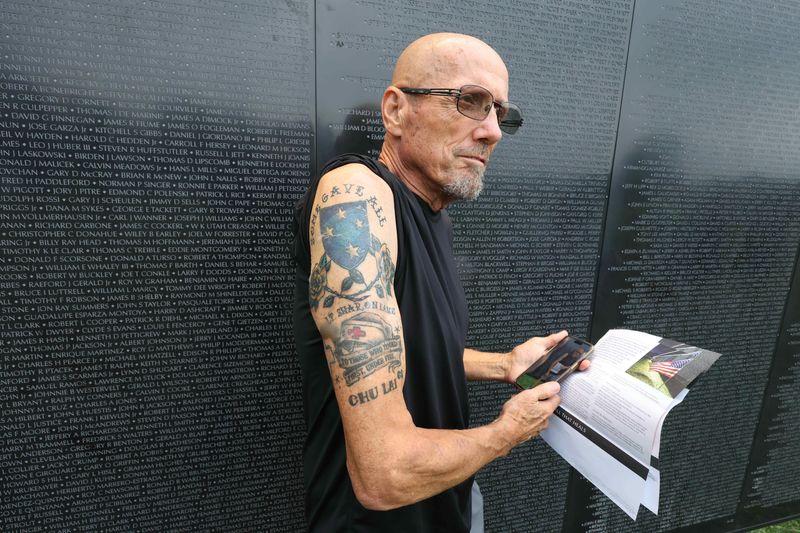
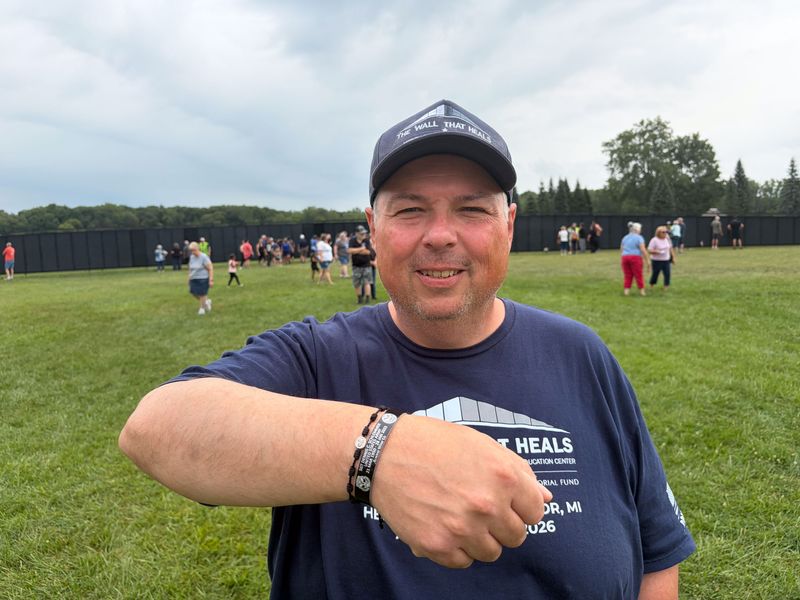
Michell’s is one of the 58,281 names etched into a traveling version of the Vietnam War Memorial. The exhibit, titled “The Wall That Heals,” came to Taylor for an extended weekend run. The free, 24-hour exhibit in Heritage Park is open through 2 p.m. Sunday.
Sandy Nugent, site manager with the Vietnam Veterans Memorial Fund, which hosts the exhibit, said the goal is to bring the memorial to veterans and communities who may not be able to make it to the national memorial in D.C. The exhibit travels to about 30 cities a year. The response, she said, is always profound.
“We call it the ‘wall that heals’ for a reason,” Nugent said. “And it really helps communities understand what happened to our Vietnam veterans, because it’s not really well taught in school. It’s really glossed over.”
The exhibit brought out Michigan Vietnam veterans who had never been to the memorial in D.C. It brought out those who didn’t serve but lost loved ones, and those who just wanted to remember or to learn.
Dennis Schlemmer, the son of a Vietnam veteran and president of the national Sons and Daughters of the Vietnam War, is a Taylor resident and pushed for the exhibit to come to his hometown.
The wall is a three-fourths replica of the wall in Washington D.C., and includes every name of Americans lost in the Vietnam War.
Schlemmer’s father, Sgt. Dennis C. Schlemmer, survived the war but succumbed to an Agent Orange-related cancer a few years ago, his son said. The elder Schlemmer is now honored as part of an “In Memory” program that travels alongside the Wall that Heals, honoring those who survived the war but died later of war-related causes.
“My commitment is because my dad was robbed of his life for serving his country,” Schlemmer said. “He should still be here.”
Schlemmer said he spearheaded the effort to bring the traveling wall to Taylor both for his community, and for his mom. On Wednesday, he was able to bring his mother, who was in a rehabilitation center at the time, to the park to see her late husband honored. Schlemmer said she thanked him for bringing her.
The way veterans were treated at the time, Schlemmer said, disregarded for their service and told to hide their uniforms because of what people might say, is what makes it still so present for so many people today. It’s also a connection to a time that still feels present to many veterans.
“It reconnects these veterans to their friends from 60 years ago,” Schlemmer said.
Michael Gibson, a Vietnam veteran who lives in Westland, said he came to the wall “to see my friends from my hometown” of Inkster.
“To have served and made it back − and all these guys didn’t make it,” Gibson said.
He was in search of several names. A team of volunteers was on hand with an app in hand on their phones to find any name, even if a visitor had just a partial name to go off. A team at the front had a paper directory to assist as well. The wall was open overnight, and Schlemmer said many veterans would find their way there after dark, wanting to be alone. Registration was not required, and being in an open park, visitors could wander in and out, no questions asked.
Wisam Dubaisi, of Dearborn Heights, wandered into the exhibit with his wife and their 1-year-old son, in search only of outdoor park activities but happening upon a memorial that took Dubaisi right back to his home of Syria.
Dubaisi is part of the Druze ethnic and religious minority in Syria that has endured thousands of deaths due to who they are in their country. Their memorial, he said, is photos taped to the center of a traffic roundabout. It’s not much, he said, but it’s something to remember the faces of those lost.
The Vietnam Memorial, he said, was staggering in the number of names.
“You can feel what the families feel,” he said.
It was an “honor” to see it, he said, and to see how emotional so many people became in its presence.
Nannette Suave, of Taylor, came to the front tent with a triumphant declaration: “I found my guy!”
Suave was just a teenager during the war, and wore a metal bracelet inscribed with the name of a Prisoner of War. Her bracelet’s name was Lt. Gol. Robert Hagerman.
“I wore it 24-7 for a long, long time,” Suave said.
She didn’t know anything about him, but “thought about him all the time.”
She also never knew what happened to him until Saturday.
Hagerman was a casualty of the war, but was found and returned home. He was a POW no longer.
She was even able to see his picture for the first time.
“He looks like a young John Wayne,” she said.
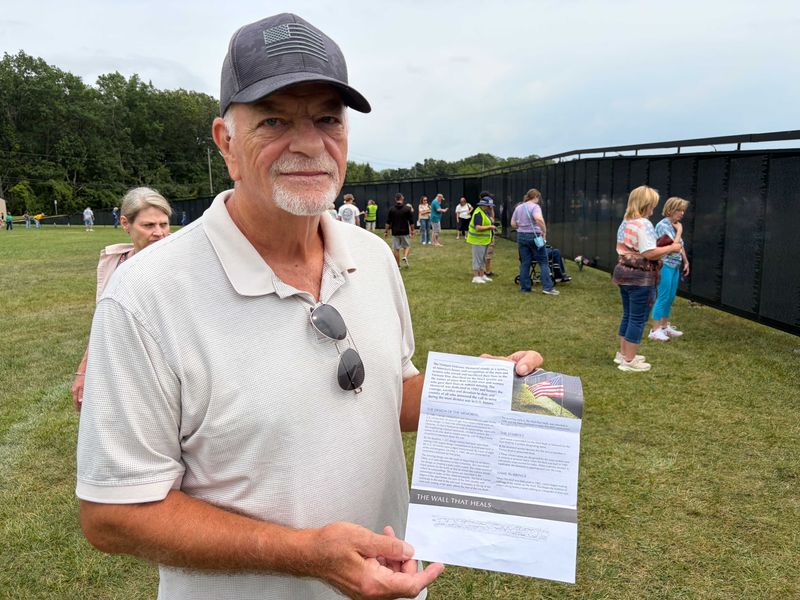
Jim VanOast, of Livonia, came to find his best friend.
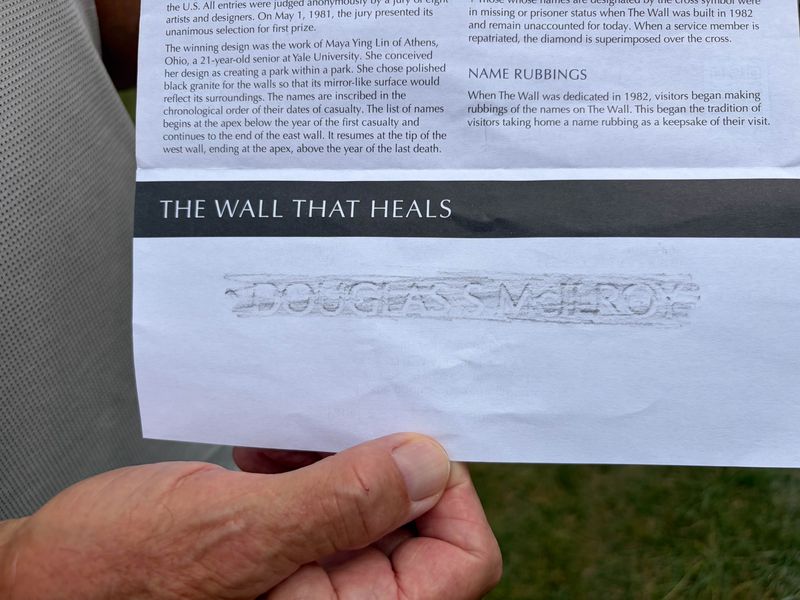
VanOast and Douglas McIlroy were inseparable in high school in Dearborn. They both ran track, and went camping and canoeing.
“We chummed around a lot,” VanOast said.
Within days of arriving in Vietnam, McIlroy was killed. He was just 19 years old.
VanOast, who had a Ford apprenticeship at the time, said he remembered his dad coming into his room during the night to deliver the news.
“Before he said it, I knew,” VanOast said.
He later named his son after his lost friend.
VanOast had yet to make it to D.C. to see the memorial. He plans to go next year. But when he heard about the traveling wall, he jumped at the chance to find his friend’s name, and do his own pencil rubbing of the etched name on the granite.
“I’ve always wanted to do it,” he said.
jpignolet@detroitnews.com
This article originally appeared on The Detroit News: The Wall That Heals: Vietnam Memorial replica comes to Downriver city
Reporting by Jennifer Pignolet, The Detroit News / The Detroit News
USA TODAY Network via Reuters Connect
By Jennifer Pignolet, The Detroit News | USA TODAY Network
