

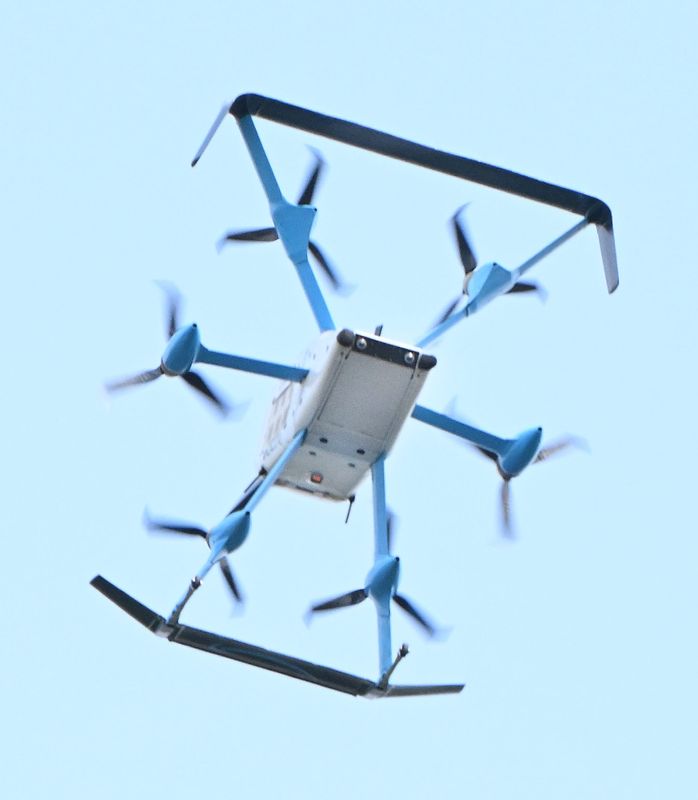
Pontiac — A drone lifts off from an Amazon facility with a package secured tightly beneath. It climbs over Metro Detroit neighborhoods on its way to a customer’s doorstep — and into a growing debate over noise, privacy and who controls the skies.
Amazon is betting drones will reshape package delivery. Amazon Prime Air launched in the United States in 2022 with the promise to deliver packages to customers via drones in 30 minutes or less. In November 2025, this service came to Metro Detroit. With one location in Hazel Park and another in Pontiac, residents living within a 7.5-mile radius of the facilities can order any package weighing 5 pounds or less to be delivered promptly by a drone flying up to 400 feet high at a maximum speed of 73 mph.

As Amazon expands its drone deliveries, some residents praise the technology. But others complain the flights are noisy, intrusive and disruptive. In Metro Detroit, those complaints — coupled with disagreements over who has the authority to regulate the flights — have left some residents frustrated.
This is not just happening in Michigan, however. With operations in select U.S. and international cities, many have raised concerns over persistent noise, privacy and safety issues. In Richardson, Texas, months of complaints to Amazon, the city and the Federal Aviation Administration resulted in what residents described as little action taken, leading homeowners from multiple neighborhoods to stage a protest, NBC 5 reported.
On Wednesday in England, one of the e-commerce company’s delivery drones crashed into a residential garden while making a delivery in Darlington, north of Leeds. No one was hurt, BBC reported.
‘An incredibly loud beehive attack’ or ‘white noise’?
Many Metro Detroit residents say they are now experiencing similar frustrations
The drones often fly directly over Nikki Ruddy’s house in Bloomfield Hills. As time has gone on, she said, she’s grown increasingly frustrated: “At first, I was more interested in it and excited to see where the future is going. But it’s just nonstop traffic all day, every day, and it’s just so loud. Even the dog was barking at it just yesterday. Then there’s that conspiracy, that idea — are they taking pictures?”
Lauren Guastella echoed the sentiment, saying the drones might even drive her to leave her home in Ferndale: “In the beginning, I saw maybe one every few days, and I was like, ‘OK, this is super weird, but whatever.’ Now it is constant. Whether I am inside my house or outside in my garden, I can hear them. It sounds like an incredibly loud beehive attack. When you go outside, you just want peace. Frankly, it makes me want to move out of Ferndale.”
Her fear, however, is that even if she relocates, the drones will follow.
“We need to be proactive about this because this is the beginning of what could come — constant flying all over the place of drones, which could lead to some sort of surveillance,” Guastella said. “Millions and millions of people use Amazon every single day, and that would suggest that, at some point, there’s going to be thousands and thousands of drones in the sky in the future.”
Evan Miller, a custodial engineer from Warren, said he believes Amazon and homeowners could reach a compromise: “I don’t feel like they need to buzz over residential areas. They take the shortest path, which is over people’s houses and playgrounds to get the package quickly. There seems to be better ways they could go.”
The drones feel invasive and potentially dangerous, Miller said: “It’s just really the nuisance of the noise — like a weed whip going over your house every day — and then just the kind of dystopian feel. You never know if they could crash or surveil you and map you. It’s not really something that you generally want going on over your head.”
Other Metro Detroit residents, however, have seen nothing but advantages from the drones. Chris Van Assche, a plumber from Hazel Park, says vehicle traffic is down where he lives and that the drone deliveries have been flawless.
“I’ve noticed a huge cutback on traffic in our street. I have two small children, so less delivery trucks up and down the streets has been a lifesaver because my kids like to play outside,” Van Assche said. “I’ve never had a package damaged during delivery. I’ve had more damaged from hand delivery. The drones deliver them right to my porch. I think it’s great. I think postal services should take notes.”
Such positive feedback has been the majority of what Amazon has been hearing from residents, Lindsay Hamilton, a spokesperson for Amazon, wrote in a statement to The Detroit News.
“The local customer response to Prime Air’s ultrafast delivery of household essentials, electronics, and medications has been overwhelmingly positive,” Hamilton wrote. “We receive very few customer service inquiries about Prime Air drone delivery, and so far this year, fewer than 1% of those inquiries about Prime Air have been related to noise.”
Amazon declined to disclose how many drone deliveries it completes each day from its Hazel Park and Pontiac facilities, but Hamilton said that the sound of the drones is comparable to sounds that many would hear daily anyway.
“The level of sound during drop-off is quieter than an idling delivery truck parked curbside or a passing passenger car,” Hamilton wrote. “During flight at altitude, the sound is comparable to an electric toothbrush or a window fan on low, and typically can’t be heard indoors.”
Karen Ruddy, Nikki’s mother who lives with her in Bloomfield Hills, said that while her daughter gets bothered by the drones, she believes they are no different than other technologies: “It’s white noise to me. I guess it’s a technology we have to live with. I mean, this fountain in our neighborhood, it’s noisy. If you pay attention, the drones are noisy too, but it kind of blends in. I don’t honestly get bothered by it.”
Amazon said it has had no crashes or incidents with its drones in Michigan. Hamilton added that the cameras are not used for surveillance: “Prime Air drones use onboard cameras and sensors for navigation, obstacle detection and safe delivery. The cameras help the drone see where it’s going and operate independently. They are not viewed live by any person.”
Ryan Latourette, director of regulatory affairs at Great Lakes Drone Company and founding member of the Michigan Coalition of Drone Operators, agreed that privacy is a non-issue: “Honestly, I could gather more information driving down your street with my cellphone camera than one of these drones could.”
Nikki Ruddy just wishes that some of this information could be shared better: “You would have thought that there would have been a little bit more communication. I would love to learn more.”
Residents look for answers
As Michiganians share their feedback, some cities — including Ferndale, Madison Heights and Auburn Hills — have shared online that local authorities are unable to regulate the drones.
“The Federal Aviation Administration (FAA) is the only agency with legal authority over U.S. airspace,” the city of Ferndale wrote on its website. “Because Amazon’s drones operate under an FAA Air Carrier Certificate (Part 135), local governments like Ferndale cannot ban flights, establish no-fly zones or regulate aircraft noise. The City of Ferndale does not have the power to regulate drones flying over the city.”
In a statement to The News, Ross Querro, community and economic development director for the city, said officials have received approximately five complaints from residents regarding the drones. He advised those with complaints to reach out to the FAA and Amazon.
“If residents have a complaint or concern, the quickest way to get help is to contact Amazon or the FAA directly,” Querro wrote. “For Amazon Air issues, they can email amazondronefeedback@amazon.com. For dangerous flying, property damage, near-misses or safety violations, visit the FAA portal at hotline.faa.gov. We are consulting with our legal team to evaluate all available options that may be pursued.”
Auburn Hills similarly posted on its website that it does not have regulatory power but has met with both the FAA and Amazon to address resident concerns: “The FAA has assured City officials that Amazon’s drone delivery program is operating in accordance with federal regulations and the terms of its FAA approvals. Amazon has also informed the City that it wants to operate its drone delivery program in a manner that is safe and minimizes impacts on surrounding communities.”
Edward Klobucher, Hazel Park’s city manager, told The News that Hazel Park has received less than a dozen formal complaints, though more could be seen on social media. “We encourage those with complaints to contact Amazon and to contact the FAA,” he said. “It’s probably not going away. I mean, this is probably just the first of the drone deliveries we will see.”
At the same time, the FAA has communicated with residents that local governments are in charge of several issues relating to the drones, including noise levels and privacy matters. In an email sent to Guastella and shared with The News, the Office of the Regional Administrator, FAA Great Lakes Region wrote that local government would be best suited to address her complaints: “Any issues involving invasion of privacy, trespass or public nuisance should be referred to your local law enforcement agency, as these matters fall under state or local jurisdiction.”
Guastella has felt frustrated, unheard and confused by what she sees as conflicting messages: “I think what’s happening is they’re just tossing the ball back and forth. No one wants to take on Amazon to actually remedy this or to get some regulations behind this outside of the FAA regulations.
Feds have authority over flights
Don Smith, an attorney at Michigan firm Willis Law with expertise in aviation legal matters, said the federal government has regulatory control over where drones can fly: “Regarding no-fly zones, the feds have the authority over flight paths, so local governments can’t get in the way of their authority by passing some other more restrictive rules.”
In contrast, local governments can address noise levels, but Smith said this is often difficult to do.
“Amazon intentionally has its drones fly way high above until they’re over your house, and then they descend,” Smith said. “So they’re not buzzing by people’s windows on the way to deliver a package. It’s permanently temporary. Maybe there’s scenarios where there are so many Amazon deliveries that the noise becomes consistent enough that it potentially could be a problem.
“And there could be ordinance violations for being above a certain decibel level, but it’s a real nightmare to prove that beyond a reasonable doubt in court. Nobody wants to consistently get involved with that because it would just be a suck on resources.”
In a statement to The News, an FAA spokesperson wrote: “Operators are encouraged to be responsive to community concerns even when noise does not rise to the level of a ‘significant impact’ under the National Environmental Policy Act. Amazon Prime Air operates under an FAA exemption with specific conditions and limitations.”
The exemption allows the company to fly its drones beyond a pilot’s visual line of sight — not requiring human observers, a key component in rolling out Amazon’s delivery service.
In a statement included in a 2023 FAA grant letter approving the exemption, the Helicopter Association International voiced concerns over the lack of visual observers at a height where problems could still occur.
“The Helicopter Association International opposes Amazon’s assertion that their operations are ‘low risk’ due to their perception that the probability of an airborne encounter is ‘extremely low’,” the document reads. “Every day, utility inspection aircraft, public safety aircraft, agricultural aircraft, air medical operations, balloons and ultralights, as well as others, conduct operations in this airspace. They assert that Amazon has essentially self-declared their operation as low risk, based on unsubstantiated probabilities.”
In response, the FAA document said Amazon’s Detect and Avoid system in its drones would be satisfactory in helping to avoid collisions: “The FAA has determined that, with proper mitigations, the petitioner’s plans to use its DAA system can be permitted, and an equivalent level of safety can be maintained.”
atisch@detroitnews.com
This article originally appeared on The Detroit News: Drones bring packages, plus noise and privacy concerns in Michigan
Reporting by Alyssa Tisch, The Detroit News / The Detroit News
USA TODAY Network via Reuters Connect

By Alyssa Tisch, The Detroit News | USA TODAY Network
