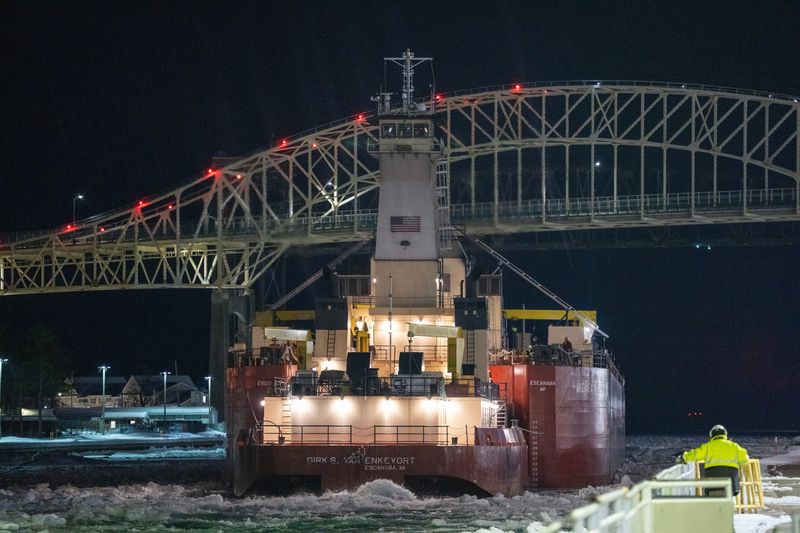
SAULT STE. MARIE, Michigan − Moments after midnight on March 25, the 8,000-horsepower Dirk S. VanEnkevort tugboat rumbled to life. It was 26 degrees and a windless evening, but the moment was charged with significance.
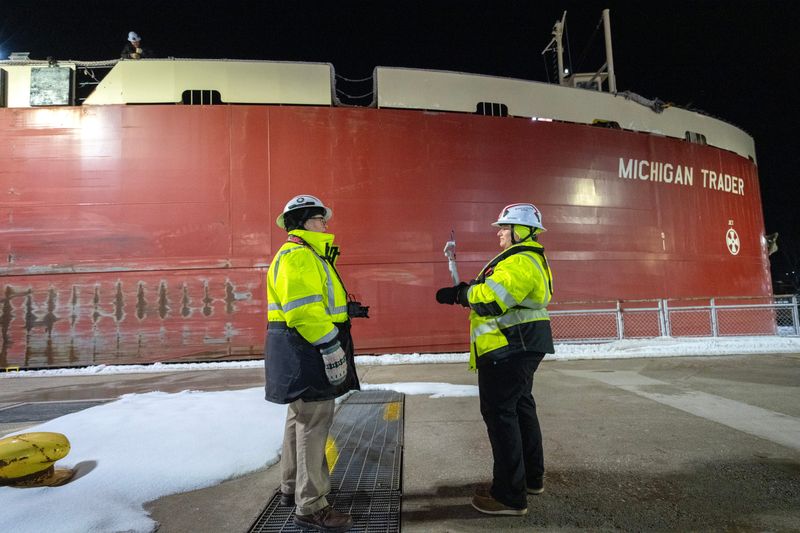
Steadily, the 130-foot tug pushed the 740-foot barge Michigan Trader towards the Soo Locks bound for Superior, Wisconsin, to pick up a load of iron ore. Four other ships waited close behind along the St. Mary’s River.

Hundreds of spectators watched from an observation deck, while another 700 watched live on social media as the vessel became the season’s first ship to navigate the Soo Locks.
This time of year some people celebrate opening day for baseball, but “this is opening day for people who love boats,” said Raymond Bell, president of the Soo Locks Visitor Center Association and a local business owner.
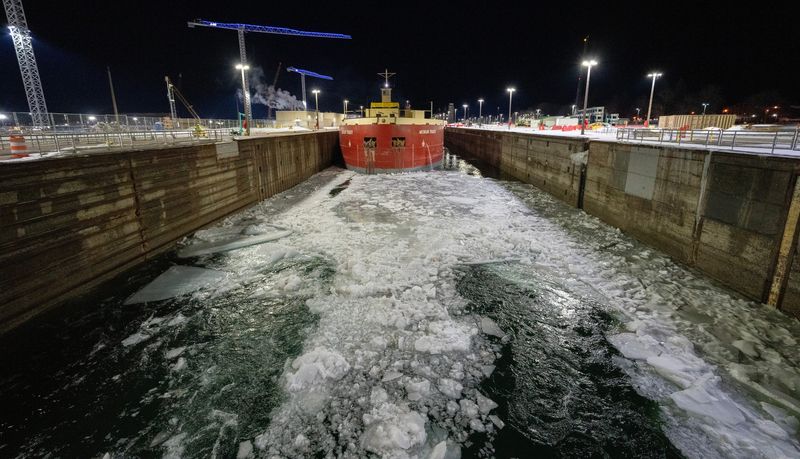
The tug and barge, with 15 crew members spread over the two vessels, pushed sheets of ice through the lock. Once they were tied to the moorings, 22 million gallons of water filled the chamber, raising the vessel about 20 feet.
At 12:46 a.m., the captain blew the horn before heading toward Lake Superior.
And just like that, the Great Lakes shipping season was underway.
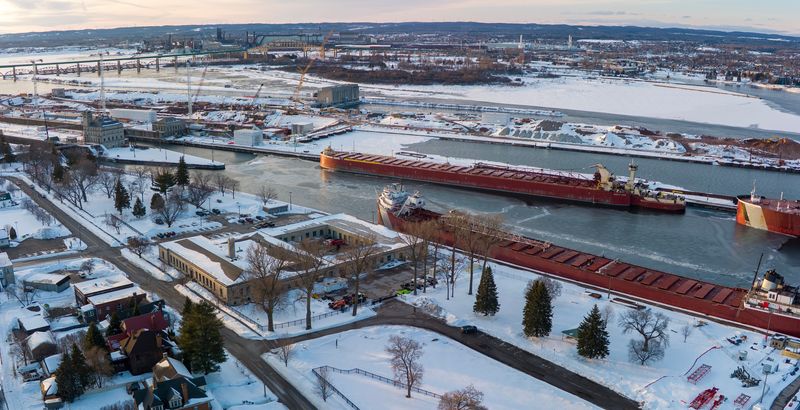
The Soo Locks, which connect Lakes Superior and Huron along the St. Mary’s River, is widely considered the busiest lock system in the world by cargo tonnage. About 7,000 passages happen each year, hauling upwards of 86 million tons of cargo.
Managed by the U.S. Army Corps of Engineers, the locks include two canals and four parallel chambers that allow ships to navigate the 21-foot elevation drop between the lakes. The system dates back to 1855, when the first locks opened in response to the region’s mining boom.
Today, most cargo passes through the Poe Lock, the only one large enough to handle the massive 1,000-foot lakers. The MacArthur Lock serves smaller vessels, while the older Davis and Sabin locks have closed.
Every year, the Soo Locks close down to maritime traffic for 10 weeks – Jan. 15 to March 25 – for maintenance, a schedule set by the federal government in 2009.
When the locks reopen, it’s a point of pride for the captain and crew to guide the first ship through.
Those bragging rights also come with a gift: each crew member receives a navy blue baseball hat embroidered with Soo Locks, “first ship” and the year.
As the first vessels move through, others follow close behind.
Just behind the VanEnkevort tug, Michigan Trader were two ships with roots in Wisconsin. The Edwin H. Gott, a 1,000-foot bulk carrier built in Sturgeon Bay headed to Two Harbors, Minnesota, was followed by the John G. Munson, a 768-foot freighter built in Manitowoc, on its way to Marquette, Michigan.
The 1,013-foot Paul R. Tregurtha – the longest freighter on the Great Lakes – moved farther south along the river, followed by the 588-foot Canadian-flagged bulk carrier Kathy McKeil.
But beyond what ship makes it to the Locks first, the night carried significance beyond tradition.
The celebration recognizes “how important the ships are, not only to our local economy, but to our regional and national economy,” said Michelle Briggs, chief park ranger with the Army Corps.
Among the world’s busiest lock systems
The Soo Locks see a steady flow of ships throughout the navigation season. Iron ore – or taconite – is the main commodity transported through the Locks, followed by coal, stone and grain products.
Transporting iron ore is vital to the U.S. economy, Briggs explained, because the nation’s only domestic supply lies along the western end of Lake Superior.
About 95% of U.S.-produced iron ore is shipped through this facility to mills on the lower Great Lakes, Briggs said.
World War II underscored the importance of the Soo Locks, Briggs said. At the time, it was one of the most heavily guarded sites in the U.S., with more than 7,000 soldiers stationed there.
The iron ore originates in the iron ranges of northeastern Minnesota. Once taken to the docks and loaded onboard, it passes through the Locks into Lake Huron. Some freighters turn west under the Mackinac Bridge toward steel mills near Chicago and Gary, Indiana. Others head south via the St. Clair River, Lake St. Clair, and the Detroit River to mills in Detroit, Toledo and Cleveland.
But ships come from all over the world. Every week, a couple of “salties” – or oceangoing ships – pass through the Soo Locks, most of which are transporting grain products, Briggs said.
Crews shoveled out 90 tons of muck
During 10-week long winter maintenance, crews spend 25% to 50% of the time clearing snow and ice, according to Briggs.
Most years consist of routine maintenance, like mucking, where crews work below the lock floor, removing debris from the drainage system using shovels and buckets. The debris, which consists of mud, rocks, sticks and taconite pieces, was up to four feet thick in one area, Briggs said. In total, the crews shoveled out about 90 tons of debris – roughly the weight of 18 elephants.
While it’s a grueling task, Briggs said one benefit is that it’s heated down there.
This winter also was an inspection year, which occurs every five years, Briggs said. A team of engineers examines every foot of the lock, checking for expanding cracks and changes in system performance. For instance, the Poe Lock, which will turn 58 in October, required fresh concrete on its jack pads.
The MacArthur Lock is scheduled to reopen in late April 2026.
Ships signal spring in the Great Lakes
To prepare for the opening of the Poe Lock, crews refilled it with about 60 million gallons of water from Lake Superior.
How quickly ship traffic ramps up after the Soo Locks open depends on the weather. Ice doesn’t just go away when the Locks open. In fact, Briggs said crews often guess how long ice will float downstream through the system. This year’s best guess is likely into May.
As the season begins, ice moves downstream, slowing operations. Sometimes a boat will have to get halfway into a lock, and then back out just to help push the ice through, Briggs said.
A lockage that typically takes 30 minutes in summer can stretch to as long as six hours in icy conditions.
“It’s a real science and an art for our lock-and-dam operators,” Briggs said.
Even so, Bell said, despite the lingering ice and towering snow piles, the passage of freighters beginning this week is a clear sign: Spring has arrived.
Caitlin Looby covers the Great Lakes and the environment for the Milwaukee Journal Sentinel. Contact: clooby@gannett.com. Follow her on X @caitlooby.
Caitlin is an Outrider Fellow whose reporting also receives support from the Brico Fund, Fund for Lake Michigan, Barbara K. Frank, and individual contributions to the Journal Sentinel Community-Funded Journalism Project. Journal Sentinel editors maintain full editorial control over all content. To support this work, visit jsonline.com/support. Checks can be addressed to Local Media Foundation (memo: “JS Community Journalism”) and mailed to P.O. Box 85015, Chicago, IL 60689.
The JS Community-Funded Journalism Project is administered by Local Media Foundation, tax ID #36-4427750, a Section 501(c)(3) charitable trust affiliated with Local Media Association, and EnMotive, a subsidiary of USA TODAY Co.
This article originally appeared on Milwaukee Journal Sentinel: Soo Locks reopen for shipping, signaling spring on the Great Lakes
Reporting by Caitlin Looby, Milwaukee Journal Sentinel / Milwaukee Journal Sentinel
USA TODAY Network via Reuters Connect