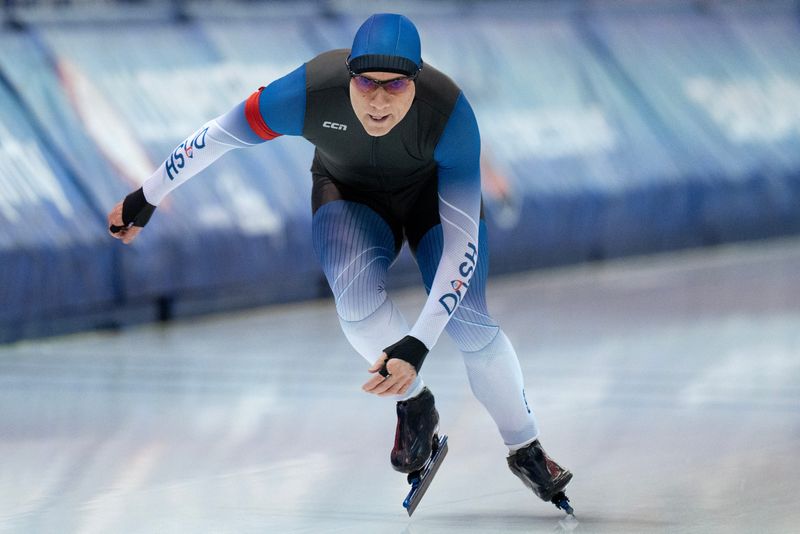
Dan Carney has been the proverbial kid in the candy story throughout January.
Except he’s 60 years old. Not a kid. His kids are adults.

And the candy, for him, is speed skating.
The hard work is what he loves. Training on the ice with an Olympian and a handful of hopefuls after his workday is done. The 3-mile low walks through his Pewaukee neighborhood in the summertime with his tailbone practically dragging in a baseball catcher’s squat as he rotates his hips through each step. Those are his indulgences.
It’s not even really the lining up, hearing the gun and taking flight that drives Carney. It’s getting there, it’s being pushed by teenaged teammates, it’s competing with his yesterday self, with his last year self and his decade ago self. That is his sweet reward.
“The decision to how you want to treat your body and how you want to live your life is yours,” Carney said. “So it’s just a decision.
“When I was 50, I was 25 pounds overweight, drank a lot, wasn’t proud of my life, and I found this sport. You’ve got to wear a skin suit, so I’m like, this has gotta change.”
And so it did.
Ten years later, Carney was wearing his skin suit with pride at the U.S. Olympic trials at the Pettit National Ice Center, telling a national USA Network television audience the 27-second version of his story. It’s a story that includes national age-group records, world championships and the crowning achievement – his Olympics – an opportunity to compete at the trials on his home ice.
“Man, I wish some of our younger guys were in love with the sport the way he is,” said Dave Cruikshank, the four-time Olympian who has coached Carney for years.
“He just naturally is an intense guy and a disciplined guy, and he has the passion for the sport. So when you add that and then strength in there, it’s kind of the perfect storm of a guy who can skate very, very well.”
The thing to know about Carney is there’s no halfway with him.
A player in the inaugural season of the Waukesha Youth Hockey Association in the mid-1970s, Carney played through his youth. Then he dropped hockey altogether after graduating from Brookfield East High School because he desperately wanted to be in a band. Then he got back into hockey via coaching his older son, and he returned to playing, not in one men’s league but three.
When Carney wearied of hockey he grew intrigued by speed skating, found a skater his age on a results webpage – another man who’d come from a hockey background – and connected via email to pepper him with questions on how to get started.
“It helps if you get into this sport and you’re good at it right away,” said Carney, whose speed remained as his hockey skills had diminished.
“Not great, far from great, but I was good enough, and I started looking at my position in the world. And I mean, I was top-10 almost immediately.”
Speed skating is a small world, but top-10 is far from nothing. It’s a heck of a baseline.
A decade later Carney has won a master’s world sprint championship, holds age-group world records in the 500 and 1,000 meters, has a speed skating video podcast and qualified for the trials.
The skaters who precede Carney on the list of age-group bests for the 500 are Marc Pelchat (age 55 level) and KC Boutiette (ages 45 and 50), both of whom competed in multiple Olympics.
At the Pettit, Carney was the oldest competitor. He missed breaking his personal best in the 500 meters – a 38.98 set in Calgary last year that made him eligible for the trials – and finished last both times it was run. But he could not have found the experience more enjoyable or rewarding.
“I got to just be here and experience it, and all my teammates are in the show and it kind of sucks when I don’t get to join them,” Carney said of DASH teammates who include such skaters as Blair Cruikshank, a 2030 Team USA hopeful, and Henry Schlichting, the 16-year-old Arrowhead High School junior who also made his trials debut.
“Honestly, I don’t even really like racing,” Carney said. “Racing, I get super nervy. … I want to do well, but I’d rather just go do a Monday night session and skate with my team and be challenged by those guys, because they’re all faster than me. And then I turn around and I coach my nine skaters right after that. I cherish every second of that.”
That’s right. Carney also coaches. Athletes in his Masters Ice Coaching Academy range from 39-74, and a handful will compete Jan. 24-25 in the Master Sprint Games in Innsbruck, Austria.
Carney didn’t necessarily set out to start coaching, but he saw a void. Most programs were focused on younger children just learning to skate and trying to stay safe as high-performance athletes whizzed around them. Few opportunities existed for skaters such as himself.
“I started coaching a couple of them ad hoc at the end of last year, and then I’m like, you know what, I’m going to start a team, and I put the word out: Who’s interested? And they were … wildly interested,” Carney said. “So we trained all summer together, and then we got on the ice together this year, and it’s been going excellent.”
After Innsbruck, Carney will coach all 14 American skaters during the Masters’ International Speed Skating Allround Games, Jan. 30-Feb. 1 in Inzell, Germany.
“I’ve made a lot of friends,” Carney said. “So there’s a handful of European skaters that I’ll probably end up coaching as well. I’m already on the backstretch. I might as well get out there with my lap board and yell at you.”
Cruikshank, who started skating as a child in Northbrook, Illinois, has been nothing but impressed during his experience coaching a skater four years older than himself. It’s a different exercise training someone who has worked for decades in manufacturing automation – “I sell robots,” Carney said – vs. with a budding teen worried about his next history exam or a 20-something for whom the Olympics are within reach.
“When Dan first came in and we started working together, more was better for him, and slowly, over time, he bought into the theory that less is better for him and rest is a part of training as much as working out,” said Cruikshank, DASH’s founder. “He can’t work out like a 20-year-old can work out because he can’t recover [the same way].
“That takes discipline and older athletes have more of that, and they have more perspective on life, and they have a different perspective on the journey versus the result, and they can understand bad races better than the younger kids that just want to keep getting better all the time. They’re immensely different.”
The discipline, effort and perspective continue to pay off. Although Carney fell short of his personal best at the trials, he will have more chances in high-level competitions within weeks. Then in a couple of years he can set his sights on records in the 65-year-old age bracket.
“It’s really ridiculous because I got into the sport when I turned 50 and I was pretty fast right out of the gate and I’ve just steadily been getting better,” Carney said. “My skating has probably never been better than it is right now.”
This article originally appeared on Milwaukee Journal Sentinel: How an overweight middle-aged Pewaukee man transformed into a world-class speed skater
Reporting by Dave Kallmann, Milwaukee Journal Sentinel / Milwaukee Journal Sentinel
USA TODAY Network via Reuters Connect