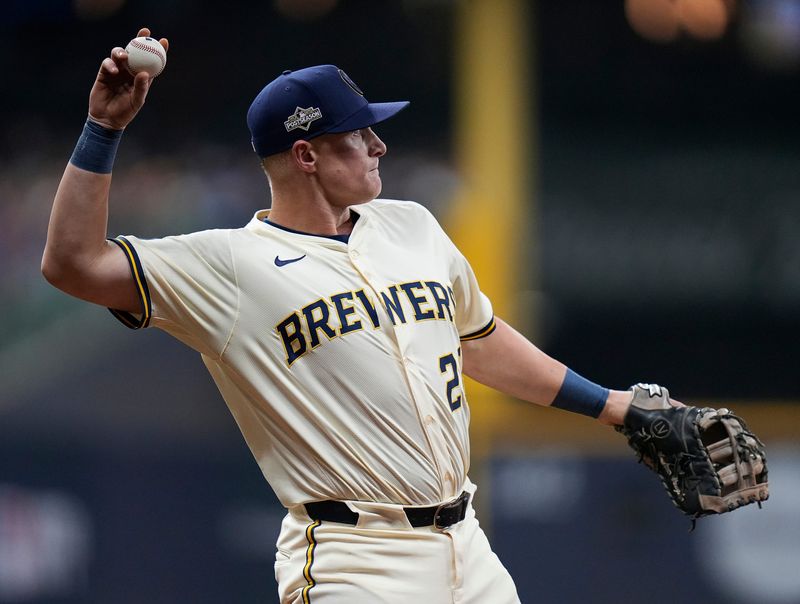
PHOENIX – The secret to the Milwaukee Brewers’ defensive edge is both simple and complex.
The team’s internal, proprietary defensive model is significantly more sophisticated than public metrics, highlighting many of the smaller nuances for a position such as first base. Want the club’s secrets? You may be better off with a crowbar at Area 51.

That’s the complex part.
The simple part is of equal – or even greater – importance. Many of the edges the Brewers gain with their defense come from the application of those subtle details on the field, achieved through simple yet disciplined work and coaching.
See, for instance, Andrew Vaughn.
Andrew Vaughn took major strides on defense with the Brewers
So much of the focus on Vaughn’s midseason surge with the Brewers last summer was on his offense – and rightfully so. Vaughn went from so bad with the stick that the White Sox didn’t want him to a key cog in Milwaukee’s offense, slashing .308/.375/.493 in 64 games after joining his new team.
But his defensive improvement might have been even more jarring.
Throughout his career, Vaughn had at least been seen as a hitter with potential. He won the Golden Spikes Award in college, was a top prospect coming up through Chicago’s system and hit 21 homers as recently as 2023.
Vaughn was never a good defender. Ever.
In his five years with the White Sox, Vaughn was worth minus-33 defensive runs saved and minus-46 outs above average.
“He didn’t have much of a routine,” said Brewers third base coach and infield guru Matt Erickson.
But with Milwaukee, Vaughn was suddenly solid defensively. His plus-4 outs above average with the Brewers would have placed him seventh among 40 qualified first basemen – and that was in less than three months.
Did Vaughn feel like he improved with the glove?
“I do,” he said. “There were some things we worked on, pre-pitch stuff to get myself in a better spot to fire on the ball. Those corner spots, you have to be good at controlling your area.”
For someone who never had a set routine for defensive work as of nine months ago when he was traded for Aaron Civale, Vaughn speaks of that side of the ball with some of his Cal-Berkeley pedigree.
This, in a nutshell, is what happens when an infielder has baseball aptitude and joins the Brewers.
“It’s buy-in,” Vaughn said. “Trying to get the best out of each player. Coming into this clubhouse and knowing this group that was here, I just wanted to buy in and be a part of it.”
How Andrew Vaughn improved his defense
The Brewers didn’t reinvent the wheel with Vaughn. The first nugget they gave him came from Andrew Romine, the organization’s infield coordinator and former teammate of Vaughn’s in spring training of 2020.
Vaughn’s first step numbers with the White Sox were, frankly, terrible. Romine noticed on video that his hop was too high and not optimally timed, causing his reactions to be slower when the ball was hit.
“I felt like with the high hop I had, I wasn’t timing up the ball going into the hitting zone very well,” Vaughn said. “I feel like being grounded, I’m able to get a better reaction. It’s being quieter with the feet, not having such a big hop. Now it’s about being in my legs and being able to move laterally faster.”
Vaughn first worked on this at Class AAA Nashville, where he spent roughly a month before the call came to join the Brewers after Rhys Hoskins suffered a thumb injury in early July. When he arrived in Milwaukee on July 7, Erickson’s message was simple.
“I’m like, ‘Hey, you know I don’t care what your defensive ceiling is physically. You just need to care,’” Erickson recalled.
Vaughn looked around, a big, sly grin on his face.
“He goes, ‘I love hitting here,’” Erickson said. “That was his answer. I’m like, ‘You son a [gun].’ I knew we were going to get along just fine.”
Erickson kept his work with Vaughn simple. They did drills on the dirt warning track near the dugout just about daily and stressed the importance of pre-pitch engagement and reactions. Vaughn even started to wear the PitchCom, which is limited to being used by five defensive players at a time, to aid with his anticipation.
“I think his footwork around the bag is pretty legit,” Erickson said. “He did a very decent job for us. It sounds simple, but when you put them in the right spot, the ball doesn’t pop out with him. He had some nice picks. The receiving tool for a first baseman is often overlooked until it isn’t. It’s a lot like the mistakes of a third base coach.
“He was very unnoticeable, which is a good thing.”
As Erickson alluded to, the results weren’t always flashy, but if you look closely, you notice them.
On an Adrian Del Castillo lined shot to Vaughn’s right in September, he had already taken a first step and was at full extension, laying out to get a glove on the liner by the time the broadcast switched to the high home plate angle.
A Nick Mears curveball ripped by Luis Garcia Jr. featured a similar result.
When Elly De La Cruz smashed a chopper into the dirt against Abner Uribe, Vaughn made the play look far easier than it was by getting a beat on it by anticipating the Reds shortstop turning on a 3-1 sinker on the inner half.
Vaughn’s work is the embodiment of what Erickson means when he tells infielders he doesn’t care what their physical ceilings are.
“I think you do have a physical ceiling of how good your defense can be,” Erickson said. “But I spend a lot of time talking about the non-physical, the engagement part, the focus part. Who are you the 127 pitches a night the ball isn’t hit to you?”
For the Brewers, this has been a recipe for success. Just ask Vaughn.
This article originally appeared on Milwaukee Journal Sentinel: Don’t overlook this part of Andrew Vaughn’s breakout with the Brewers
Reporting by Curt Hogg, Milwaukee Journal Sentinel / Milwaukee Journal Sentinel
USA TODAY Network via Reuters Connect