The City Council is again looking at the potential reuse of treated wastewater to fulfill Corpus Christi’s water supply needs amid an indefinite shortage.
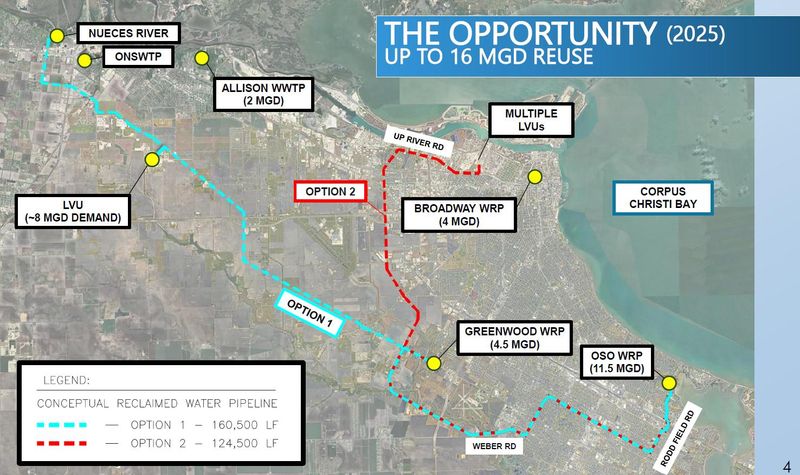
Under a new proposal, an engineering firm and a state agency are pitching to send as much as 16 million gallons of reclaimed water per day by pipeline from the Southside to either the Nueces River or, alternatively, industrialized areas populated by large-volume water users.

The proposal, presented to the City Council on Sept. 9, was led by representatives from the nonprofit Gulf Coast Water Authority — described in city documents as a political subdivision of the state — and private company Ardurra Group Inc.
Dan Leyendecker, a representative of Ardurra, described rough plans as potentially “another water tool to put in your water tool chest.”
“It’s not a silver bullet or an end-all, do-all, but it is more water … that can be utilized and not only for now, but it offers you flexibility in the future,” he said. “It’s a short-term solution and it’s also a long-term solution.”
The treated effluent, according to the presentation, may be sourced from either the Oso Wastewater Treatment Plant or the Greenwood Wastewater Treatment Plant.
Purposes of reclaimed water can be potable or nonpotable, depending on the sanitizing processes employed.
One of the two propositions would route the reclaimed water 28 miles to the Nueces River, where it would be treated again at the O.N. Stevens Water Treatment plant, officials said.
The other would be to dedicate it as a supply exclusively for industrial use. A point on a map provided by the engineering firm indicates the area of Refinery Row.
City Councilman Eric Cantu asserted that residents may not be keen on the idea of consuming treated reclaimed water, supporting instead that all the reclaimed water go to industrial operations.
“I don’t think the public (would) like to drink this water,” he said. “But I’m sure the (refineries) would love just to get it.”
Leyendecker, as well as City Councilwoman Sylvia Campos, noted that Corpus Christi is downstream from its current water sources.
“We have been drinking upstream water for I don’t know how many years already,” Campos said. “So this is going to be just as good and safe.”
Officials in the discussion suggested the project could be accomplished by what was described as a “public-public partnership” between the city and the Gulf Coast Authority.
GCA is capable of performing major tasks, said Chris Canonico, Ardurra principal — construction, design and operation — in various combinations.
The next step, according to the presentation, would be to craft a memorandum of understanding between the entities that would “refine project concept and define final scope.”
Although there are meetings pending, that could likely be put before the council relatively soon, said City Manager Peter Zanoni.
Should a preliminary agreement be reached, a subsequent development agreement could be pursued, officials have said.
It would be possible that a project could go online within 18 months to two years following sign-off on a development agreement, according to Ardurra’s presentation.
City Councilman Mark Scott, speaking with the Caller-Times on Sept. 12, said he believes that “reuse has a place in our overall water development plan.”
He cautioned, though, that there are “some competing statements” on the timeline expected to acquire the necessary permits.
“If it were me, I would use as a planning document … the longer permit estimates, and then I would work hard to reduce that timeline,” Scott said. “I think it’s important that we all default to the longer-time permit based on outside independent consultant analysis.”
MORE WATER COVERAGE
This article originally appeared on Corpus Christi Caller Times: Wastewater may be part of the solution to Corpus Christi’s drought. Here’s a new proposal.
Reporting by Kirsten Crow, Corpus Christi Caller Times / Corpus Christi Caller Times
USA TODAY Network via Reuters Connect