RUIDOSO, NM — Jesus Figueroa laments his busy summer in the high mountain village of Ruidoso.

The longtime resident is known for his dramatic breaking news videos on social media, which captured flash floods after flash floods that battered Ruidoso during the 2025 monsoon season.
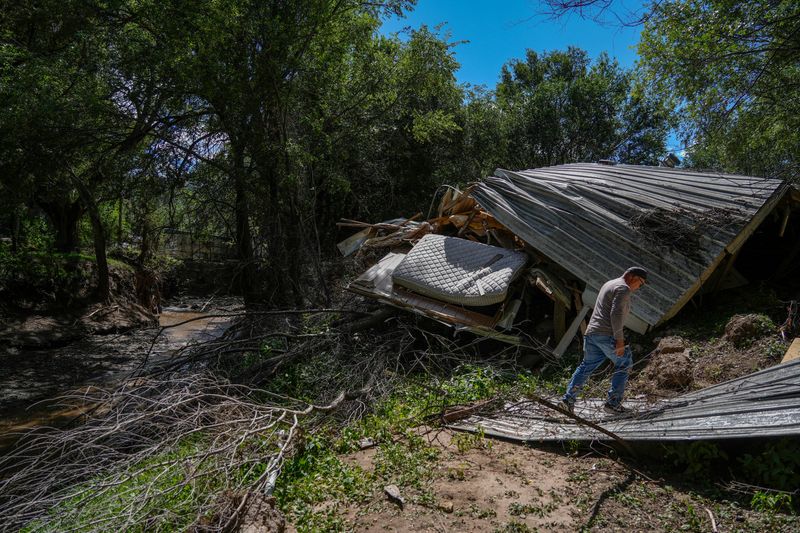
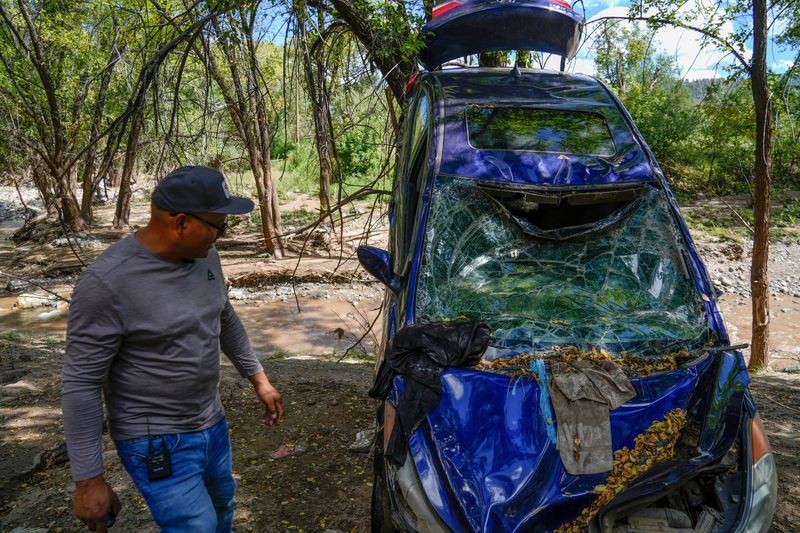
“No one expected the rain would do this much damage,” Figueroa said as he surveyed the flash flood damage last week that ravaged Ruidoso this summer. “(I’m) not seeing this river like it used to be. Back in ’98, this is where you wanted to live, but now it has changed. The river has taken its land back.”
It’s been a terrible monsoon season in this beautiful resort village, which is anchored by its nearly 8,000 residents, who swell to about 25,000 when tourists arrive to escape the West Texas summer heat.
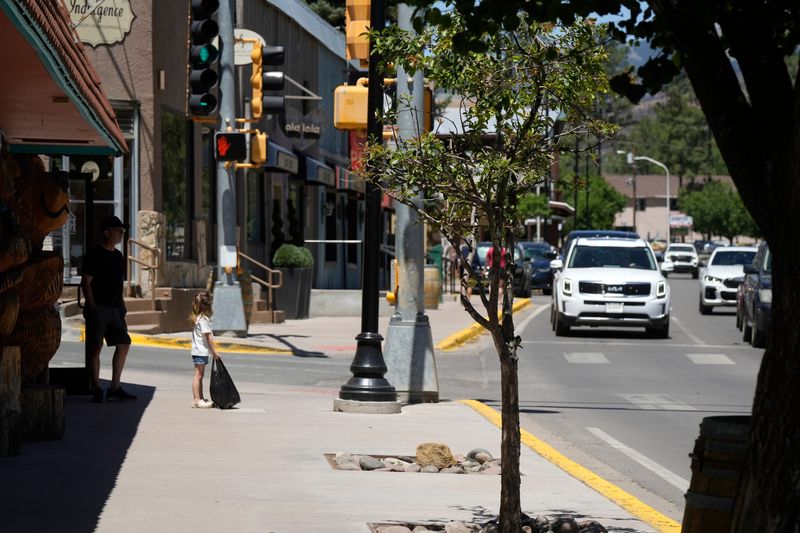
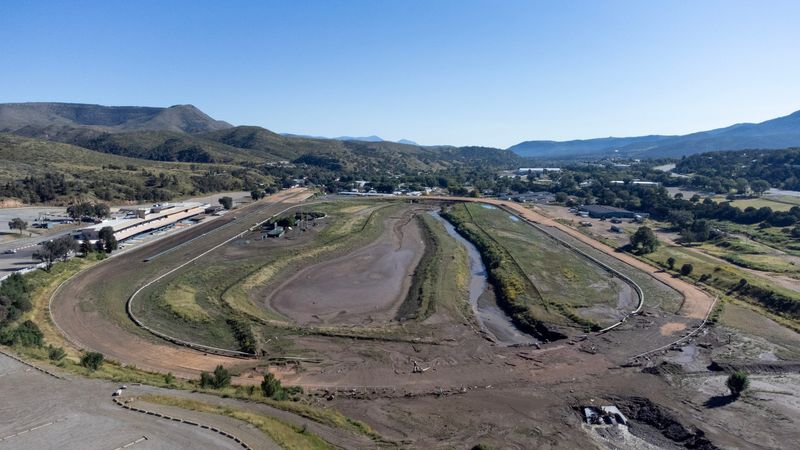
Record flash flooding — made worse by recent wildfires — claimed three lives, all but destroyed landmarks like Ruidoso Downs racetrack, turned thriving Sudderth Drive businesses into mud pits, and slowed a robust housing market to a crawl.
The record flash floods were as much about survival as it was about difficult lessons learned.
As the 2025 monsoon season comes to an end on Tuesday, Sept. 30, residents continue to keep a wary eye on the heavens.
A Fort Bliss family camping along the Ruidoso River was among those devastated by flood waters. Charlotte, 4, and Sebastian Trotter, 7, were killed by flood waters in early July that ravaged an RV park. Benjamin Timothy Feagin, 64, also died in the flooding.
Data from the office of New Mexico Gov. Michelle Lujan Grisham estimated that 200 homes were lost. Lujan requested approximately $100 million from the federal government for reconstruction and flood mitigation efforts, but received less.
Kerry Gladden, a spokesperson for the village of Ruidoso, noted the state awarded it $44 million for approved Federal Emergency Management Administration projects. The village has been approved for 20 out of 29 projects, and several of these projects have been assigned to the engineering department for design. This process can take three to nine months for design, and then the design must be approved by FEMA before construction can occur.
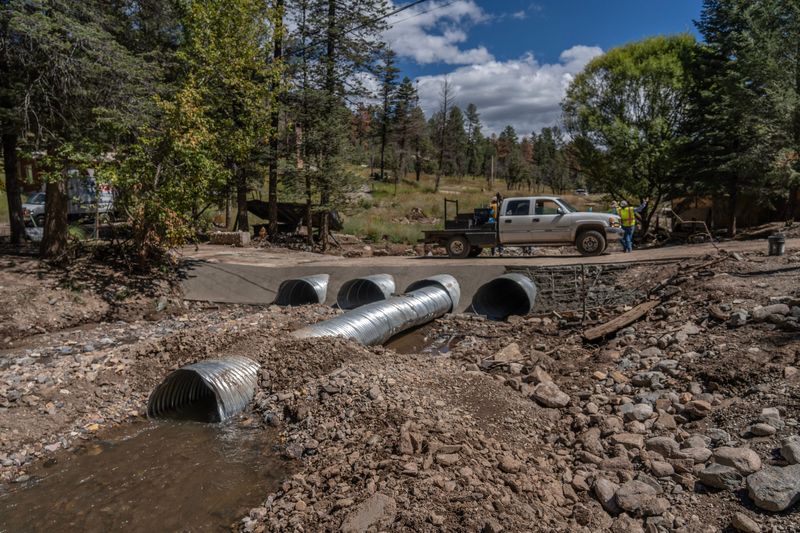
After major storms, Ruidoso village crews worked quickly to remove debris from main streets.
“Streets are clear and right-of-way debris is picked up,” Gladden said. “FEMA is working on approving Private Property Debris Removal and Business Property Debris removal programs. This should be approved by FEMA in the next few weeks.”
Michael Martinez, deputy village manager, said there is a bevy of projects on the drawing board.
“There have been several mitigation projects mentioned and discussed, but they first have to be approved by FEMA before any design, work, or construction can take place,” Martinez said. “Projects include diversion and silt ponds, hardening of the entire waterway, buyout and mitigation programs for properties in the floodway, partnerships with Mescalero and National Forest for debris catchment projects such as geobrugs and cross-jurisdictional flood detention.”
Martinez explained that floodway maps were adopted in 2014 after FEMA mapping. After last year’s burn scar flooding, Ruidoso conducted hydronic and hydrology studies, and proceeded to do a floodplain study to better understand new and significant flooding that would occur for the next five to 10 years.
As a result, new floodplain maps were adopted by the village council and shared with the community through public forums and educational information.
Ruidoso officials then looked to wildfire hazards in neighborhoods.
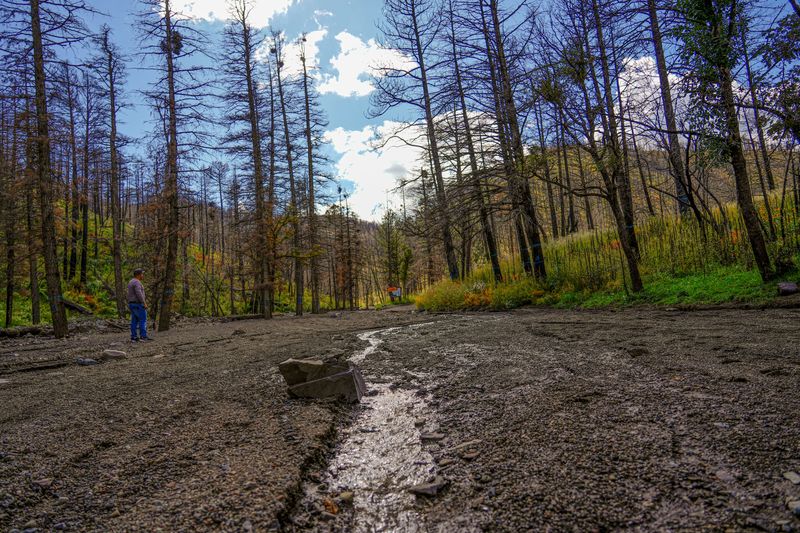
“The village of Ruidoso has a thinning ordinance that requires property owners to be in compliance to help the hardening process and reduce the possibility of forest fires,” Martinez said. “The burn scars directly contribute to the flash flooding. The rainfall is similar to monsoon rates from years past, however, due to the burn scars, not allowing absorption of water and creating significant flows.”
Martinez explained mitigation efforts will continue for the next several years during the monsoon season that starts June 15 and ends Sept. 30.
‘We knew it was going to be bad’
Figueroa is no stranger to the damage torrential downpours can cause in the mountain village.
Aside from becoming a widely followed source on social media for flood updates, Figueroa works as a tree removal professional specializing in clearing dead or potentially fire-spreading trees from private residential structures. Years of knowing the terrain have made him keenly aware of Ruidoso’s most vulnerable areas for fire and flooding incidents.
“The first couple of storms, we knew it was going to be bad,” Figueroa said. “When we got the first two inches of rain, things got out of control and the ones who had a house along the river, they knew it was going to get destroyed.”
Flooding on Sept. 9 was exacerbated by another on Sept. 18, where, according to the National Weather Service, the river rose 12.5 feet, sparking a new round of evacuations and rescues by village first responders.
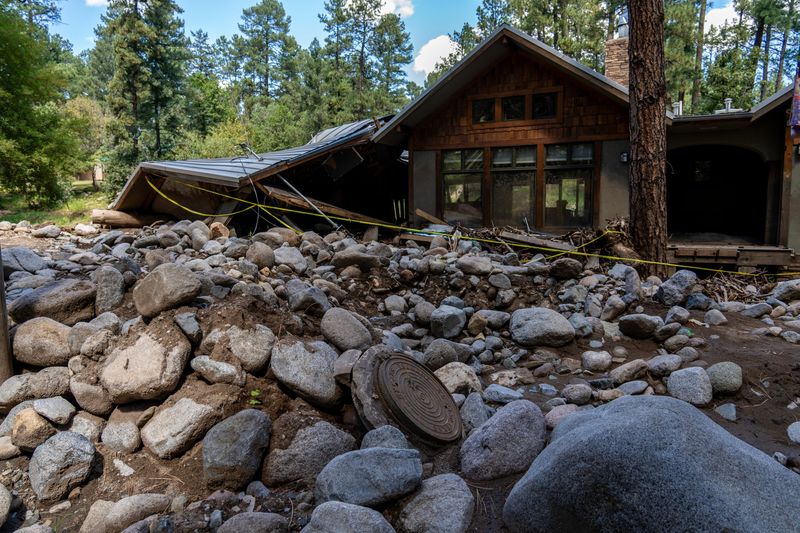
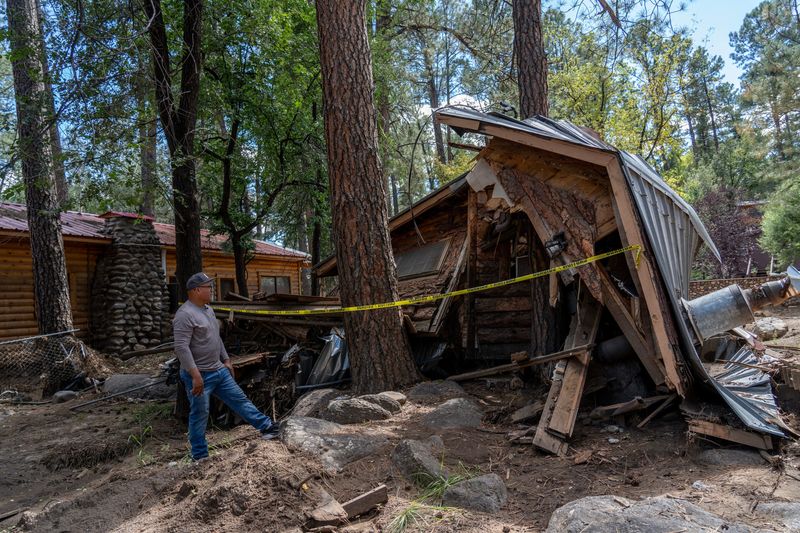
Every step into the aftermath of flooding brings familiar footage of a house once alive with the sound of tenants, now eerily docile and empty, as mud residue cakes its walls and destroys once-pristine hardwood floors.
“Do Not Cross” police tape dances in the wind as it attempts to cover a front door in vain.
“First, the fires came and then came the flood, and it was sad to lose all those homes. Those couple of inches on Sept. 9 made about 20 feet of water come down from the upper canyon. Once it hit the racetrack, it was just done when it damaged it and created the lake in the middle of it,” Figueroa said.
He also shares videos of recovery efforts, such as work crews working on roadways, horses in familiar pastures, and businesses reopening to entice customers.
Summer has yielded to fall, yet the question remains: What can be expected in the next wildfire and monsoon seasons? For residents of Ruidoso, it is a topic that never dissipates, but quietly fades during fall and winter.
Why was Ruidoso flooding so severe in 2025?
David Dubois, a climatologist based at New Mexico State University, explained the science behind the active monsoon season and its devastating flooding in the Sacramento Mountains, a mountain range in the south-central part of New Mexico.
“The high levels of precipitation are creating issues with runoff with eight to 10 inches of rain above average in the last 60 days,” Dubois said in an interview with the El Paso Times on Aug. 19. “The traditional monsoon that starts on June 15 through now is normally 8.63 inches of rain. Wildfires modify the soil so less water goes into the ground. In severe cases, the depth of the water can rise deeper than you are in a matter of five minutes.”
The roadways in Ruidoso saw firsthand how that can happen, with the deluge sweeping away mobile homes, vehicles and debris. The aftermath was an amalgam of mud, personal property, and foliage dumped wherever they managed to stop.
“The force of the water is very strong as well and it’s an evolving problem we’re having. It’s not just water running off, but anything it can carry,” Dubois said.
While there are limited ways to address the flooding and wildfire hazards, Dubois noted the public should not take warnings lightly. Flash flood, severe thunderstorm and even severe dry conditions are part of the vernacular of living in the mountains of New Mexico.
What starts as a minor concern can quickly evolve into a village-altering event.
“This can be the new normal when you have those two conditions of rain and land recovering from wildfires. The cycle of warming in the region creates fuel for fires next season, whether it be from a lightning or human start,” Dubois said.
David Craft, a meteorologist for the National Weather Service in the Albuquerque office, said there have been an estimated 199 flash floods from June 1 to Sept. 18 in the Ruidoso area. That is the highest on record in the region.
NWS data indicated that the Ruidoso River reached a height of more than 20 feet, surpassing the previous record of 15.86 feet. The now second-highest crest was recorded in 2024. Previous historic crests for the river are over 12 feet in 2008, 9.68 feet in 1984, and 8.63 feet in 1978.
Ruidoso flooding’s impact on local business, real estate
Gavin Bigger, a real estate agent who works in Ruidoso and Lincoln County, cited the recent fires and severe flooding as the cause for a dip in property sales, as well as some homeowners leaving the area. Yet despite the temporary downturn, he says an uptick is already underway.
Bigger was like many in the flooding aftermath, trudging through the mud and flowing rainwater, helping neighbors move items from homes that once stood. Selling property in a pristine mountain locale took on a different meaning after such a tumultuous monsoon season.
“When we had the fire and the subsequent flooding, all our business stopped because people stopped coming to our area at our request,” Bigger said. “For the last two summer seasons, we’ve seen more listed properties due to the emergency activities going on. That’s led to a larger inventory than what we’re used to having.”
Overall price drops in the Ruidoso market have been seen for more than a year. While lower prices usually mean a boon for buyers, sellers are feeling the crunch.
Bigger said that in the case of purchasing or selling a home, a certified inspector from Ruidoso visits the property to assess which trees need to be removed to better protect one’s home. The same process is applied to water runoff by planting new vegetation or utilizing existing foliage.
New and existing homeowners have also dealt with issues insuring their properties because of wildfires and flash flooding. Bigger underscores he has seen fewer companies willing to write a policy for some properties in Ruidoso. New insurance vendors to the market are alleviating those woes.
Deborah Douds, executive director of the Ruidoso Valley Chamber of Commerce, stressed that Ruidoso is open for business and potential homeowners.
The chamber of commerce office is within walking distance of the site of the deadly floods and a Mexican restaurant surrounded by flood barricades.
“The biggest thing is to let the public know that Ruidoso is still a safe place to visit and we’ve been open for business even with the flooding. It’s essentially localized along the Ruidoso River and all our roads are accessible,” Douds said.
Ruidoso Downs recovery set to start
Rick Baugh, the general manager of the race track, announced good news in a video that debris removal and rebuilding efforts of the tourist attraction can get underway.
“We take the first step to begin construction and we should get our final engineer drawing from the Army Corps of Engineers and Department of Homeland Security by the end of the week.” Baugh said in a Facebook video on Sept. 24. “We’ll keep doing the updates periodically.”
State agencies in New Mexico are also involved in the cleanup and reconstruction efforts.
The documents from federal departments open the door to debris removal from the location following the flash floods.
In 2024, the race track was shut down for the first time by flood waters. A July 2025 storm ravaged the Ruidoso Downs Race Track again. Flood waters wiped out the track’s first attempt at rebuilding and mitigating flooding following the wildfires.
The 2025 All American Futurity was held on Sept. 1, at the Downs of Albuquerque. It was the second straight year the prestigious $3 million quarterhorse race could not be contested at Ruidoso Downs Race Track and Casino, and the summer racing meet was canceled.
“We might not have the racetrack,” Ruidoso Mayor Lynn Crawford warned in July. “That’s something that people need to understand, that racetrack, after being here 77 years, it looks like it’s done.”
Baugh and Lujan-Grisham have publicly vowed not to let the race track fold.
“We’re going to do everything in our power to make things right in Ruidoso,” Lujan-Grisham said in an Aug. 7 interview at the state capital.
Kristian Jaime is the Top Story Reporter for the El Paso Times and is reachable at Kjaime@elpasotimes.com. Visual journalist Omar Ornelas contributed to the reporting of this story.
This article originally appeared on El Paso Times: Surviving the monsoon season: Ruidoso left battered by severe, record flash flooding
Reporting by Kristian Jaime, El Paso Times / El Paso Times
USA TODAY Network via Reuters Connect