As the City Council considers its next steps in the potential removal hearing of Mayor Paulette Guajardo, it may be embarking on a process that has likely transpired only twice in Corpus Christi’s history — and one that isn’t available under charter in all cities.
Should the council ultimately move forward with a requested removal hearing, two cases in the 1980s may lend insight into how a hearing was managed in the past.

Starting the process of a removal hearing can take two routes: one, by submission of a petition signed by at least five registered voters or, two, by the council’s own initiative.
Like Guajardo’s case, the two previously held removal hearings — one of a council member in 1981 and another of a council member in 1987 — were launched through petitions.
The 1981 hearing
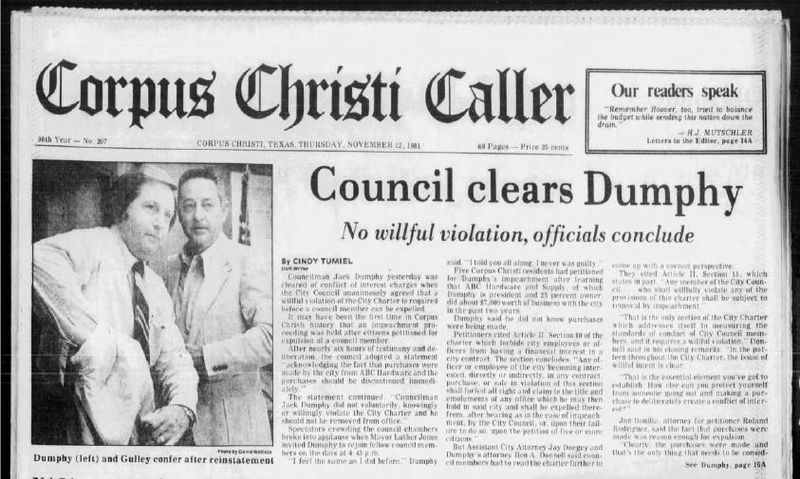
Jack Dumphy, who served on the City Council from 1979 through 1983, is believed to be the first council member to face a removal hearing.
Although the council eventually sided with Dumphy, he became a subject of the process after discovery that the city had made about $7,000 in purchases from 1979 to 1981 from a hardware store in which he served as president and was a 25% shareholder, previous reporting states.
The charter prohibited “any office holder or employee from having direct or indirect interest in any contract or sales to the city,” according to the articles.
He was unaware of the purchases and no contract had come before the council for deliberation during his tenure, Dumphy had said, stating that a 50% shareholder managed daily operations.
A petition bearing five signatures, submitted after the discussion became public, demanded Dumphy be removed based on what was alleged as a “flagrant conflict of interest.”
Dumphy’s attorney told reporters the councilman was innocent of the allegations because he did not know about the purchases, according to a Corpus Christi Times article published Nov. 10, 1981.
Petitioners, meanwhile, disputed that awareness of a conflict of interest was not the issue, one stating that the “charter does not distinguish between ignorance of the law and knowledge of it.”
As part of decision-making on procedures, the council voted that the findings of an investigation by the city attorney’s office, including records and conversations, would be included among items of evidence, and that hearsay would also be allowed if the evidence could “be substantiated according to regular court room regulations,” articles state.
Each party would be allowed legal representation — Dumphy, the city and petitioners — as well as the ability “to call and question witnesses, present evidence, and make opening and closing statements,” according to a Nov. 10, 1981, article.
Petitioners would themselves be subpoenaed and compelled to testify, according to a Nov. 5, 1981, story, but attempts to subpoena some of the petitioners were unsuccessful.
Called as the first witness, Dumphy said he had “received neither a salary as president nor any dividend checks for the 25 percent share he holds in the business,” states a Nov. 11, 1981, article.
The deciding factor of the hearing was knowledge and intent, Dumphy’s attorney asserted.
After a six-hour procedure, which included deliberations, the council voted unanimously “that a willful violation of the City Charter is required before a council member can be expelled,” previous reporting shows.
“Councilman Jack Dumphy did not voluntarily, knowingly or willingly violate the City Charter and he should not be removed from office,” a statement is quoted.
One of the petitioners, Roland Rodriguez, is cited in the articles, stating “he was satisfied with the council decision, adding he felt ‘the people of Corpus Christi won,’” a Nov. 12, 1981, article states.
“Any day a group of citizens such as ourselves are able to petition the City Council and exercise our constitutional rights, I believe the community is being served,” he is quoted.
Dumphy died in 1996, according to an obituary printed in the Caller-Times.
The 1987 hearing
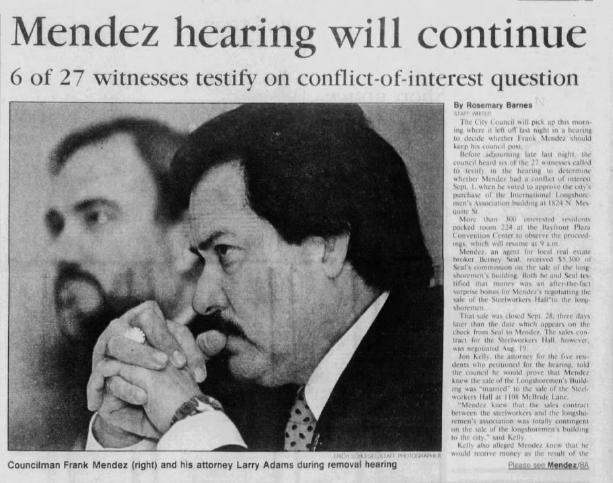
The second hearing before the council, held in 1987, led to the removal of then-City Councilman Frank Mendez, after allegations that he had violated conflict of interest provisions related to a property sale.
He had served on the council since 1983.
According to archive reports, Mendez had voted to support the purchase of a property off North Mesquite Street.
The transaction had been handled by a local real estate broker whom Mendez had worked for as an independent real estate agent, the article states.
Mendez is quoted in an Oct. 21, 1987, article as saying he hadn’t abstained from the vote because he had not been a part of negotiations for the property and that the $5,300 bonus didn’t pose a conflict of interest because it was received after the fact.
A petition signed by five residents was submitted within days of city officials opening an investigation into the matter. The petition alleged that Mendez had “accepted profits from a real estate transaction which was made possible by his vote on the council,” according to an Oct. 27, 1987, article.
Under procedures adopted by the council, Mayor Betty Turner would be who decided on the admissibility of evidence, according to an Oct. 31, 1987, story.
Council members, however, could still “question particular evidence” with a majority vote.
Evidence collected by petitioners in the case included “a list of calls Mendez has made on his city-funded car telephone” as well as appointment calendars of the city manager and his administrative assistant, an article shows.
Subpoenas were issued for the petitioners; however, they were only required to disclose their names and addresses, and affirm they had signed the petition, an effort to “protect the petitioners from harassment,” according to a Nov. 25, 1987, article.
The hearing was held at the Bayfront Plaza Convention Center, now the Hilliard Center, with more than two dozen witnesses expected to testify and about 300 residents in attendance.
Both Mendez and the real estate broker said that the bonus was related to Mendez’s negotiation of a separate sale, and unrelated to the North Mesquite Street property.
In the hearing, a petitioners’ attorney suggested the two property sales were “married,” an assertion the real estate broker denied.
As reported in the Nov. 25, 1987, edition of the Caller-Times, Mendez’s attorney said the councilman’s vote was a mistake of judgment.
“I do deny that that vote had anything to do with his influence to get this sale,” the attorney is quoted. “It was a mistake, but it was not willful.”
Mendez similarly said he had made “an error in judgement,” according to a Nov. 26, 1987, article.
“This has been the worst period in my entire life,” he is quoted in the story. “My family and I have been subjected to unfair treatment.”
The proceedings, extended over two days, led up to a 5-3 vote to oust Mendez.
Mendez shortly after pursued a lawsuit, but later dropped it, according to previous reporting, and the council ultimately appointed Frank Schwing Jr. to serve the 14 months of Mendez’s remaining term.
Mendez ran for county commissioner in spring of 1988 but lost in the primary election, archives show.
The Caller-Times attempted to reach Mendez by phone, but there was no immediate response to voicemails left on a listed number.
City charters
A Caller-Times review of several charters of larger cities in Texas show citizen-submitted petitions as early initiations of recall elections, not removal of council members via hearing, and most did not appear to include removal proceedings similar to Corpus Christi’s at all.
Houston’s City Charter describes a removal provision, but under a different process.
The document says potential removal of the mayor — as opposed to any council member, as is allowed under Corpus Christi’s charter — could be based on alleged “misconduct, inability or willful neglect in the performance of the duties of his office.”
The allegations prompting the action are similar to Corpus Christi’s.
Removal of the mayor in Houston, under its charter, could be accomplished by a two-thirds vote on the council.
Removal of a council member in Corpus Christi requires a majority vote, with no participation by the council member under scrutiny.
The provisions on removal proceedings in Corpus Christi’s charter were carried over from the 1950s, attorney John Bell told the City Council on March 24.
Some Corpus Christi City Council members have suggested the charter be amended to require more than five signatures to file a petition for removal, noting that the number of signatures to get on the ballot for City Council — absent paying a $100 fee — is higher.
Under the existing charter, there is a more complicated formula.
The signers of a petition to place a candidate on the ballot must be eligible to vote in a specific election based on residency, with the number of signatures required being the greater of either 25 or “one-half of one percent of the total vote received in the territory from which the office is elected by all candidates for mayor in the most recent mayoral regular election,” according to the charter.
The documents show that separately, the percentage of voters required for a petition for a recall election of a council member is 10% of those eligible to cast their ballots in the election. For example, for the mayor and at-large council members, that would be 10% of voters citywide, while for a district it would be limited to 10% of voters in that district.
That would amount to more than 19,000 signatures for a recall election for the mayor, based on county records of the 2024 election.
Guajardo garnered about 46,700 votes in the 2024 election and about 14,200 in the subsequent runoff, the records show.
Any charter amendments — such as those that would increase the number of necessary signatures to submit a removal petition — as proposed by some council members would need to be approved by voters.
Kirsten Crow covers city government and water news. Have a story idea? Contact her at kirsten.crow@caller.com.
Consider supporting local journalism with a subscription to the Caller-Times.
This article originally appeared on Corpus Christi Caller Times: Have Corpus Christi council members faced removal hearings before?
Reporting by Kirsten Crow, Corpus Christi Caller Times / Corpus Christi Caller Times
USA TODAY Network via Reuters Connect