Knocking on the door to inform the family of a soldier’s death is a solemn duty.
Today, a U.S. military officer and chaplain deliver the awful news with dignity in a timely manner.

But the limits of communication and different sensibilities in the past made it tough on families for much of the nation’s first 200 years.
“The practice of in-person Next of Kin (NOK) notification is actually a relatively recent development,” Chaplain Justin Daniel writes in “Honor the Fallen: A History.”
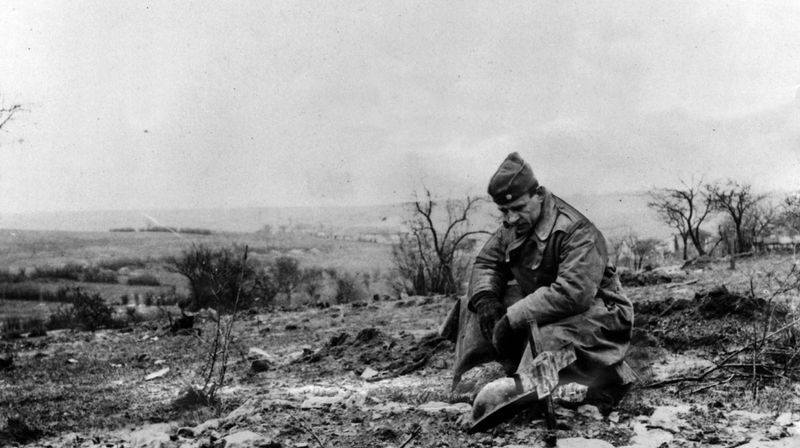
Identifying fallen soldiers was a challenge in early wars. During the American Revolution, pragmatism ruled the day. Dead soldiers were stripped of their uniforms and buried in mass graves in swamps and ditches. Then the troops marched on.
“What are you going to do with that uniform? The answer is: you wear it,” said historian Robert Selig. “…There’s no reason, at least as far as the 18th century is concerned, why you should bury somebody with a perfectly good pair of shoes.”
In the Civil War, the quartermaster general was charged with keeping accurate records of deceased soldiers and their place of burial.
The Enquirer regularly published names of dead and wounded, but only officers. Many enlisted men, fearing they would not be identified if they were killed, wrote their names in their clothes or wore engraved metal tags – the first dog tags.
More than 40% of dead Union Army soldiers went unidentified and were buried near battlefields. Many of those burial sites became national cemeteries, such as the one at Gettysburg where President Abraham Lincoln gave an address at the dedication.
Some officers made it home for burial.
Gen. William Haines Lytle of Cincinnati was killed at the Battle of Chickamauga on Sept. 20, 1863. The Cincinnati Gazette war correspondent’s reports from the scene, sent by letter, were published five days later. By then, telegraphic dispatches had brought news of Lytle’s death.
Weeks later, The Enquirer wrote that Lytle’s remains had been buried by Confederate troops, but were recovered under a flag of truce. His body was transported to Cincinnati, then reinterred in Spring Grove Cemetery, one of 41 Civil War generals buried there.
During the Spanish-American War in 1898, the War Department received so many inquiries from parents about their sons they began sending a list of the dead by cable – the beginning of notifying next of kin.
The Graves Registration Service, or GRS, was created in 1917 to track burials during World War I. Combat units in France buried the dead as soon as possible near a battle site. The GRS then removed the bodies and shipped them back to the U.S.
Many, though, remained overseas. Lt. Robert E. Bentley of Clifton, killed in action in Cierges, France, in 1918, is buried in the Meuse-Argonne American Cemetery in France.
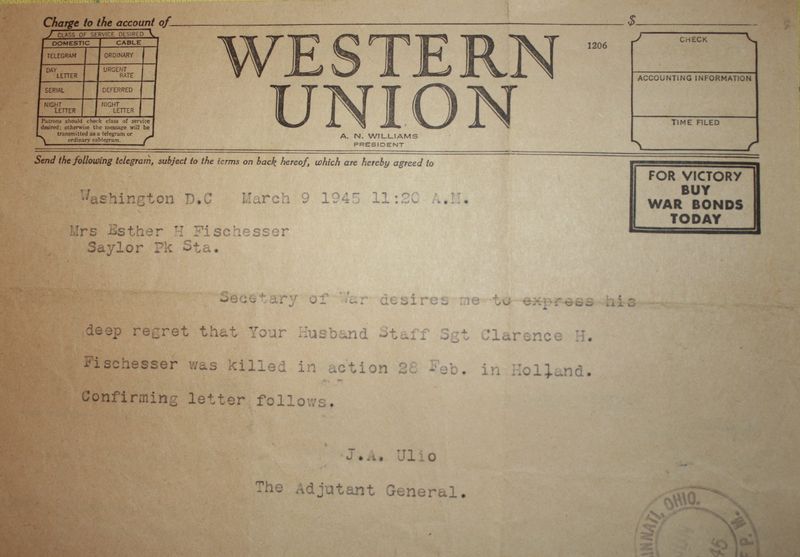
Technology greatly sped up next of kin notification during World War II. Information from casualty reports was input on IBM punch cards that were read by mobile Machine Records Units. The cards were transmitted to the Adjutant General and a telegram was sent to the next of kin. Nearly 7,000 families a day could be notified that way.
The War Department sent telegrams by Western Union to inform families a loved one was killed in action or missing. With limits to the number of words, the military conveyed the devastating news in the concise phrase, “We regret to inform you…”
Families watched with dread as the Western Union delivery boy bicycled through the neighborhood, fearing he’d stop at their house.
The modern notification process took shape during the more sensitive Vietnam era.
In 1965, Army wife Julia Moore complained to the military that death notice telegrams were too impersonal. She personally delivered notifications to wives of deceased soldiers at Fort Benning, Georgia. Her example became the official practice still used today.
This article originally appeared on Cincinnati Enquirer: How notifying next of kin has drastically changed in the miltary
Reporting by Jeff Suess, Cincinnati Enquirer / Cincinnati Enquirer
USA TODAY Network via Reuters Connect