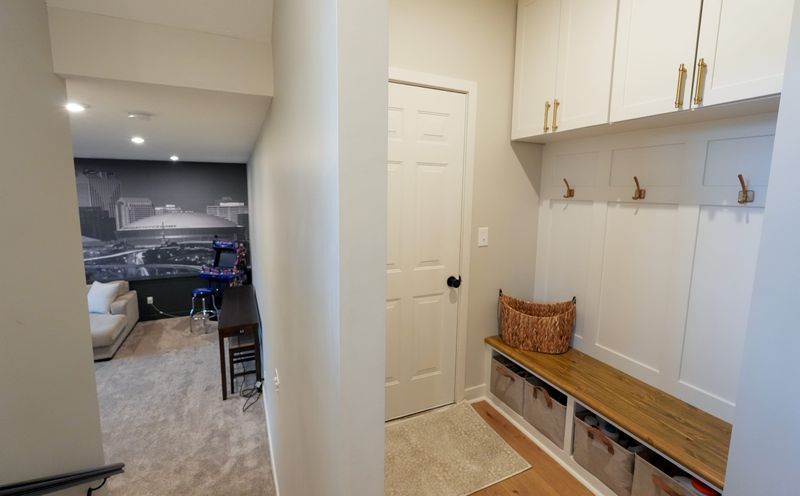
At Farm Science Review last week, I visited with many attendees at the Universal Design display. This has been in the McCormick Building for several years, but it was my first time leading parts of the educational tour.
According to Rosemary Rosetti, owner of the Universal Design Living Laboratory, “Universal design is a framework for the design of living and working spaces and products, benefiting the widest possible range of people in the widest range of situations without special or separate design.”

Our Ohio State University Universal Design demonstration facility has a mudroom, laundry room, bedroom, bathroom and kitchen featuring different options to consider in universal design. The idea is if an individual or family might be renovating a part of their home, or building a new home, they would consider design elements that make everyday tasks easier and safer for everyone in the space. Here are a few of the considerations we talked about with the attendees.
Mudroom: For farm families, it can be very helpful to have a space upon entry to the home to remove dirty clothes and be able to shower before entering the main living space of the home. This is especially important when farmers have been handling chemicals and pesticides.
Laundry room: In this space, there is a display featuring different sizes and shapes of cabinet door pulls. Grip, hand strength and dexterity can diminish with age or be weakened with a stroke. Small knobs on cabinet doors, as well as no pulls at all, can make it a challenge to open the doors. Larger pulls and D-shaped pulls can be easier to grasp.
Another consideration is door width. Exterior doors are standard 36 inches wide. But interior doors are often narrower. Depending on the decade, or century, when your home was built, the doors may be 32, 30 or even 28 inches wide. A 28 or 30 inch wide doorway is not wide enough to get a wheelchair through. It often means a person must turn sideways to get a walker through as well.
Bedroom: Lighting is another general universal design consideration. Lighting should be positioned to avoid creating shadows, glare and reflections. For fall prevention, place a lamp close to the bed where it is easy to reach and place a nightlight on the path to the bathroom to help you see where you are walking.
Bathroom: My favorite part of the bathroom is the zero threshold, or curbless, shower with built-in bench. Even if this is not a possibility for your home, grab bars are a must for increased stability. Be sure when you install grab bars to mount so they are affixed to studs. Grab bars should be installed in and next to bathtubs and showers and also by toilets. Another consideration in this space is facet handle choice. Single lever facets are easier to operate with limited hand strength.
Kitchen: The demonstration kitchen has many drawers under the counters rather than cabinets with shelves. This allows for easier access to lower stored items. Height of countertops and shelving are a big consideration in universal design. Ergonomic studies show counter height should be about 3 to 4 inches below a person’s elbow. It can be helpful to have surfaces at multiple heights for families with various heights, such as an island with lower seating. Making the island’s height both high and low allows for multiple seating options.
You can learn more about universal design at go.osu.edu/universaldesign.
Today, I’ll leave you with this quote from Steve Jobs: “Some people think design means how it looks. But of course, if you dig deeper, it’s really how it works.”
Emily Marrison is the OSU Extension Family & Consumer Sciences Educator in Coshocton County and Assistant Professor at The Ohio State University. She may be reached at 740-622-2265 or marrison.12@osu.edu.
This article originally appeared on Coshocton Tribune: Emily Marrison: Building or remodeling a home? Consider family-essential rooms
Reporting by Emily Marrison, Special to the Tribune / Coshocton Tribune
USA TODAY Network via Reuters Connect