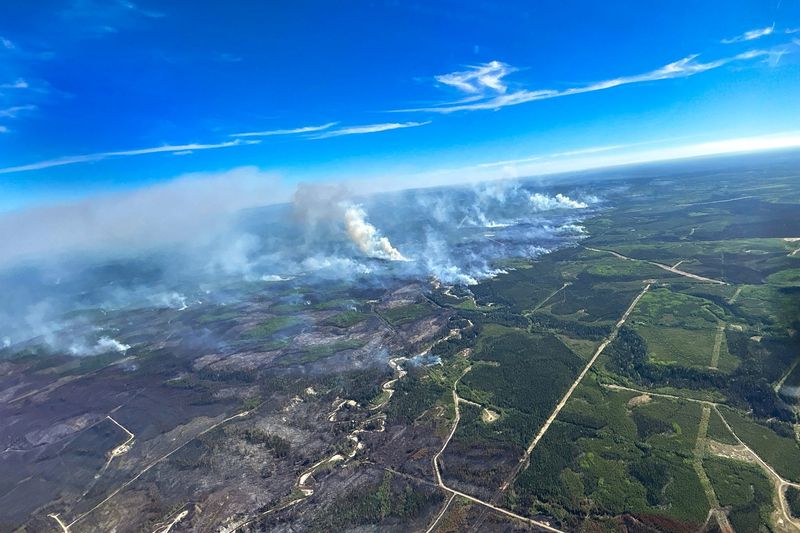
Air quality in some states across America is worsening as wildfires rage across Canada — and central Ohio is may begin to see the effects.
On the morning of June 2, AirNow.gov reported “moderate” air quality in Columbus, with an air quality index — or AQI — of 67 for ozone and 57 for particulate pollution around 11:30 a.m. A “good” AQI is 50 or under, which AirNow predicts will be achieved by the end of the week.

These moderate AQIs arrive in light of blazing wildfires throughout Canadian provinces Manitoba — which declared a state of emergency May 28 — and Saskatchewan. The smoke from these fires has traveled to parts of U.S. states Ohio, Indiana, Illinois, Wisconsin, Minnesota and the Dakotas, all of which were experiencing moderate-to-unhealthy levels of smoke particulates in the air the morning of May 31, according to USATODAY.
As of mid day on June 2, no air quality alerts have been issued in Ohio. The Mid-Ohio Regional Planning Commission, which uses AirNow to track central Ohio’s AQI, will issue an Air Quality Alert only if the area’s AQI is projected to reach 101 or above.
Where is the smoke now?
USATODAY reported that air quality alerts have been issued in Minnesota and Wisconsin, though the latter’s advisory expired after 24 hours on May 31.
The smoke is expected to drift southeast, where cloud cover would minimize its impact, according to USATODAY.
In Canada, authorities have said a combination of rising temperatures, winds and low humidity has caused active fires to spread across hundreds of thousands of acres. As of May 31, at least 17,000 Canadians have been forced to evacuate.
Looking ahead in central Ohio
AirNow reports that moderate air quality levels in central Ohio will be maintained for a few days before improving. If you are “unusually sensitive” to particle pollution, experts suggest shortening your time outdoors or reducing your physical activity level during moderate levels.
On June 3 and 4, central Ohio’s AQI is expected to reach 77 and 80, respectively, with temperatures in the mid-to-upper 80s. Additionally, winds are predicted to carry more smoke into the area, resulting in mid-moderate AQI levels.
By June 5, light winds will continue carrying pollutants into central Ohio, but mostly cloudy skies and rain showers are expected to reduce total ozone formation. This should result in a decreased AQI of 53.
By June 6, mostly cloudy skies and widespread rain showers are expected to continue while westerly winds further spread pollutants, resulting in AQI levels lowering to high-good at 44.
To continue tracking how central Ohio may be impacted by this smoke, check out AirNow.gov’s air quality forcast.
How do I protect myself from harmful wildfire smoke?
According to the Ohio Department of Health, you should check air pollution forecasts and air quality indexes every day. The following color-coded index can help remind you when the air in your community is unhealthy.
Ohio’s Department of Health also suggests keeping windows and doors closed to limit outdoor air from entering. For indoor air, use air purifiers or HVAC systems with high efficiency particulate air filters to keep the air clean.
It is also recommended to set your air conditioning system to recirculate and avoid burning candles, vacuuming and using gas or wood-burning stoves during times of poor air quality.
Make sure to check your area for health advisories and air quality alerts, especially for individuals with pre-existing respiratory conditions like asthma, who may experience worse symptoms during exposure to low-quality air.
Learn more tips for staying safe during times of poor air quality through the Ohio Department of Health.
Reporter Emma Wozniak can be reached at ewozniak@dispatch.com, or @emma_wozniak_ on X, formerly known as Twitter.
This article originally appeared on The Columbus Dispatch: Columbus air quality levels worsen amid Canadian wildfires. Here’s what you need to know
Reporting by Emma Wozniak, Columbus Dispatch / The Columbus Dispatch
USA TODAY Network via Reuters Connect