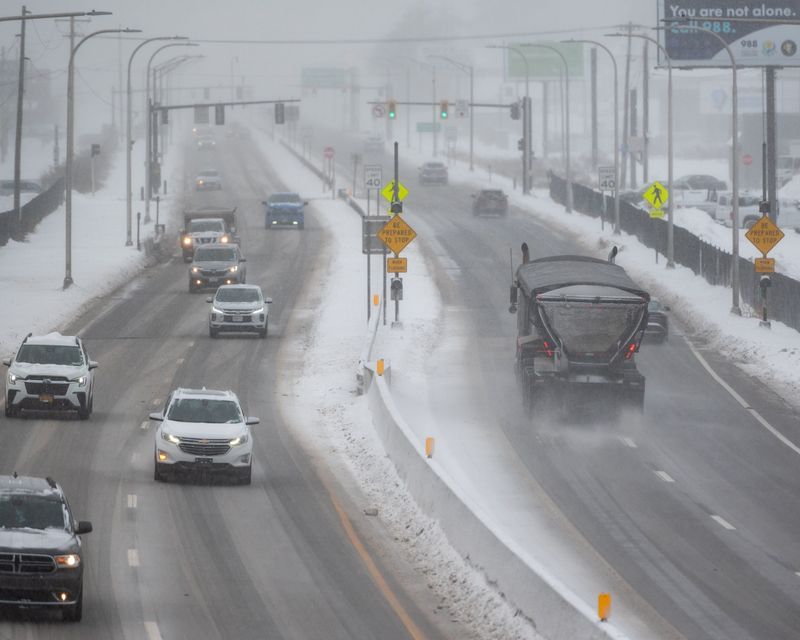
If you’re already dreading Utica’s pothole season, just be glad you don’t live in Rochester, Syracuse or Buffalo.
Overall, the roads in the Utica area are in better shape than roads in other cities in the state, according to a transportation report released in January by the national transportation research nonprofit TRIP.

In Utica and its suburbs, the pavement of about 51% percent of major roads — defined as arterial and collector roads, and highways —is in good condition compared to a statewide average of 39%, according to the report.
That percentage also puts Utica ahead of the seven other urban areas, defined as cities and their suburbs, included in the report: Syracuse, Rochester, Buffalo-Niagara Falls, Binghamton, Albany-Schenectady-Troy, Poughkeepsie-Newburgh-Middletown and New York City-Newark-Jersey City.
The cities with the next highest percentage of roads rated good were Rochester and Syracuse, both at 47%.
The report, “New York Transportation by the Numbers: Providing a Modern, Sustainable Transportation System in the Empire State,” also looks at bridge conditions, traffic congestion and traffic safety across the state and in each metro area as well as how much poor conditions, traffic jams and unsafe roads cost drivers every year.
The state of transportation infrastructure is important to both quality of life and to economic growth across the state, the report’s authors argue. And the report cites a statistic from the New York State Department of Transportation, which estimates a 23% increase in vehicle travel by 2040.
The report also notes that the longer roads and bridges go without preventive maintenance and repairs, the faster they deteriorate and the more repairs end up costing.
“As New York works to enhance its thriving, growing and dynamic state, it will be critical that it is able to address the most significant transportation issues by providing a 21st century network of roads, highways, bridges and transit that can accommodate the mobility demands of a modern society and allow for economic recovery and growth,” the authors write in the report’s conclusion. “But declining investments and the impact of inflation will hamper the state’s ability to complete needed projects and provide a transportation network that is smooth, safe and efficient.”
The Utica area fares well in most sections of the report. A higher percentage of bridges in Oneida County are in good condition than in other urban/suburban counties and in the entire state. And there is less congestion on the roads in Utica and its suburbs than in other urban areas, according to the report.
The cost of accidents
The one area in which Utica doesn’t fare as well is safety.
The report does not include motor vehicle accident rates or fatality rates allowing comparisons between areas. But it does include estimates of how much traffic accidents end up costing local drivers each year.
Utica drivers paid more on average due to traffic accidents than drivers statewide and more than driver in other cities except Poughkeepsie-Newburgh-Middletown.
Oneida County Executive Anthony Picente Jr gave some of the credit for the condition of local bridges and roads to county Department of Public Works crews and their partners (although municipalities also maintain many of the bridges in the county and roads in the Utica area). He noted that they maintain more than 600 miles of roads, bridges and culverts.
“It is always encouraging to see that the hard work we put into ensuring the best possible conditions for our infrastructure is being recognized,” he said in a statement. “While the report highlights both strengths and areas for improvement, it serves as a valuable reminder of the importance of our work and the constant need for efficiency and innovation.”
“We are committed to finding new and better ways to maintain and enhance our transportation network to ensure safety and convenience for all drivers in Oneida County.”
More on roads
The pavement may be good on 51% of major roads in and around Utica. But it’s in only fair condition on 21% of roads, mediocre condition on 16% of roads and poor condition on 12% of roads. That compares to 16% in fair condition statewide, 20% in mediocre condition statewide and 25% in poor condition statewide.
Utica ties with Rochester for the lowest percentage of roads in poor condition among urban areas in the report.
And there’s a payoff to the relatively good condition of Utica-area roads beyond fewer bumps and vibrations.
Driving on roads in poor, mediocre or fair condition increases a driver’s costs to repair and maintain a vehicle, the report points out. Those costs come in the form of accelerated vehicle depreciation, more repairs, needing more gas or diesel, and tires that wear out more quickly.
In the Utica area, that adds up to $413 per vehicle annually, TRIP calculated. But that’s well below the statewide average of $718 (a number heavily influenced by the highest cost per vehicle in New York City — $728 a year.
And Uticans pay less annually than drivers in other upstate cities with the next lowest annual cost at $438 a year in Rochester. In Syracuse, the average vehicle owner spends $537 more a year because roads that aren’t in good condition, according to the report.
About half the bridges in good condition
In Oneida County, 45% of bridges are in good condition, 43% in fair condition and 12% in poor or structurally deficient condition, according to the report. That compares to 32% of bridges statewide in good condition, 58% in fair condition and 10% in poor condition.
The percentage of bridges in poor condition in New York — one in 10 — is the tenth highest percentage in the country, the report notes.
None of the other urban areas had such a high percentage of bridges in good condition with the closest being Albany-Schenectady-Troy and Rochester, both at 32%.
But Utica and Oneida County did have more bridges in poor condition than most urban areas, tying with Rochester and being topped only by Poughkeepsie-Newburgh-Middletown at 16%.
The bridge statistics in the report are for entire counties; for some cities, the information includes data from multiple counties. The Syracuse data, for example, includes bridges in Onondaga, Madison and Oswego counties.
The report also noted that all bridges in the state that are 20 feet long or longer are in poor condition.
Losing time in congestion
In the Utica area, drivers lose, on average, 29 hours a year to traffic congestion and waste six gallons of fuel a year, according to the report. The lost time and fuel are worth about $515 annually for the average local driver.
Those numbers are lower than for any other city included in the report. Syracuse came closest, tying Utica with 29 hours of time lost, but losing seven gallons of fuel with a total annual cost of $535.
Congestion was, not unexpectedly, worst in the New York City area where drivers lost an average of 99 hours and wasted 31 gallons of fuel a year at a cost of $2,662.
Safety
On average, 20 people, including pedestrians and cyclists, died annually in traffic accidents in Oneida County between 2019 and 2023, according to the report. The report did not provide traffic fatality rates that can be compared to statewide averages or other counties.
Three major factors contribute to traffic fatalities, according to the report: driver behavior, vehicle characteristics and roadway features. Road features that affect safety include the number of lanes, lane widths, lighting, lane markings, rumble strips, shoulders, guard rails and other shielding devices, median barriers and intersection design, the report said.
TRIP estimated that roadway features, although seldom the primary factor in an accident, contribute to about one in three fatal crashes.
Fatal crashes come with economic costs on top of the premature deaths, injuries and pain they cause, the report notes. Those include medical care, lost productivity, legal and court costs, insurance administrative costs, workplace costs, impacts from related congestion (lost time, fuel use and pollution), emergency services and property damage.
In Oneida County, fatal traffic accidents end up costing every driver, on average, $697 a year, the second highest of any of the area studied in the report. The highest average cost was $726 in the Poughkeepsie-Newburgh-Middletown area. The costs elsewhere ranged from $365 in New York City to $641 in Rochester.
The report did not explain specifically why the costs are higher in some areas than in others.
This article originally appeared on Observer-Dispatch: Report: How is transportation infrastructure in Utica, other NY cities
Reporting by Amy Neff Roth, Utica Observer Dispatch / Observer-Dispatch
USA TODAY Network via Reuters Connect