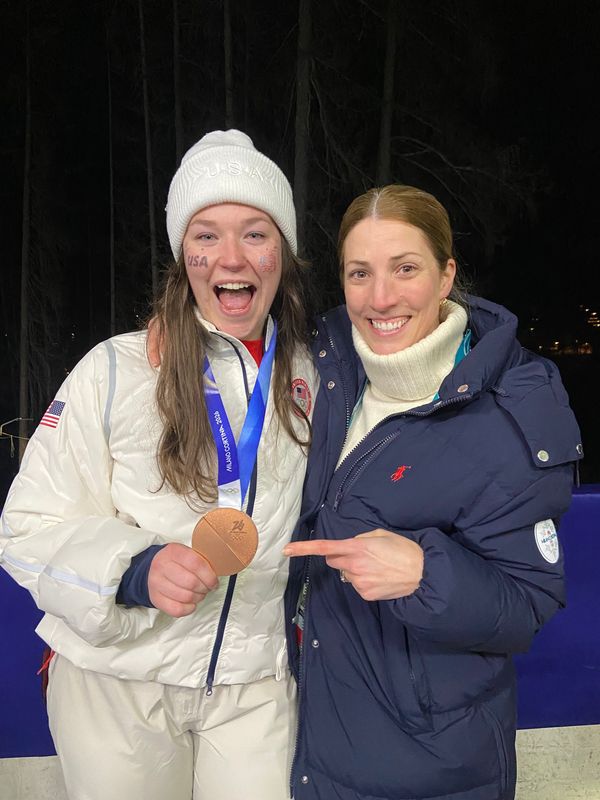
Erin Hamlin Hodge surprised Ashley Farquharson in Cortina d’Ampezzo, Italy, where the 26-year old from Park City, UT, had just become only the 7th U.S. slider, only the third individual slider, and just the second American woman to win an Olympic medal in the Luge event when she claimed Bronze on Feb. 10 at the 2026 Winter Olympic Games.
“We were walking to the podium for the medal ceremony,” recounted Farquharson, “when she came out of the broadcast box and gave me a big hug.”

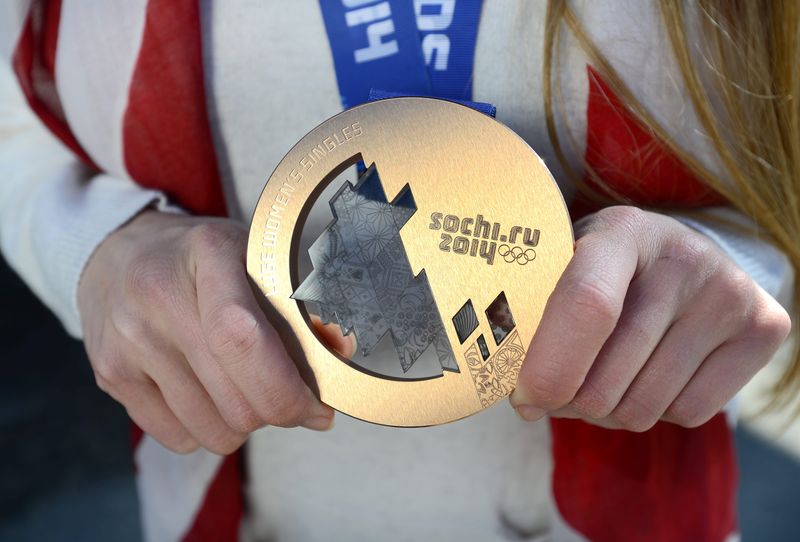
Hamlin Hodge is a Remsen native and Mohawk Valley hero, four-time Olympian Erin Hamlin, who at 27 years old became the first U.S. Woman to medal in the Luge event when she won Bronze on Feb. 11 at the 2014 Winter Olympic Games in Sochi, Russia.
After becoming the first, Hamlin Hodge remained the only woman to luge for an Olympic medal for 12 years, until Farquharson joined the club.
“To medal and be in that club with Erin,” said Farquharson, “it was pretty surreal.”
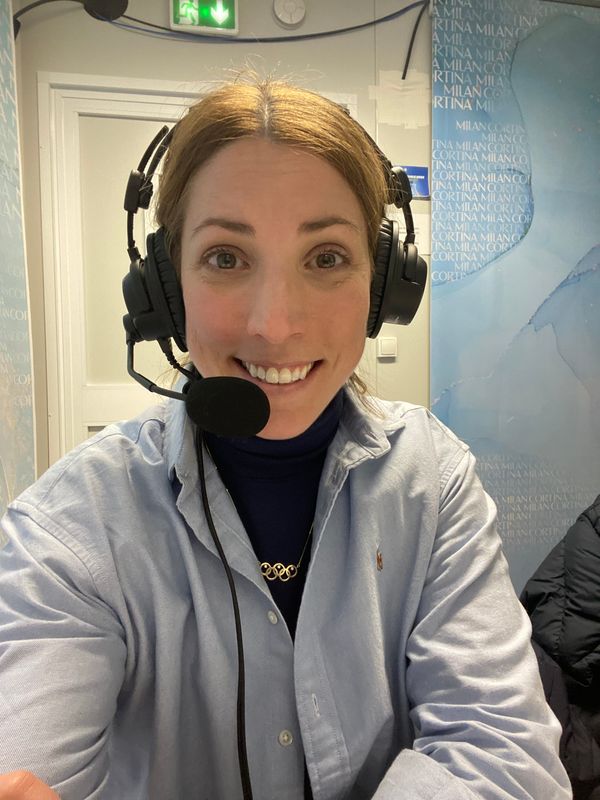
Hamlin Hodge was in the NBC broadcast booth, calling Farquharson’s medal-winning slide.
Farquharson remembers the moment she saw Hamlin Hodge while on route for her medal.
Recalled Farquharson of that moment, thinking to herself she and Hamlin Hodge both won Olympic Bronze, “I said, twin!”
Farquharson a success story in Team USA effort to expose youth to Winter Olympic sports
Today, in addition to a short, unrefrigerated track in Muskegon, MI and a “natural” track course in Negaunee, MI, there are two, competition-length, refrigerated Luge tracks in the U.S.
One is a combined luge/bobsled/skeleton track that opened to replace the original 1980 Winter Olympic sliding runs in Lake Placid, less than three hours from Hamlin’s hometown of Remsen. The small Adirondack village is also the USA Luge Headquarters.
The only other refrigerated facility opened in 1997 and was used for the 2002 Salt Lake City Winter Olympic luge competition in Park City, UT, hometown of Ashley Farquharson and the international event that compelled her to sign up at age 11 for a Park City-based Youth Sports Alliance after-school luge program at Ecker Hill Middle School.
“They started a foundation in Park City to keep the venues constructed for those Olympics alive,” shared Farquharson, “and to expose youth to Winter Olympic sports.”
She also gave figure skating and skiing a try.
Concluded the middle-schooler at the time, “but I liked luging the best.”
Farquharson recalls sometimes seeing Hamlin at the Park City training center.
“They would race in Park City every now and then,” said Farquharson of the Olympian sliders, “and we would go and watch.”
Second medalist recalls watching Hamlin’s win
Farquharson had been “watching Erin” slide for a few years when Hamlin’s historic Olympic race would etch her into the record books.
“We all knew about it,” said Farquharson as she recalled watching Hamlin become the first American woman to medal in luge with her eighth grade class in Park City, UT.
“It made it seem more achievable and real,” said Farquharson.
“I remember being so in awe about it,” continued Farquharson. “Being the first woman to win a medal in the sport is really special.”
Challenge to inspire future U.S. winter Olympic athletes
Hamlin Hodge’s hometown of Remsen is just less than three hours from Lake Placid, NY, where one of those only two of those Olympic competition-sized, refrigerated sliding facilities can be found. The second is literally in Farquharson’s hometown of Park City, UT. Both Olympians acknowledge the issue of access to Winter sports for young American athletes.
Hamlin Hodge confesses there is “not much opportunity locally” for aspiring sliders, although she notes “a few kids” from the Mohawk Valley region of New York State are in “the development pipeline.”
Farquharson points out how many kids are being forced to focus on one sport at such a young age in order to stand a chance of being competitive.
“To focus on one thing before you have your adult body and all your teeth is crazy I think,” said Farquharson, who favors a more holistic approach to youth sports that allows kids to try different sports, to “grow and evolve” with sport itself, and “more than anything else, ensure that kids are “having fun.”
Farquharson also agrees with Hamlin Hodge regarding access to sports such as sliding, calling the “barrier entry,” particularly to winter sports, “really vague.”
“Half the country doesn’t even have snow,” Farquharson pointed out. “If you’re watching a half-pipe skier doing these crazy jumps, but you’re from Florida, that’s something that you just can’t wrap your head around.”
She also noted that climate change has, if not eliminated, at least shortened the winter sports season in many parts of the U.S. that do see snow.
Farquharson also emphasized the issue of access and the monopolization of public spaces for winter sports participation by the affluent and elite.
“Here in Park City,” said Farquharson, “it can cost $600 a day to ski.”
Optimistic, supportive of youth learning to luge
Disappointed by how many kids who might like to try the sport would not be able to afford it, Farquharson was encouraged to hear the story of the outdoor public ice skating rink and Val Bialis Ski Center at a public park in Utica, NY, and of the anonymous benefactor there who established an endowment to ensure that Utica’s kids could skate and ski for free.
I think it is getting better, said Farquharson, “especially with the Winter Olympics shining a light on those sports as it gets bigger and bigger every year.”
“When the recruitment event comes to the area, I’m around,” promised Hamlin Hodge, “and I hope to get more involved in the future.”
To kids who might have been inspired by her medal slide, or who aspire to do anything that feels out of reach, Farquharson had this message.
“If you want to learn how to do something, there will always be a way and a path, if you want it bad enough!”
This article originally appeared on Observer-Dispatch: Olympian Erin Hamlin, ’26 Bronze winner Ashley Farquharson ‘twins’
Reporting by Cara Dolan Berry, Utica Observer Dispatch / Observer-Dispatch
USA TODAY Network via Reuters Connect