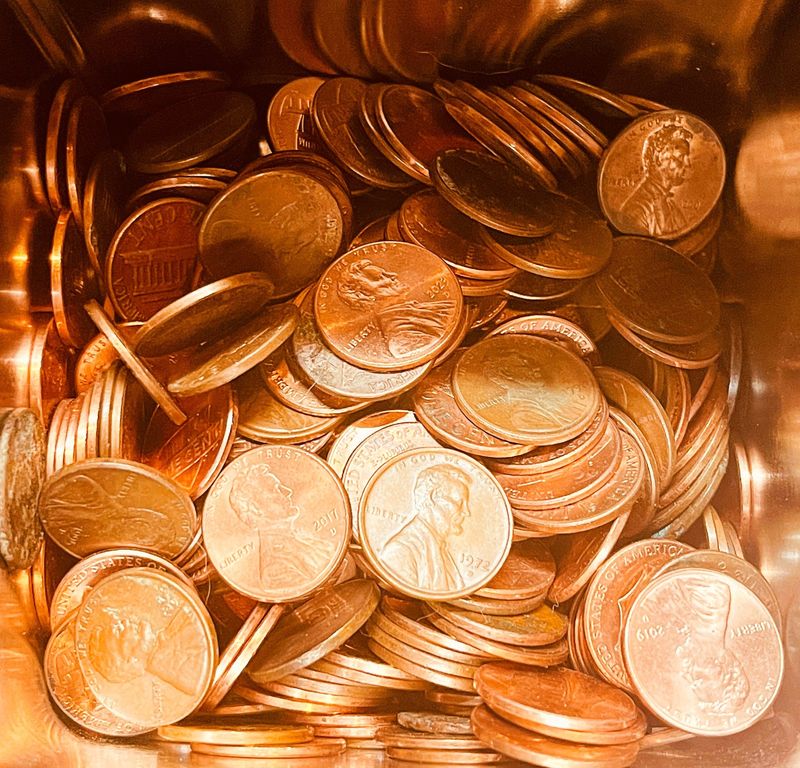
The U.S. Treasury Department has stopped producing pennies. U.S. Treasurer Brandon Beach struck the final circulating penny on Nov. 12 at the Philadelphia U.S. Mint facility after President Donald Trump halted its production in February, leaving many wondering what they should do with their pennies now.
Here’s what to know.

Why was penny production stopped?
Essentially, the production cost exceeded its value. According to the U.S. Mint, the cost of producing a single penny has risen from 1.42 cents to 3.69 cents over the past 10 years.
The coin had been in production as a circulating coin for 232 years.
Can I still use pennies?
Yes, you can. There are about 300 billion pennies in circulation, currently, and they’re still considered legal tender and accepted at retailers and businesses nationwide, according to the U.S. Mint.
However, a bill introduced in April could round all cash transactions to the nearest 5 cents, if passed. The Common Cents Act “would eliminate wasteful government spending and update the U.S. currency system to match reality.”
U.S. Sen. Kirsten Gillibrand, D-N.Y., who helped introduce the bill, has supported the penny production stoppage, calling the one-cent coin “outdated” and “inefficient” and saying it “no longer serves the needs of our economy.”
What should I do if I have some pennies or other coins I think are valuable?
You may have seen one of many headlines blasted online lately about valuable pennies in circulation, “Lincoln Wheat Penny Worth $124M You Could Have at Home” reads one, but the reality is most pennies are worth 1 cent or possibly a bit more.
The most valuable U.S. coin ever, a $20 gold piece, a 1933 “Double Eagle” coin, sold for $18.9 million at auction in 2021. The most valuable pennies, which are rare but possibly still in circulation, are 1943 copper Lincoln wheat pennies, a few of which were produced accidentally as the U.S. mints were supposed to use zinc to save copper for the World War II effort, John Feigenbaum told USA TODAY, publisher of rare coin price guide Greysheet.
In rare cases, some 1943 pennies have sold for $1 million, while one went for more than $200,000 at an auction in 2019.
Depending on their condition, those 1943 Lincoln wheat pennies would be worth at most between $100,000 and $250,000, Feigenbaum told USA TODAY.
But the likelihood of having a near-priceless penny is similar to “saying your lottery ticket might be worth $100,000. Of course, anything is possible, right? But not likely,” said Feigenbaum, who is also the PNG’s executive director.
Even though the most valuable coins are usually in collections and have very publicly been “sold and resold,” Feigenbaum said, sometimes people may inherit a cache of well-preserved coins or purchase some at an estate sale.
Emily Barnes reports on consumer-related issues for the USA TODAY Network’s New York Connect Team, focusing on scam and recall-related topics. Follow her on X and Instagram @byemilybarnes. Get in touch at ebarnes@gannett.com.
This article originally appeared on Rockland/Westchester Journal News: Can you still pay with pennies? What to do know that they’re out circulation
Reporting by Emily Barnes, Mike Snider and Daniel de Visé, New York Connect Team / Rockland/Westchester Journal News
USA TODAY Network via Reuters Connect