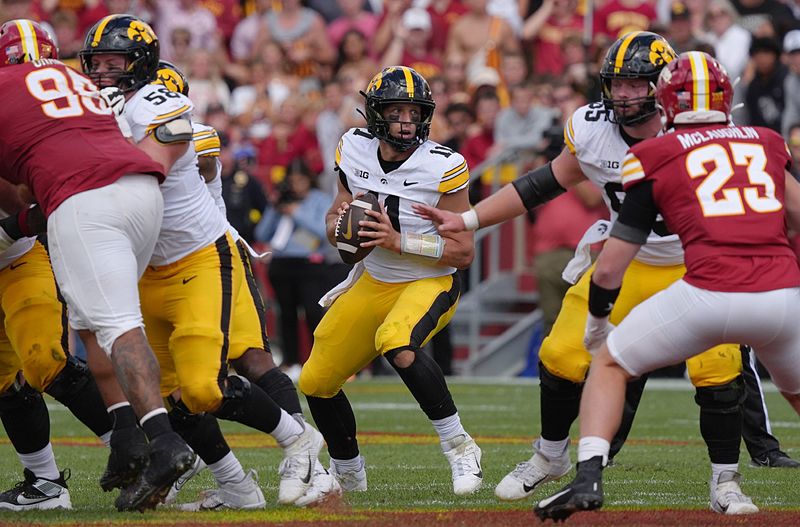
IOWA CITY — Iowa football quarterback Mark Gronowski first became aware of the “slow mesh” on social media.
When the Hawkeyes hired Warren Ruggiero this offseason, discourse about the innovative scheme he ran as offensive coordinator at Wake Forest surfaced on Gronowski’s timeline.

“All of a sudden, I saw it pop up on my X (formerly Twitter) like five billion times,” Gronowski joked about the slow mesh. “They were like, ‘Oh, is Iowa going to run this now?’ And I was like, it kind of looks pretty cool, and it worked really well for them.”
The Hawkeyes debuted it against Iowa State in Week 2. To some outside the program, it came as a bit of a surprise. Just because Iowa added Ruggiero to the staff as a senior analyst did not definitively mean that the Hawkeyes were going to run the slow mesh.
But the Hawkeyes did, in fact, install it and then utilize it against the Cyclones.
“It’s going to be a good wrinkle into the offense,” Gronowski said. “I feel really comfortable with it and it’s going to give us good opportunities to kind of switch up the speed of the game, I guess, on certain plays.”
What exactly is the slow mesh?
It’s a version of the run-pass option with slower-paced decision-making. The quarterback holds the ball in the running back’s stomach for an unnaturally long period, even walking toward the line of scrimmage with them, before deciding whether to hand it off or pull it out to throw based on what the defense presents.
“You can kind of see how it messes with the defense,” Iowa receiver and special teams returner Kaden Wetjen said. “If you have a safety or corner who’s not disciplined enough, it can really get him.”
There is a story behind the creation of the slow mesh.
When Dave Clawson went from the head coach of Bowling Green to Wake Forest, Ruggiero made the move with him. Ruggiero tried to implement that same offense at Wake Forest as he did at Bowling Green, but quickly realized that wasn’t going to work. As Ruggiero tells it, the talent gap between the Demon Deacons and the rest of the ACC was much wider than what Bowling Green faced in the MAC.
Ruggiero wanted a way to generate explosive plays despite that.
“We had to find a way to be unique,” Ruggiero told the Register before the 2025 season, “probably similar to how Army and Navy at some point figured out ‘Boy, we’re not going to be able to do what everybody else does to be competitive, so we’ve got to do something different.’”
It helped produce success at Wake Forest. Ruggiero was a finalist for the Broyles Award in 2021, which honors the best assistant coach in college football.
The motivation behind the creation of the slow mesh fits Iowa’s current situation, as well. The Hawkeyes don’t have the most talented offensive weapons compared to the other Big Ten programs. So, gaining an advantage in any way possible should be welcomed.
Iowa launched the slow mesh in small doses against the Cyclones. The results weren’t resounding, but it did prompt intrigue. In one instance, Gronowski initially kept the ball to pass, but ended up scrambling for 11 yards. The next time Iowa ran the slow mesh, Gronowski handed it off to Terrell Washington Jr. for a two-yard gain.
It remains to be seen how prominent the slow mesh will be in Iowa’s offense moving forward, but now we know it’s at least in its bag of tricks.
“We’ve got to just continue to be smart with those plays,” Gronowski said. “Take the shots when they’re given. But then handing the ball off on those plays is OK, too, because they usually end up popping out because they’re trying to protect the pass, and all of the sudden, now there’s nobody in the run game. So I always think it’s a great opportunity and a great wrinkle into the offense.”
Along with the slow mesh, Iowa is also running more traditional run-pass options (RPOs). A common practice in modern football, RPOs provide flexibility for an offense to read and react to a defense.
“It allows me to put our offense in the best situation possible,” Gronowski said about RPOs. “Whether they end up only putting five guys in the box or if we have seven guys to block six, we should have some great run game. But if they end up bringing those safeties down and trying to be aggressive and stopping our run game, it gives me the option to tell our running back I’m not giving it to him and be able to throw the ball downfield.”
This allows the Hawkeyes to accomplish something they struggled to do last season: Capitalizing on their threatening rushing attack in the passing game.
Because defenses have to respect Iowa’s ability to run, it should open plenty of room to throw the ball. The Hawkeyes haven’t taken full advantage of it this season, with a passing game currently near dead last in the FBS, but RPOs can help create chances to break through.
“It’ll end up opening the run game,” Gronowski said about RPOs. “And at some point, the run game will close again and then we’ll end up opening the pass game. So they’re always great opportunities to kind of keep the defense guessing throughout the games.”
Follow Tyler Tachman on X @Tyler_T15, contact via email at ttachman@gannett.com
This article originally appeared on Des Moines Register: How Iowa football is using RPOs, slow mesh to try to spark Hawkeyes’ offense
Reporting by Tyler Tachman, Des Moines Register / Des Moines Register
USA TODAY Network via Reuters Connect