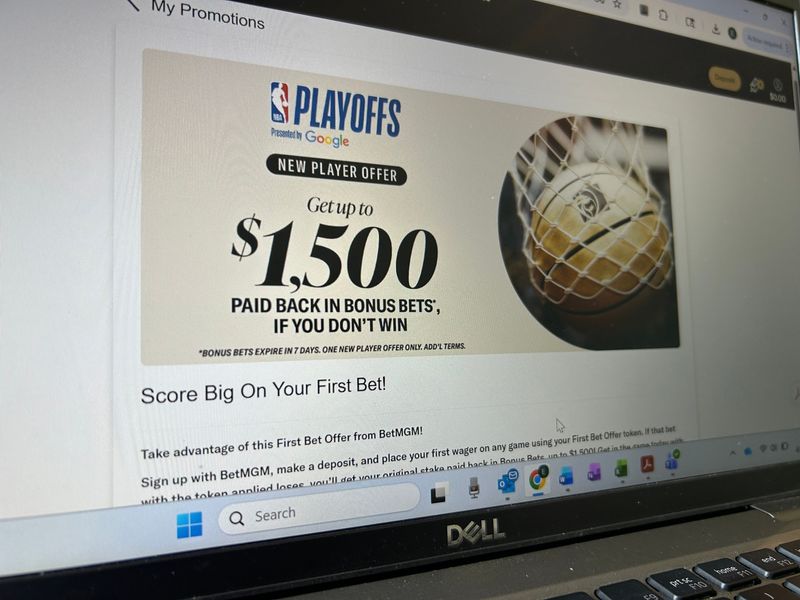
Sportsbooks want your attention and money. They’re succeeding.
Americans wagered over $166 billion on sports in 2025. You might assume that such a popular industry would at least be somewhat profitable for its users. That assumption would be wrong.

For all the cash that Americans throw at sportsbooks, there’s very little that they make in return. For your average bettor, it’s a lofty goal to break even.
Sports betting presents a special set of problems that other gambling counterparts don’t. Namely, it’s easily accessible to underage and at-risk users and has ultra-thin margins between winning and losing.
It’s a lucrative industry that needs reining in.
The rise of sports betting
Sports betting soared after the U.S. Supreme Court overturned the Professional and Amateur Sports Protection Act in 2018, leaving legality up to each state.
In Indiana, sports betting launched soon after in September 2019. Hoosiers wagered over $22 billion on sports between 2020 and 2025, with an overwhelming majority of bets placed on online sportsbooks.
With the advent of legal online sportsbooks, wagering on sports has become ridiculously easy. Gone are the days of needing a bookie or a casino; today, all you need is a device and an internet connection.
A survey commissioned by the Indiana Problem Gambling Awareness Program, or IPGAP, showed that about 89% of adults in Indiana had engaged in some form of gambling in the past year, and a little over 23% of Indiana adults had participated in sports betting.
The widespread popularity of sportsbooks is surprising when you consider the odds are stacked against users — and those odds are often changing.
A losing bet for most
Sports betting is a skill that few can master. It requires complex models and algorithms that track lines and odds — tools that are inaccessible to the average bettor.
Another problem is that sportsbooks dislike profitable users. If you consistently make successful wagers, sportsbooks limit the amount you can bet.
As with most gambling, there’s usually an amount that the house — the casino, or in this case sportsbook — receives. Known as the vig or vigorish, it’s about 4% to 5% for your standard sports wager. To break even, bettors need to win about 52% of their wagers. Once you factor in taxes, that figure is likely closer to 55%.
That’s just how often you need to win to make sure you don’t lose money.
Nate Silver, a statistician and election forecaster with over $1 million in poker winnings, ran an experiment. He bet just shy of $2 million over an NBA season with the help of a player-rating model he created called RAPTOR. He made a profit of about $5,000, a meager 0.3% return on investment.
Even that put Silver in the upper echelon of sports bettors.
People gamble for the thrill and prospect of making a few quick bucks, but sportsbooks only make it easy if you lose. DraftKings CEO Jason Robins once said that profitable players are not the type that the sportsbook wants. He later had to clarify that he actually meant that the sportsbook didn’t want professional bettors.
How sportsbooks keep people playing
Sportsbooks are raking in profits because of the growing popularity of prop bets, parlays and microbets. Prop bets are wagers on outcomes other than the final score of a game. Microbets are rapid in-game wagers on granular outcomes such as the next pitch or play. Parlays combine multiple bets into a single wager with long odds and potentially huge payouts.
Parlays account for anywhere from half to two-thirds of revenues for sportsbooks. In Indiana last year, Hoosiers bet an average of about $159 million per month on parlays.
A small fraction of bettors bring in the most revenue for sportsbooks. Some estimates show that 10% of bettors make 80% of profits, while one Wall Street Journal analysis found that half a percent of users had brought in more than 70% of revenue at one sportsbook.
Bettors lose money — with some going into significant amounts of debt — while sportsbooks make incredible profits.
‘Training wheels’ for children
The nuances of sports betting are many, and not all bettors understand them. For underage users, that lack of knowledge is especially dangerous.
Sportsbooks are adamant that they prevent underage users from betting. But Lisa Hutcheson, the vice president of prevention and policy at Mental Health America of Indiana, told me that it doesn’t take much to circumvent the age-verification measures in place.
“You do not have to be a mathematical genius to skip right through that verification,” Hutcheson said. “And while some sportsbooks might have more verification where you might have to take a photo of your ID or whatever, you can easily borrow an ID from someone. You can easily ask a parent or an older sibling or a friend to log in to games for you. You can ask them to bet for you.”
A recent study found that over a third of boys between the ages of 11 and 17 had gambled in the U.S. in the past year. About two-thirds of American adults gambled before the age of 21.
Indiana University Prevention Insights’ youth survey found that gambling rates for middle and high schoolers ranged from a low of about 32% to a high of just under 39%. Anywhere from 3% to 5% of middle and high school students had used an online sportsbook.
Kids are exposed to gambling everywhere. Hutcheson described things in online games like loot boxes as “gambling with training wheels” for children.
“Our brains aren’t fully developed until we’re around the age of 25,” Hutcheson said. “Any gambling that happens, any substance use that happens while our brains are still developing, impacts our brains and those dopamine responses.”
Ads without guardrails
Youth and adolescents are at a much higher risk of developing gambling disorder, making exposure to gambling even more concerning. Compared to adults, they are two to four times more likely to develop problematic gambling behaviors.
Another problem is that adolescents — and even some adults — don’t entirely understand how odds and probabilities work. When sportsbooks advertise incessantly, especially on youth-friendly broadcasts, it doesn’t seem like the industry is taking many precautions.
“We know that young people are susceptible to advertising, particularly young men,” John Holden, associate professor at the Kelley School of Business at Indiana University Bloomington, said.
Holden is a legal expert on the sports betting industry and among those who advocated for additional research prior to the legalization of the industry in the U.S.
“A lot of people like myself suggested that before we go around legalizing this, we should really learn from what’s happened in the UK, what’s happened in Australia,” Holden said. “Both those jurisdictions have said, ‘Hey, there’s a huge problem with advertising.’ … And they did something about it.
“For whatever reason, U.S. regulators, perhaps because of the influence of the gambling industry, (were) basically like, ‘We’re going to wait and see what happens here.’ And that was a huge mistake in my opinion, because we know what happens.”
A tobacco-sized problem
Advocates have a few ideas for regulation. Some compare the gambling industry to the tobacco industry.
While Holden isn’t an expert on the tobacco industry, he thinks something similar to the Tobacco Master Settlement Agreement could bring real change to the sports betting industry.
“I think that is a very possible path forward here,” Holden said. “That brought a lot of change by the companies basically coming to the table with the government and agreeing to a lot of restrictions.”
Some problems just need stronger enforcement.
Consider athlete harassment. As sports betting grows, harassment and threats towards athletes by bettors also have increased. States have considered legislation to protect athletes, but existing laws already prevent criminal harassment.
“When you’ve got harassment happening and athletes being threatened, those are crimes,” Holden said. “We could do something about that. We could have investigations. But the reality of it is, is that there just isn’t a lot of resources to do that.”
While sports betting remains unchecked, those who choose to wager should do so wisely. Financial literacy and an understanding of how probabilities and odds work are a must.
It’s a game rigged in the sportsbooks’ favor. The only way to really win is to quit when you’re ahead.
Contact IndyStar opinion fellow Sadia Khatri at sadia.khatri@indystar.com.
This article originally appeared on Indianapolis Star: You can’t beat the sportsbooks. They make sure of it. | Opinion
Reporting by Sadia Khatri, Indianapolis Star / Indianapolis Star
USA TODAY Network via Reuters Connect
By Sadia Khatri, Indianapolis Star | USA TODAY Network