Energy seems to be on everyone’s mind these days.
Hoosiers are watching their electric bills balloon, communities are rallying against energy-gobbling data centers, and government officials, consumer advocates and utilities have competing interests and ideas for how to move forward, including building several nuclear reactors.

All the while, opportunities for renewable energy development — which could quickly alleviate some of the pain from electric bills and electricity demand from new industry — are constricting across the state.
A USA TODAY and IndyStar investigation found that 40 of Indiana’s 92 counties had bans or impediments on new wind development and 24 counties had similar restrictions on solar energy as of September 2025. Battery storage systems, which are emissions-free energy sources, are also facing opposition; a Hamilton County proposal was axed this summer after the community pushed back.
With energy demands anticipated to rise significantly in the coming years, especially due to the buildout of AI and data centers, the speed at which wind and solar projects can be built is in their favor. A solar farm can go up in as little as 18 months. With current gas turbine backlogs, a natural gas plant can take five years and nuclear a decade or more.
Gov. Mike Braun campaigned on an all-of-the-above approach to addressing the state’s energy crisis, so for Braun’s energy secretary, the county-level pushback to new renewable development isn’t helping Indiana’s beleaguered energy grid.
“I’m concerned about that for all energy development,” said Suzanne Jaworowski, Indiana’s top energy official, in an interview with IndyStar.
Counties currently have power over whether or not to allow projects like wind and solar. Efforts to move more authority to the state level have failed in recent years, and controversy over who should green-light energy projects remains. Jaworowski has previously railed against counties who court energy projects for months or years, only to reject them in the end. She called the practice “disgraceful” according to reporting from the Indiana Capital Chronicle.
So, the state is working on a solution.
Jaworowski hopes to unveil the first iteration of a map in November that could guide interested developers toward counties looking to bring in more industry, which would include renewable energy projects.
“We’re trying to be strategic about inviting counties to raise their hand to say, ‘Yeah, we’re interested in this,’ or ‘No, we’re not,’” Jaworowski said. Counties can note interest in industrial projects like wind, solar, batteries, nuclear or even data centers.
It’s not a commitment, Jaworowski added. Rather, it’s a way for counties and developers to match interests early in the development process so as not to waste time and money.
Indiana feels the breeze
Even without state guidance, developers found their way into Indiana counties to build renewable projects decades ago.
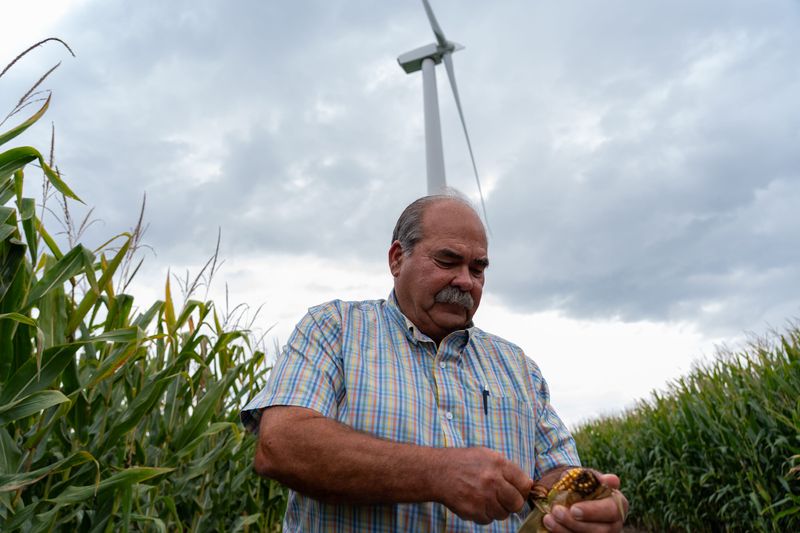
Bryan Berry, a Benton County landowner who later became a commissioner, started wondering about bringing wind to the county in the late 1990s.
When he raised the idea to sitting commissioners, “they laughed at me,” Berry said. They “said that will never happen, you know, it’s not windy enough here to do that.”
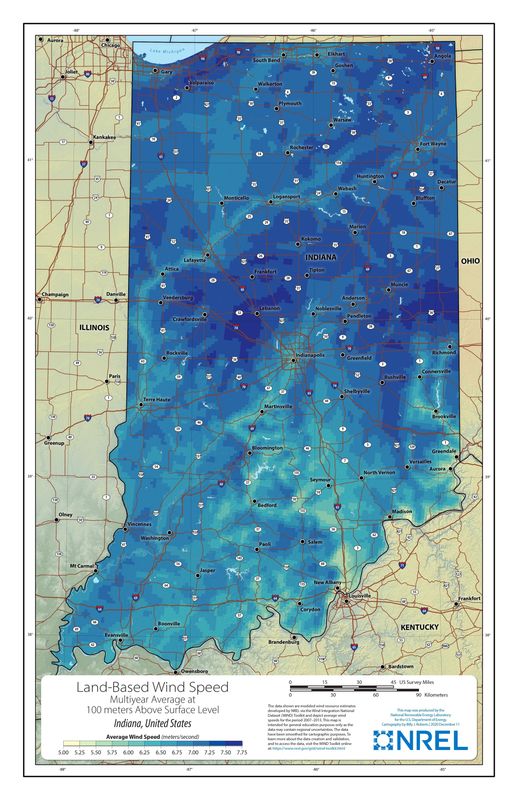
But Benton, on the western edge of Indiana, is one of the breeziest parts of the country where it counts: hundreds of feet above the county’s fields and farmland.
Developers eventually caught wind of the county’s potential. When they touched down in the mid-2000s they were met with swaths of wide-open farmland and high wind speeds. Eighty meters (about 262 feet) above some of the plains in central and northern Indiana, the wind races past at more than 7.5 meters per second (about 25 feet per second). This is considered a “suitable” speed for wind energy development, according to the U.S. Department of Energy.
Berry saw early on the county was poised to gain financially if it allowed wind farms to move in.
“There’s not a lot of industry, not a lot of jobs, and not a lot of people,” he said. This trifecta can make taxes a burden for rural families. But wind development could lead to an influx in the county’s assessed valuation and drop property tax rates.
Indiana’s first wind project, the Benton County Wind Farm, went online in 2008. That spring, Indiana’s first turbines — 85 in total — started adding megawatts to the grid.
And over the next several years, Berry saw property tax rates drop.
“I don’t know where it would be if we didn’t have the assessed value of the wind turbines,” he said.
Development across the state has since escalated. Now, most of the state’s wind projects sit in a corridor that stretches from Benton County east to Randolph on the Ohio border. By mid-2024, Indiana had about 3,400 megawatts of wind capacity, according to the U.S. Energy Information Agency. Over 10 percent of Indiana’s total in-state energy production came from wind in 2024, and over 3 percent came from solar.
Indiana feels the burn
But Benton was a special case.
Despite the economic boon wind and solar can provide for rural economies, county governments across the state have begun placing significant impediments and outright bans on their development. Many of the restrictions have cropped up over the last two years.
Some counties have such strict regulations on noise or location that it has become effectively impossible to build new wind projects. For example, from the front porch of a nearby house, wind turbines don’t typically sound louder than a household refrigerator, which hums at around 55 dBA. But Wabash County limits sound from turbines to 32 dBA.
Counties like Huntington restrict solar panels from being placed on “prime farmland,” and counties like Jay and Parke have placed temporary moratoriums on wind, solar and/or battery storage.
County-wide pushback like this is concerning for organizations like the Indiana Conservative Alliance for Energy (ICAE).
Like Jaworowski, ICAE wants to see an all-of-the-above approach to energy in Indiana, which would encompass everything from coal and nuclear to solar, wind and hydropower. So the organization is trying to divert conversations about wind and solar away from politics, which has historically influenced attitudes toward renewables.
“We need to have more of these fact-based conversations to really make good energy policy,” Anderson said. Bringing the conversations about renewable energy out of the ever-changing political landscape is important, he added, because projects take so long to get approval. It’s difficult for developers to propose projects will satisfy the energy grid’s needs and the needs of their business model when national attitudes can change on a whim.
One solution proposed by Indiana lawmakers is creating statewide standards for renewable energy projects. Right now, individual Indiana counties have the authority to create ordinances dictating regulations on solar and wind project developments. Other states, like Wisconsin, have seen much of this control moved to the state level.
Indiana attempted to implement similar statewide standards, but proposed bills faltered in 2021 and in 2025. Simply put, it’s controversial.
Unsubstantiated rumors still swirl online and in county meetings that wind, solar and battery storage facilities will degrade the environment, destroy rural culture and lower property values.
“It is just so hyper-partisan and political that often that’s drowning out the facts,” said Topher Anderson, the director of programs and operations for ICAE. “The facts are, things like wind and solar are really fast to deploy, and once you get them on, they’re the cheapest dollar per megawatt hour.”
IndyStar’s environmental reporting is made possible through the generous support of the nonprofit Nina Mason Pulliam Charitable Trust.
Sophie Hartley is an IndyStar environment reporter. You can reach her at sophie.hartley@indystar.com or on X at @sophienhartley.
This article originally appeared on Indianapolis Star: Wind and solar face resistance in Indiana despite statewide push for more energy options
Reporting by Sophie Hartley, Elizabeth Weise and Karl Schneider, Indianapolis Star / Indianapolis Star
USA TODAY Network via Reuters Connect