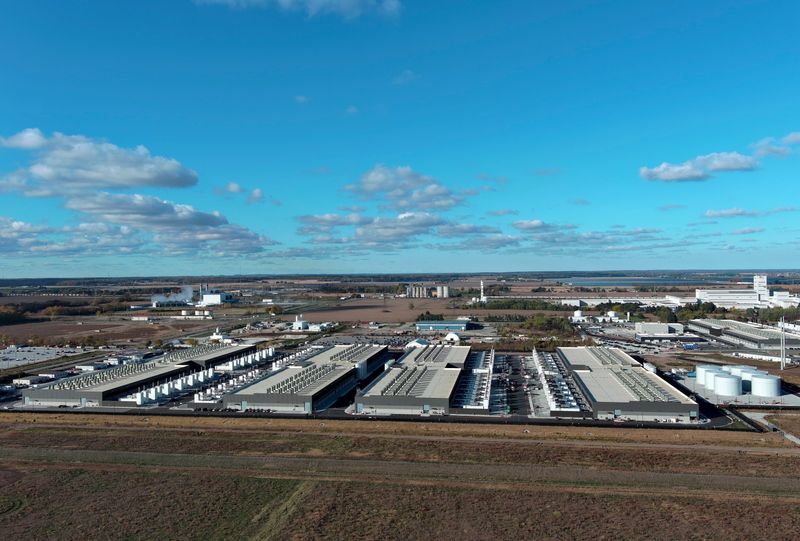
When lawmakers first approved generous tax incentives for data centers in 2019, few Hoosiers anticipated that the legislation would catalyze the data center drama gripping the state today.
Billions of dollars and dozens of data center projects later, Indiana has now become a cornerstone in the global race to advance artificial intelligence. The rapid pace has spurred many Hoosiers, and some lawmakers, to ask for a moment to pause and reflect.

But the gatekeepers of data center legislation in the Indiana General Assembly — mainly powerful utility chairmen and majority party leaders — are forging ahead anyway.
Of the at least six data center bills proposed this session, the sole measure to advance was not the bipartisan bill to study data centers’ electricity demand, nor the Republican bill to prevent utilities from increasing rates because of data centers, nor yet another bipartisan bill regulating data center water usage. It was House Bill 1333, which punts a piece of data center sales tax savings to locals to sweeten the pot. The bill also nearly eliminated local say in putting data centers on unproductive agricultural land before backlash led lawmakers to kill the language. It’s unclear if the underlying bill will be revived later.
Communities big and small, rural and urban, blue and red have organized to block data center projects across the state. The pace of the data center boom isn’t slowing, either: Facebook owner and tech giant Meta just broke ground on a one gigawatt, $10 billion data center in the controversial LEAP district.
Meanwhile Republican leaders are split, as they attempt to balance concerns about rising utility costs and anti-corporate sentiments from the growing populist wing of the party, with the more hands-off approach of pro-business devotees. That division was made clear by the tight House vote on HB 1333 earlier in session.
Gov. Mike Braun is attempting to thread the needle by welcoming data centers while pushing for them to pay their share.
“If other companies will follow this model,” Braun said during his State of the State address, “we’ll lead the country in the AI race and Hoosiers’ electricity rates won’t go up — they’ll go down.”
Some of the grassroots dissatisfaction in other states has helped catapult challengers to victory in unlikely legislative or swing gubernatorial races. But could Hoosiers wield similar power at the ballot box this fall?
Data center bills stall
Despite little movement in the General Assembly, the momentum against data centers on the ground has only grown.
At the heart of the efforts are everyday Hoosiers turned part-time organizers who are seeing the intensity of the data center fight firsthand. There are at least 10 Facebook groups dedicated solely to stopping data centers in Indiana communities, and organizers have been successful in at least 14 places.
“There’s a disconnect between legislators and lawmakers, and the public,” said Tori Pindell, chair of the Miami-Cass Counties Coalition for Utility & Environmental Protection.
While lawmakers are able to see the legislative process from start to finish, Pindell said, the communities impacted often feel like they have no say in the way their neighborhoods are changing.
And organizers like Pindell aren’t asking for a ban. Instead, she said, they just want more transparency and local control.
But legislative efforts that could have delivered more transparency never got hearings. Part of it could be this legislative session’s unofficial mantra of “do no harm,” said Greg Shufeldt, a political science professor at the University of Indianapolis.
“There probably is some intention to lower the temperature,” he said.
In fact, lawmakers on the House Utilities, Energy and Telecommunications Committee made it clear they felt the data center debates had become far too heated.
“The hyperbole has gotten so wild and crazy,” Chairman Rep. Ed Soliday said after proposing an amendment to strip language eliminating the data center tax exemption from HB 1333. “We’re trying to take a balanced approach.”
As utility chairs, Soliday and Sen. Eric Koch, R-Bedford, are often the gatekeepers of data center-related legislation. But the two have been involved in bringing data centers to Indiana, either by authoring Indiana’s sales tax exemption bill or pushing to expand energy production, during which they’ve been the beneficiaries of campaign contributions and lobbyist dinners from the energy industry, which stands to benefit from the data center boom.
Soliday and House Speaker Todd Huston, who also supports data centers, have pitched a market-based approach to lowering utility costs.
“The fact of the matter is, if you want to have lower property taxes, if you want to have lower utility costs and energy costs, you’re better served to have economic development,” Huston said at the Dentons Legislative Conference in December.
By having a large power user like a data center pay for electric grid upgrades, regular users don’t have to pay the cost. But that only works if the data center company makes such a commitment and follows through — abandoning a project could create stranded costs all consumers would have to bear.
Growing concerns over the impact of data centers on electric rates have prompted companies like Amazon and Meta to pledge to pay for the cost of grid upgrades, including for their Indiana projects. Still, the inherent lack of transparency in the process can lead utilities to charge ratepayers in less obvious ways, a recent Harvard paper contends, such as by contracting with data centers for a lower rate and recouping the difference in a later rate hike.
Soliday and Koch did not immediately respond to a request for comment.
Could there be consequences at the ballot box?
While there have been instances of data center-related electoral upsets in other states, the jury’s out on how salient the issue could be for Hoosier voters.
Sen. Spencer Deery, R-West Lafayette, co-authored a bill with Sen. J.D. Ford, D-Indianapolis, to study the impact of data centers on electricity prices. The legislation never got a hearing.
He said he authored the bill because while he supports pursuing economic development opportunities, those efforts need public buy-in and transparency.
“There is a lot of questions among the public and among lawmakers, actually, too,” Deery said, “about what exactly are we doing, who’s paying for what, who’s getting a subsidy, who’s not.”
And he thinks there could be electoral consequences for not taking data center concerns seriously, too.
“I think anybody that doesn’t recognize that hasn’t spent enough time in their community,” Deery said, “unless their community is very different than mine.”
Shufeldt, however, is skeptical the data center backlash could manifest at the ballot box. Any pressure would likely come during primary season, he said, where a single policy issue is unlikely to shape voter behavior.
That could change depending on the candidate. A lawmaker’s record on data centers may not make or break a race, but it could put a well-organized opponent over the edge.
One legislative challenger has already become well-acquainted with the data center debate. Victoria Martz, a Democrat running against Rep. Lindsay Patterson, R-Brookville, has posted more than a dozen times about data centers and made a special point to call out HB 1333 before its most controversial provisions were killed.
“Our state representative, Lindsay Patterson, voted yes,” she said in a post following the House’s passage of the bill. “I would have voted no.”
Patterson told IndyStar she voted for the bill because it advanced other goals that would support rural communities by protecting prime farmland and giving benefits to communities that welcome data centers.
“While the bill will not be moving forward this session, I remain hopeful that these components can continue to be part of the conversation,” she said in a statement to IndyStar. “Any future proposal should ensure strong local control and reflect the needs of the communities it would impact.”
In an interview with IndyStar, Martz described earlier comments from pro-data center lawmakers that downplay concern with the issue as “a bit tone deaf.”
“I don’t think they are in line with a majority of people in rural Indiana,” she said.
As a Democrat in a deep-red district, the data center issue likely won’t be enough to push Martz past the finish line. She lost to Patterson by 65 percentage points in 2024.
But even small successes could help the “first domino” fall, said Shufeldt, the professor.
“If one elected official would be held accountable for their position on this, it surely scares other incumbents on how they interact on this, but also we’re going to see a lot more candidates campaigning on this issue too,” he said. “Success breeds success.”
Contact breaking politics reporter Marissa Meador at mmeador@gannett.com or find her on X at @marissa_meador.
This article originally appeared on Indianapolis Star: Republican lawmakers are split on data centers. Could it reshape the party?
Reporting by Marissa Meador, Indianapolis Star / Indianapolis Star
USA TODAY Network via Reuters Connect