Editor’s note: This story has been updated with new information.

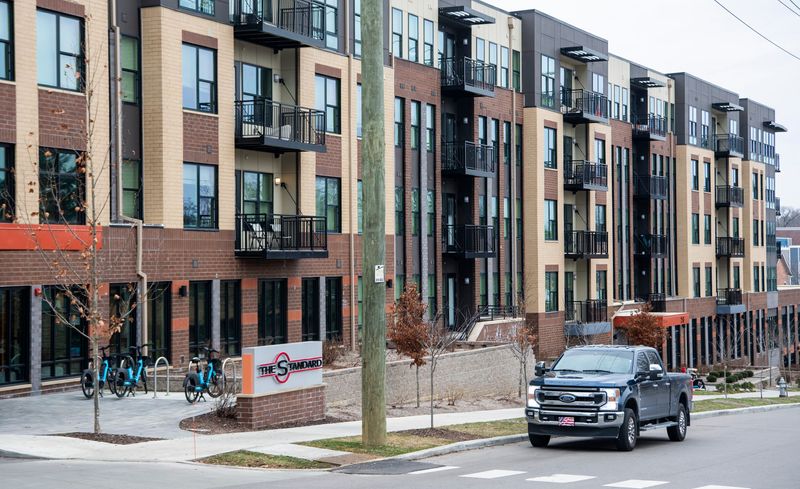
Enrollment at Indiana University’s Bloomington campus has risen by thousands of students in the last decade, but the university has failed to add any significant amount of on-campus housing during that period, forcing an increasing number of students into the city’s already tight rental housing market.
Enrollment on the Bloomington campus, at a record 48,626 this fall, has grown by nearly 5,500 students since 2015, while the number of residence hall beds had increased by 556 since then.
The surge in student enrollment is putting additional pressure on rental availability, while students report rising prices and limited options close to campus.
IU declined to make anyone available for an interview. Instead, an IU spokeswoman sent a statement that indicated the institution is “excited to have all first-year beginner students in permanent on-campus housing this fall.”
IU turns lounges into makeshift dorms
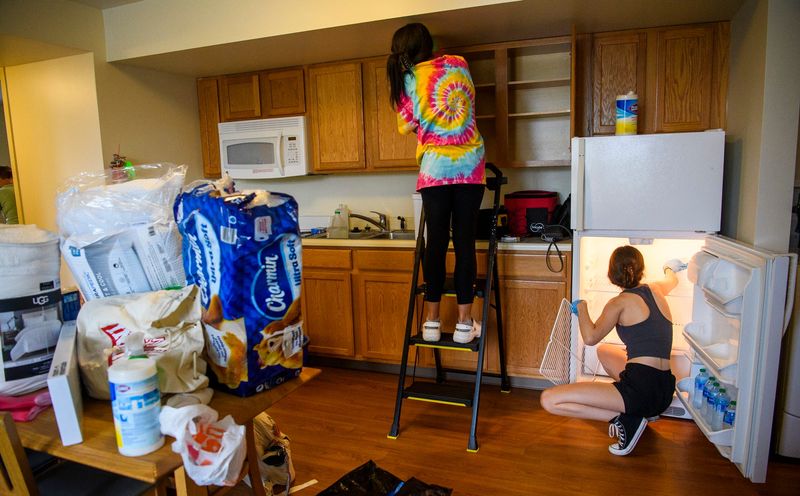
However, some students are reporting that their accommodations appear to be rather temporary and include bunk beds in lounges that have been converted into makeshift dorm rooms.
For Seerat Gill, an IU student who worked as a resident assistant during her sophomore year, the flaws in IU’s housing system are clear from the inside.
From the initial applications to the final housing assignments, students deal with delays and uncertainty, often leaving students confused about where they will live.
Gill recalled a friend placed in “emergency housing,” which meant staying in converted lounges packed with three or four students in bunk beds, without locks, privacy, or security.
“It was just a messed-up situation,” she said, noting that dorm overcrowding also led to doubles being turned into triples.
On Reddit, a student in early August said they were assigned to “supplemental housing” set up in floor lounges, with someone else on the thread saying the university sometimes groups four to six “random kids” into open lounge space during housing shortages.
Another student said on Reddit in August that they also were assigned “supplemental housing,” in Eigenmann Hall, “with 3 other random ppl.” The student asked others about that arrangement, with one answering that it was “not great.”
“Essentially, there are too many people signed up to live on campus and not enough rooms,” the respondent said. “They basically convert the floor lounges to rooms. Luckily, a lot of people either drop out, move off campus, … (and) rooms free up within the first few weeks, so it’s unlikely you’ll be there for the entire year.”
Another respondent warned that the thermostat in the lounge would have only “a very limited range,” and that lounges in the winter may get very warm and the student should “bring a T-shirt and shorts for the winter and bring a fan and a small air purifier.”
IU spokesman Mark Bode said via email that the number of beds on the IU campus has increased by 1,112 in the last year because of the $52 million renovation of Wright Quadrangle.
“That was part of the reason for the weeks-long temporary beds two years ago — a major dorm had gone under construction,” Bode said.
IU razes dorms — adds few new ones
The thousands of additional students who are looking for off-campus housing in Bloomington are — much like non-students — finding an expensive rental market: The typical monthly rent in Monroe County in the first five months of the year averaged $1,410, according to Zillow Research. That was $545 more than a decade ago, an average annual increase of 6.3%.
A 1,700-square-foot house with four bedrooms and four bathrooms in Bloomington recently was for rent for $10,000 a month. Large local apartment complexes routinely offer single bedrooms for $1,700. Meanwhile, wage growth in the Bloomington area has lagged national and even state averages.
While IU says the number of residence hall beds has increased by 370 in the last decade, the university in recent years has razed or earmarked for demolition multiple residence halls and apartment buildings, including Redbud Hill, Evermann, Banta, Bicknell, Hepburn and Nutt. In 2022, IU tore down the Poplars building, a 1960s-era former dorm, hotel and office building. It initially planned to keep the area as a green space but is now building an $81 million, 396-bed apartment building on the site.
Local and national experts said universities’ failure to provide more housing nationwide is worsening the housing crisis and negatively affects the students’ graduation rates and their parents’ pocketbooks. However, the experts also said universities are dealing with rising construction costs and increased competition from private sector builders that make on-campus housing a financially risky proposition.
Local experts also said while IU’s rising enrollment and lack of on-campus housing contributes to the local housing crisis, other factors — including scarcity of land, high land costs and rural resistance to housing developments — play a bigger role.
County officials have said they have an obligation to preserve some of the county’s rural areas and to prevent sprawl. A county official last year also suggested the city should allow taller buildings to counter the housing crisis.
The problems with which Bloomington is dealing aren’t new: A U.S. Department of Housing and Urban Development report noted in 2015 that despite surging enrollment at college campuses across the country, “on-campus housing construction has not matched increased enrollment.” Between 1990 and 2012, enrollment at degree-granting institutions increased by 48%, while the on-campus student housing stock rose just 31%, the agency said.
The dynamics have not improved in Bloomington — and many other college towns — since then. Other Midwestern cities are dealing with similar challenges, though some to a lesser extent: At the University of Michigan, enrollment has increased by more than 9,000 in the last decade, but housing capacity has increased by about 1,500.
Purdue University got some unwanted attention in 2018, with BuzzFeed reporting that people compared makeshift dorm rooms to “prison” and “boot camp.” Enrollment at the university has increased by about 20,000 in the last decade, to 58,000 last fall. The university reported a residence occupancy of just under 16,000 in 2023 and has said that places it in the top 3 of the Big 10 schools and among the largest nationally. The university did not respond to an emailed inquiry from The Herald-Times.
At the University of Illinois Urbana-Champaign, record enrollment in 2020 prompted the institution to convert lounges into dorms, according to the student newspaper The Daily Illini. In 2022, a university official told the paper that the institution had no plans to expand on-campus housing capacity.
In an annual report on university housing, the university pointed to high maintenance/upgrade costs and competition from the private sector among the reasons for not adding more on-campus housing: “The new construction growth in the private apartment market continues to challenge the ability to attract and retain returning residents across all types of certified housing,” it said.
The university also said it “continues to address significant facilities challenges to keep apartments in good condition, including updating electrical panels, replacing tile, and initiating more extensive remodeling.”
Some universities also are luring students with luxurious digs. Rather than sparse accommodations with shared bedrooms and twin beds next to bare cinderblock walls, the University of Kentucky, for example, is offering on-campus living with individual bedrooms, semi-private bathrooms, a full kitchen, washer, dryer, granite countertops, built-in closets and full-size beds with a Tempur-Pedic mattress.
Experts: IU is part of the problem — but not the main one
IU declined to answer emailed questions, including how it planned to balance growing enrollment with on-campus housing availability, how many students it had placed in temporary housing because of limited space, whether it had plans to expand on-campus housing or how it views its role in the broader Bloomington housing market.
Geography scholar Steve Volan, a former Bloomington City Council member and now host of The 812, a podcast about local government, said IU, like all public universities, rely on the local market to provide housing for students.
The university’s enrollment has increased by about 250 students per year on average since 1970, and neither IU nor the local market has added enough housing to keep up, he said.
“The housing stock has not grown with the enrollment growth,” Volan said. “I don’t think it’s a secret that if there’s more people looking for the same amount of housing, the price goes up.”
While he wished that IU added a small number of beds every year — 600 or so per decade — Volan said the root problem lies elsewhere.
“IU’s failure to provide housing isn’t really the issue. It’s failure to (cap) enrollment,” he said.
Volan, who addressed some of the local housing challenges in his master’s thesis, said the university should control its growth and cooperate more with the city, but the community should prepare for the fact that the university’s enrollment will always increase.
Anna Killion-Hanson, director of the city’s Housing and Neighborhood Development department, said the increasing number of IU students in Bloomington plays a role in the local housing market, but other factors — local zoning laws, ease of financing for corporate developers, shorter-term rentals such as Airbnbs — play a much bigger role.
“I think that it’s not as cut-and-dried as you think it is,” she said.
For one, Killion-Hanson said, undergraduate students represent a different segment of the housing market than local working families.
Local zoning laws make it easy for out-of-state developers to come in and build apartment complexes, but they make it more difficult for local builders to add housing, she said. For example, getting a local permit to allow building sometimes takes more than six months, Killion-Hanson said, and at that point people start losing their financing — which benefits people with deep pockets and essentially eliminates projects from smaller, local builders.
Student-centric developments do, to some extent, crowd out developments for non-students, in part because of the scarcity of available land within the city, but Killion-Hanson said factors such as high land costs, high construction costs, historic preservation restrictions and county officials’ antipathy toward density contribute more to the local housing crisis than the university’s failure to provide more housing for students.
“We really need to start thinking about what kind of development we’re encouraging,” she said.
The administration of Mayor Kerry Thomson has said it wants to reduce administrative hurdles for those local builders in Hopewell, the city’s planned neighborhood on the former hospital campus.
Killion-Hanson, a former local realtor who also worked in the construction industry, said the city is analyzing local laws especially to reduce the time it takes to obtain local permits.
“We’re trying to figure out how not to be our worst enemy,” she said.
IU students ask for more dorms, better communication
Gill, the IU student and former resident assistant, said the limited number of beds provided by IU makes the housing process stressful for students and forces them to think ahead.
“I remember being advised to look out for housing at least a year out,” she said.
At IU, many students find themselves searching for off-campus housing as early as October of their freshman year, a process that can feel overwhelming, especially for students looking for a good deal.
“Finding housing is pretty easy because there are a lot of apartments where you can go starting from what your price range is to amenities,” said Dhruvika Pareta, a junior at IU. “But then getting deals on it is kind of hard. What I realized in the past two years is that people do negotiate, and if you talk to them, you can get your apartment for lower.”
Competition adds pressure, she said, with units quickly being claimed, and students rushed to make decisions. While she believes off-campus housing can be manageable, she also stressed that IU needs to do more to prepare students for the process.
“Maybe creating awareness is what IU should do,” Pareta said.
While Gill acknowledged IU has made changes, such as reserving Union Street Apartments for sophomores and upperclassmen, she said the university still hasn’t fixed the root issue.
“The only solution I see is to add more dorms,” Gill said. “And they need to fix the timeline. Students should get housing information well in advance instead of being left scrambling.”
Volan, the former city councilman, said the university could transform the local housing market if it built additional housing not just for students but for staff. If IU built housing for some of its employees, so that the clerical staff doesn’t have to commute from Owen County, “that would be the real breakthrough,” he said.
Ayzah Khan can be reached at akhan@gannett.com. Boris Ladwig can be reached at bladwig@heraldt.com.
This article originally appeared on The Herald-Times: More students, same beds: Indiana University’s dorm dilemma fuels housing crunch
Reporting by Ayzah Khan and Boris Ladwig, The Herald-Times / The Herald-Times
USA TODAY Network via Reuters Connect