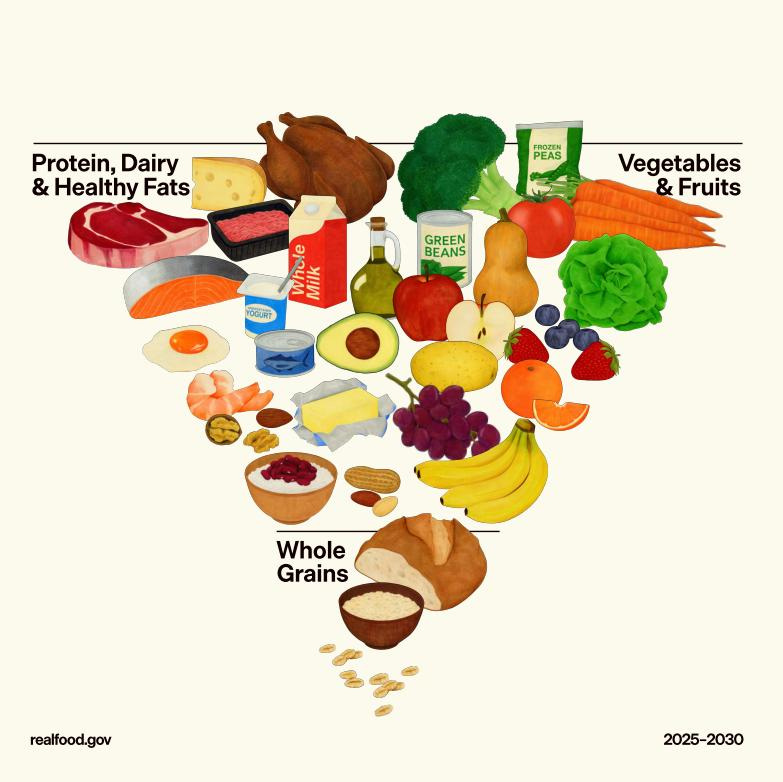
In January, Robert F. Kennedy Jr., Secretary of Health and Human Services, issued a new “food pyramid,” the required five-year update entitled the “2025–2030 Dietary Guidelines for Americans.”

The new food pyramid is a significant change from previous federal nutritional guidance that was grounded on decades of evidence-based nutritional and metabolic research. The new pyramid is considered an “upside-down” version of previous models, including the more recent “MyPlate” adaptation. It prioritizes protein, healthy fats, vegetables, and fruits at the wide top and positions whole grains at the bottom narrow tip.
Kennedy developed the new guidance out of public view, using a panel appointed by him rather than utilizing traditional independent expert input. Kennedy has criticized previous recommendations as being influenced by the food industry; yet half of the members of his new panel have financial relationships with the food, beef, dairy, and supplement industries.
Consistent with Kennedy’s previous health recommendations (for example, the childhood vaccine schedule, COVID and influenza recommendations, and Tylenol use in pregnancy), portions of the new guidelines are confusing and conflictual, emphasizing research consistent with his views while ignoring or minimizing unsupportive research.
That said, there are many positive aspects to the new pyramid, and it adds detail never before included. Kennedy’s pyramid:
However, concerningly, the new pyramid:
My concern with eggs and red meat is that they contain high amounts of saturated fat, which can lead to cardiovascular and cerebrovascular atherosclerosis. Decades of research confirm this.
Kennedy states, nonetheless, that “We are ending the war on saturated fats.”
Saturated fat from animal sources, including red meat, eggs, butter and beef tallow, is emphasized and considered one of the healthy fats. But the new guidelines send mixed messaging by simultaneously advising that saturated fat remain below the previously recommended 10% of total calories.
These are more than just guidelines; they also form policy frameworks for nutritional programs accepting federal funding.
Endorsements by the American Medical Association, the American Academy of Pediatrics, and the American College of Cardiology carefully highlight only the positive aspects of the new nutritional guidelines as outlined above.
Although there are many positive aspects to the new nutritional guidelines, I remain uneasy, mostly about the new pyamid’s promotion of saturated fats.
Dr. Richard Feldman is an Indianapolis family physician and the former Indiana state health commissioner. Email him at richarddfeldman@gmail.com.
This article originally appeared on The Herald-Times: Feldman: What to make of America’s new food pyramid?
Reporting by Dr. Richard Feldman, Columnist / The Herald-Times
USA TODAY Network via Reuters Connect