Welcome to Florida!
You’re probably aware that Florida has battled invasive species for decades. From Burmese pythons, tegus and green iguanas to rhesus macaque monkeys and lionfish, non-native species pose a significant problem for the Sunshine State.

One of the invasive creatures squatting in Florida is difficult to distinguish from its native cousin, poisonous, competitive and rapidly reproduces.
Meet the invasive, toxic cane toad, also known as bufo toad, marine toad and giant toad.
Cane toads secrete a milky-white toxin from the glands behind their eyes called bufotoxin that can harm or even kill animals that lick, bite or eat them, including domestic pets. Cane toad eggs also contain bufotoxin and can sicken or kill animals that consume them.
Additionally, bufotoxin can irritate the skin and burn the eyes of people who handle cane toads.
Here’s what to know about cane toads and how to keep yourself and your pets safe:
How did cane toads get to Florida?
According to Florida Fish and Wildlife, cane toads were first introduced into Florida to control agricultural pests in sugar cane in the 1930s and 40s.
It is believed that current populations are the result of escapes and releases by importers in the 1950s and 60s.
Cane toads are currently found in central and south Florida, generally south of the I-4 corridor.
Are cane toads still a problem in Florida?
Yes. Cane toads compete with native species for food sources and alter the ecosystem by preying on native frogs, lizards, snakes, small mammals, and just about anything else that fits into their mouths.
Cane toads are commonly found in yards, around buildings, near canals and ponds. Cane toads breed year-round in standing water, streams, canals and ditches.
According to the University of Florida, as of 2017, cane toads were established in much of Florida’s southern peninsula as far north as Tampa, with several isolated sightings in northern Florida.
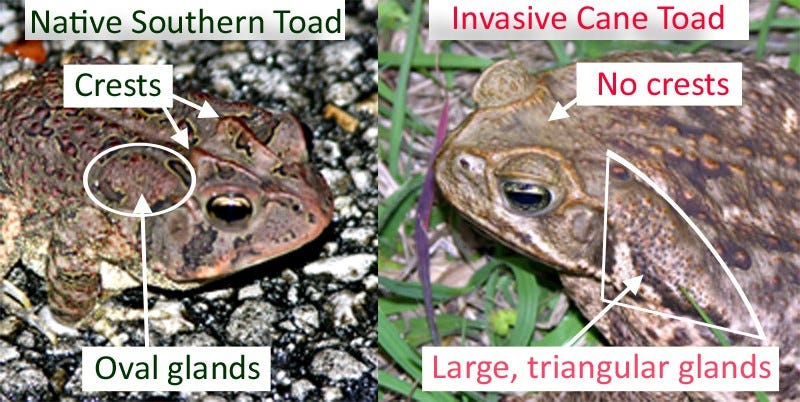
Cane toad vs native southern toad: How to tell the difference
Cane toads generally range from 6 to 9 inches in length. With few exceptions, a toad in Florida that is larger than 4 inches is almost certainly an invasive cane toad, according to the University of Florida.
The native southern toad is most likely to be mistaken for a cane toad.
According to the University of Florida’s Wildlife-Johnson Lab, the cane toad’s body is tan to reddish-brown, dark brown, or gray with warty skin and back marked with dark spots. Large, triangular parotoid glands are prominent on the shoulders; parotoid glands of native “true” toads are oval.
Unlike native southern toads, cane toads don’t have ridges or “crests” on top of their heads.
What if my dog or cat licks, bites or eats a cane toad?
If your pet bites or swallows a cane toad, they can get sick and die in as little as 15 minutes if left untreated.
Symptoms include frantic or disoriented behavior, brick red gums, seizures and foaming at the mouth.
Treatment:
Prevention
Cane toads are often found in yards during rainy, warm days, but you can help prevent encounters with pets by removing cane toad attractants and places where they might hide. Installing no-gap fencing and removing as many sources of standing water as possible can help keep out cane toads.
How to get rid of cane toads in Florida
To safely remove cane toads that have been properly identified, FWC recommends wearing eye and skin protection, and wearing latex, rubber, or nitrile gloves if handling.
Captured cane toads may not be relocated and released. Cane toads are not protected in Florida except by anti-cruelty law and can be removed from private property and humanely killed year-round with landowner permission.
To humanely euthanize a cane toad, generously apply benzocaine or lidocaine ointment or spray (found in drug and grocery stores) to the toad’s back or belly and freeze it overnight.
Those needing assistance removing cane toads from their property can hire a wildlife trapper.
This article originally appeared on Fort Myers News-Press: New to Florida? These invasive creatures can harm dogs and cats. How to keep pets safe
Reporting by Kim Luciani, USA TODAY NETWORK – Florida / Fort Myers News-Press
USA TODAY Network via Reuters Connect