The world watched as Boeing’s Starliner spacecraft malfunctioned in orbit, turning what was supposed to be a 10-day mission into a nine-month stay for two astronauts aboard the International Space Station.
Now NASA released the findings of its investigation, prompting the space agency to classify the incident as its most serious “Type A” mishap and call for improvements to not just spacecraft design but leadership and safety oversight.

“It is worth restating what should be obvious at that moment, had different decisions been made, had thrusters not been recovered or had docking been unsuccessful, the outcome of this mission could have been very, very different,” said NASA Administrator Jared Isaacman.
“Starliner has design and engineering deficiencies that must be corrected, but the most troubling failure revealed by this investigation is not hardware, its decision making in leadership that left that, if left unchecked, could create a culture incompatible with human spaceflight.”
NASA made the surprise announcement about its investigative findings Thursday, Feb. 19, stating that Congress will be briefed and the results of the investigation will be released this week. However, Isaacman immediately released some documents via X.
“Propulsion anomalies cascaded into multiple thruster failures and a temporary loss of six degree of freedom control,” he said during the press briefing.
That loss of control was seen live on NASA TV during the June 2024 docking, as multiple thrusters on the spacecraft shut off as the spacecraft was approaching the ISS. While the astronauts took manual control, teams on the ground raced for a solution. Eventually the engines were “hot fired” and the spacecraft was successfully docked.
Isaacman said that while the two astronauts and controllers acted with urgency and professionalism, the outcome could have been drastically different.
“The engineering reality, however, is that Starliner, with its qualifications deficiencies, is less reliable for crew survival,” said Isaacman.
Isaacman said there is no such thing as perfection in challenging missions, such as a spacecraft’s first crewed flight, and mistakes will occur. But what defines NASA is its willingness to learn from those mistakes, he said.
Isaacman pledged that moving forward, learning and remaining vigilant will be the guiding principle at NASA. This includes having “multiple sets of eyes” on both the Commercial Crew Program and Artemis, he said.
It was also noted that disagreements regarding crew return options escalated into instances of unprofessional conduct during the crew’s time in orbit.
Isaacman said that Boeing’s approach to propulsion system design and certification permitted hardware operation beyond established qualification limits, a practice that did not meet required safety margins for NASA crew. But the mission was flown anyway as NASA sought a second vehicle to take astronauts to the station in addition to the SpaceX Dragon.
An uncrewed Starliner-1 mission could still fly as soon as April, but it will not launch until all problems has been corrected, Isaacman said. The agency will continue to work with Boeing to correct these issues.
How NASA got to this point
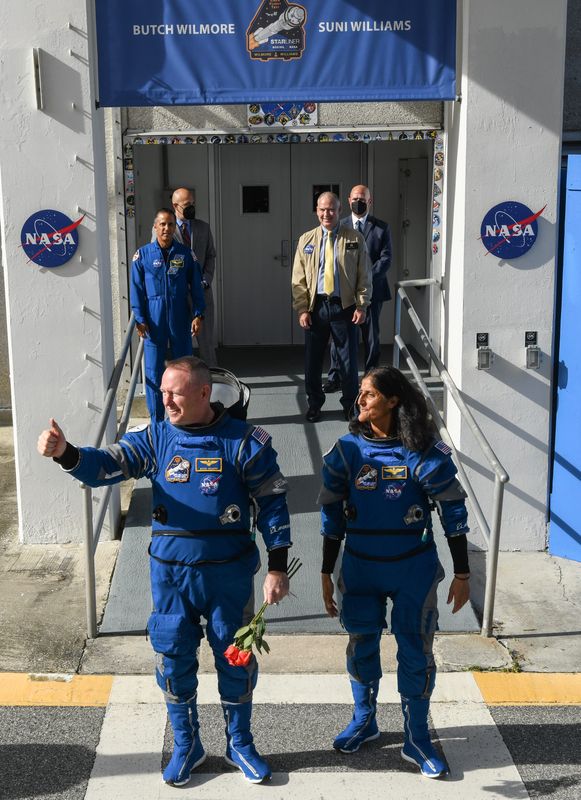
NASA watched in June 2024 as two of its astronauts, Butch Wilmore and Sunita Williams, took off on the first crewed flight test of Boeing’s Starliner. The spacecraft was planned as the next vehicle in line to transport astronauts to and from the space station, with SpaceX already leading the way with its Dragon.
The much-delayed Starliner flight test lifted off on June 5, 2024 atop a United Launch Alliance Atlas V rocket from Cape Canaveral. The two astronauts experienced issues with Starliner from the start, seeing five thrusters in the service module shut off as the spacecraft approached the station.
After teams performed a “hot fire” — during which commands were sent to Starliner from the ground — the thrusters were signaled to come back on and Starliner was able to safely dock. But then NASA worried about thruster performance upon reentry. After much testing by Boeing and NASA on the ground in the months that followed, NASA decided the safest path forward was to return the spacecraft without crew.
Williams and Wilmore were added to the upcoming Crew-9 expedition and remained on the ISS until March 2025, when they finally splashed down aboard a SpaceX Dragon. What was supposed to be a 10-day mission had turned into nine months away.
Both Williams and Wilmore have since retired from NASA.
NASA’s Starliner backstory
After retiring the Space Shuttle in 2011, NASA sought two private proposals to transport astronauts to and from the ISS. They wanted two options for redundancy sake.
The agency eventually awarded $4.82 billion for Boeing and $3.14 billion for SpaceX to develop new spacecraft. SpaceX has flown NASA astronauts since 2020 while Boeing still seeks to catch up and fly a successful crewed mission.
The first uncrewed test flight of Starliner (OFT-1) launched in 2019, and while it reached orbit, it failed to reach the ISS. The follow up flight test (OFT-2) launched in 2022, and while it met standards of docking to the ISS and successfully landed, multiple issues were discovered as Boeing crews inspected the spacecraft after its return.
The problem-plagued crew test flight, the subject of this investigation, was next.
Brooke Edwards is a Space Reporter for Florida Today. Contact her at bedwards@floridatoday.com or on X: @brookeofstars.
This article originally appeared on Florida Today: NASA’s investigation calls Starliner most serious ‘Type A’ mishap
Reporting by Brooke Edwards, Florida Today / Florida Today
USA TODAY Network via Reuters Connect