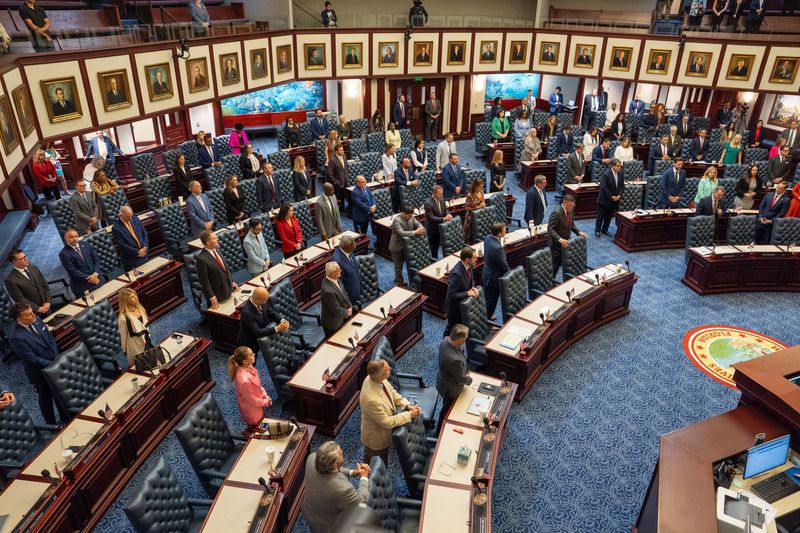
In the final hours of writing Florida’s state budget, outside the standard appropriations process, legislative leaders steer hundreds of millions of dollars to select projects through what Capitol insiders call the “sprinkle lists.”
It’s slang used by reporters, lobbyists and lawmakers to describe last‑minute supplemental funding added to the budget by chamber leadership after major spending decisions have been finalized. The idea is that lawmakers are “sprinkling” extra money across the state – often to favored districts or causes – outside the main budget.

The current Senate and House supplemental funding lists together total more than $400 million based on various line items. And that spending includes money for major policy priorities as well as local projects across the state.
Government accountability groups have long criticized the practice, saying legislative leaders effectively direct funding to select projects during closed‑door negotiations after the formal public review process has ended.
And this year’s budget process was more behind-the-scenes than most. Lawmakers had to return in special session starting May 12 just to finish the spending plan; several days passed when there were no public meetings between the House and Senate budget chiefs.
Florida TaxWatch, a nonpartisan, nonprofit research institute focused on taxes and spending, has been particularly critical. Kurt Wenner, its senior vice president of research, has argued sprinkle lists undercut sound budgeting practices because they are approved without public deliberation.
“The practice of spending hundreds of millions of dollars, largely on members’ pet projects, as an afterthought, should be discontinued,” Wenner wrote in a 2023 position paper.
A year earlier, when the group released its annual Budget Turkey Watch report, former U.S. Sen. George LeMieux, then chairman of Florida TaxWatch, bluntly framed the issue.
“Sprinkles are the new turkeys,” LeMieux said, using the group’s term for questionable appropriations that bypass the normal budget vetting process.
Legislative leaders, however, defend the practice as a practical tool.
Sen. Tom Leek, R‑Ormond Beach, led House budget negotiations for 2023 and 2024. He said the supplemental lists allow lawmakers to address priorities left unresolved during formal debate.
“The supplemental list has enabled us to make key investments in rural infrastructure, correctional officers, universities and colleges,” for instance, Leek said.
And when former Senate President Tom Lee, R-Thonotosassa, was asked about the practice, he said being able to steer money to home districts is a powerful incentive for lawmakers.
“That’s why people run for office,” said Lee, who also was a chair of the Senate Appropriations Committee.
What’s in the sprinkle lists
The latest lists include a mix of big statewide spending and smaller local projects. Examples include:
Smaller local items can include stormwater upgrades, after‑school programs and community health initiatives.
The mechanics of a sprinkle listing unfolds in the final stage of the budget process. The first step is for the House and Senate to each pass their separate spending plans. Then a conference committee of representatives and senators meet to negotiate a final budget.
But legislative leaders will have held back a portion of funds not part of conference negotiations. While negotiations proceed, each chamber compiles its own supplemental funding list. And the two chambers typically agree to accept each other’s lists. The items are added shortly before the final budget vote.
Critics say that structure limits transparency. Supporters say it allows negotiators to resolve outstanding issues and close budget deals.
Is it a ‘slush fund’?
When the practice emerged in the early 2010s it was for relatively modest late‑stage allocations but then quickly expanded.
By 2015, lawmakers were steering roughly $300 million through last‑minute project lists. And in recent years, the totals have grown dramatically, reaching about $670 million in 2023 and totaling several hundred million dollars again this year.
Watchdog groups have long raised concerns about a process that concentrates spending decisions in the hands of legislative leaders and unfolds largely out of public view. That’s why critics say they resemble a “slush fund.”
But the money is formally appropriated within the overall state budget, and lawmakers note legitimate programs are often included on the list. The numbers underscore how what once was informal budget practice now has become an acceptable practice.
So sprinkle lists now are a routine feature of Florida budgeting – and aren’t likely to go away anytime soon.
Some reporting in this story was previously published. James Call is a member of the USA TODAY NETWORK-Florida Capital Bureau. He can be reached at jcall@tallahassee.com. Follow on X: @CallTallahassee.
This article originally appeared on Tallahassee Democrat: Florida ‘sprinkle lists’ steer millions for pet projects from behind closed doors
Reporting by James Call, USA TODAY NETWORK – Florida / Tallahassee Democrat
USA TODAY Network via Reuters Connect