This story is part of our weekly Hidden Gems feature series as the USA TODAY Network-Florida takes readers around the state to highlight some of our most interesting attractions.
There are almost no traces left to indicate that Jacksonville once reigned as the Winter Film Capital of the world, with more than two dozen studios shooting films around the city more than a century ago.

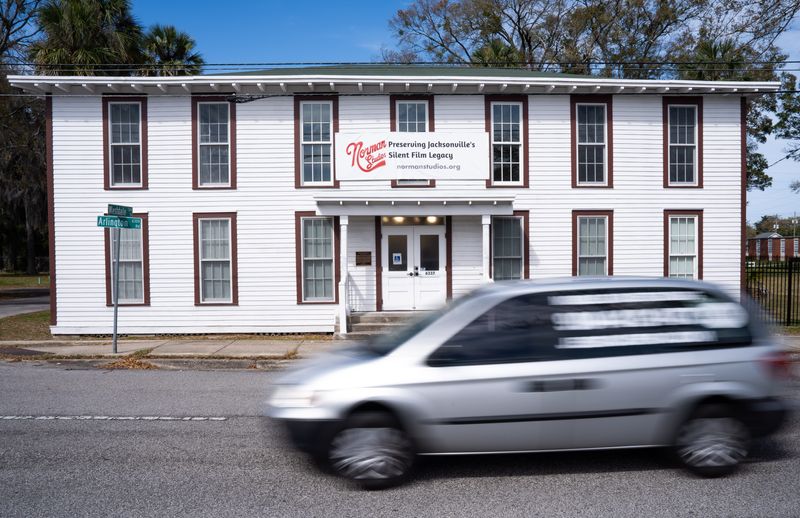
But the volunteers at Norman Studios Silent Film Museum in Arlington aren’t about to let that heyday go unremembered. They lead tours of the on-site museum and grounds two Saturdays a month and would love to do so more often if they could find more helpers.
They haven’t shot movies at Norman Studios for decades, but it has a set building, a wardrobe cottage, a props garage and a generator building on the grounds with the main studio building, which now serves as a museum.
“There’s no place like this in the country,” said Barbara Wingo, president of the Norman Studios board of directors. “This is a full silent-film studio complex.”
The only thing missing from the complex is a water tower. “And if some generous person wanted to donate …,” Wingo added.
Old photos show a water feature that once fronted Arlington Road and was filled in decades ago. Wingo said she’d love to work with local archaeological groups to see what might be buried in there.
What makes the Norman Studios Silent Film Museum special?
The studio — added to the National Register of Historic Places in 2015 — is owned by the city of Jacksonville and operated by a nonprofit group that has no employees. Most of the buildings are closed to the public; there’s really nothing interesting in them at this point, but there are plans to utilize them in the future. The main focus is the first floor of the production building, which houses the museum. The second story of the building remains unfinished.
It was originally built as a cigar factory that never operated. In 1916, Eagle Film City began operating a silent-film studio on the site. Richard E. Norman bought it in the early ’20s and began making race films, with a Black cast aimed at a Black audience. Norman, who had previously made a name for himself by traveling around the country and shooting the same film over and over with a local cast, chose Jacksonville for his studio because it had a large Black population and the weather was right for filming.
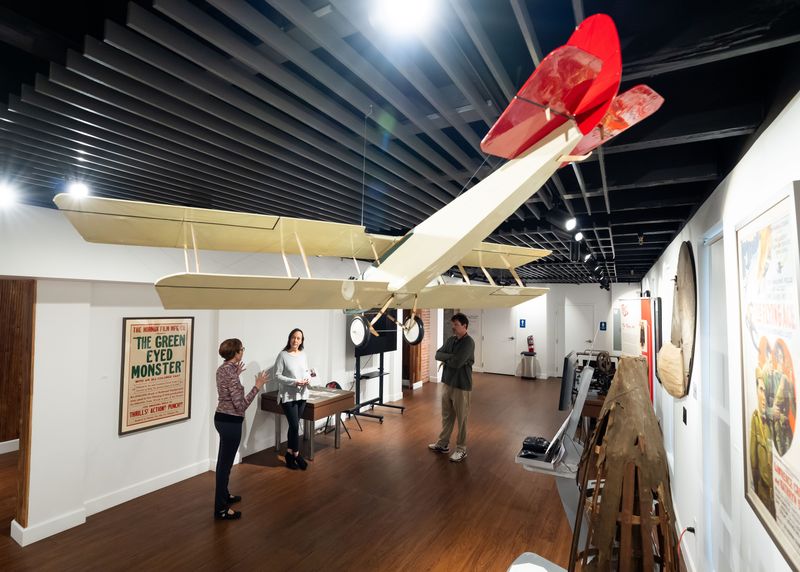
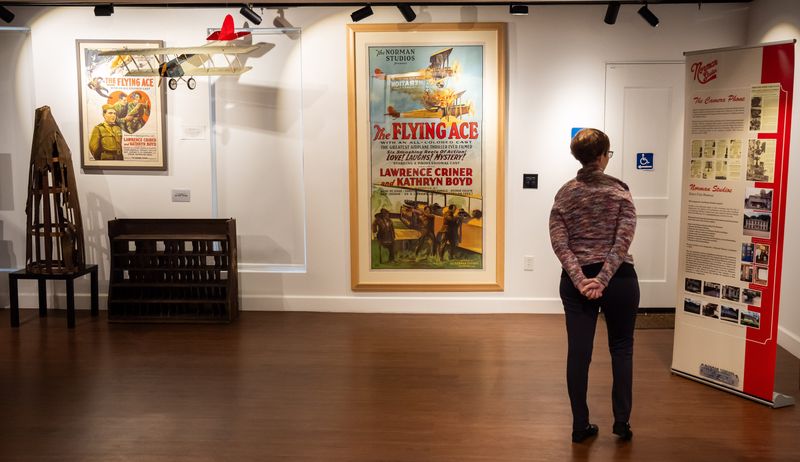
A few Eagle City films still exist, but posters and props are all that remain of most of the Norman Studios movies, which were recorded on film that either deteriorated or were lost over the years. “Sleepy Sam the Sleuth,” “The Crimson Skull,” “The Green Eyed Monster” and “The Bull-Dogger” were among the Norman Studios titles filmed in Jacksonville.
“The Flying Ace” is the only Norman film that survives in its entirety. It was added to the Library of Congress’s National Film Registry in 2021. It tells the story — silently, of course — of a World War I pilot who takes a job as a railroad detective to track down a stolen payroll. It was filmed on the Norman Studios lot, and pieces of the prop airplane (they used the same prop for the hero’s plane and the villain’s) are on display in the museum. There’s also an interactive flying game that museum visitors can play.
Devan Stuart Lesley, media and publicity director, said she’s optimistic that prints of some Norman Studios films still remain to be found. “The Bull-Dogger,” a 1922 movie starring Black rodeo cowboy Bill Pickett, was one of Norman’s most popular films, and she said she thinks it is the most likely to be recovered. “I have a feeling that we’ll eventually find a copy of ‘Bull-Dogger,’ and it will come out of Europe,” she said.
A brick-lined vault is smack in the middle of the building. When the city bought the complex in 2002 after a grassroots group in Arlington formed to save it, a locksmith was brought in to open the vault, which had been closed for as long as anyone could remember. The vault, which was originally built to store the highly flammable film stock, was filled with old reels, film cans, equipment and an old toy camera that had belonged to Norman’s son. The toy camera is now on display at the museum, which also features movie posters and cameras.
Many people raised in Jacksonville associate Norman Studios with dance, rather than film, because it was the site of the Gloria Norman Dance Studio for decades. The studio was run by Richard Norman’s wife long after filming had stopped on the site.
They don’t show films at Norman Studios, and at this point, don’t have permits to hold large public events. Wingo said she’d love to see it used for festivals or weddings, but there’s still work to be done before that can happen. “There are a lot of people in this town where that is their emotional touchstone,” Lesley said.
Future plans call for the development of the main building’s second floor, converting the wardrobe cottage into a concession stand and gift shop and adding a summer camp for kids.
What to know before you go to the Norman Studios Silent Film Museum
Where: 6337 Arlington Road, Jacksonville
Hours: 11 a.m. to 3 p.m. the first and third Saturdays of each month for tours
Cost: Admission is free, but donations are welcome.
More info: For more information, visit normanstudios.org.
This article originally appeared on Florida Times-Union: Florida Hidden Gem: Norman Studios recalls Jacksonville’s movie-making past
Reporting by Tom Szaroleta, Jacksonville Florida Times-Union / Florida Times-Union
USA TODAY Network via Reuters Connect