The Collier County Planning Commission has given a thumbs up to a proposed affordable housing development on a less than five-acre plot in Golden Gate Estates.
At a hearing on April 2, the advisory board voted 5-1 to recommend approval of the project to county commissioners, who will make the final decision.

The project faces neighborhood opposition in an area of rural character, with single-family homes on large lots.
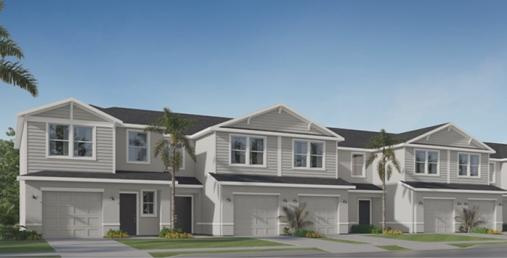
The development would include up to 36 townhomes for rent or sale, with priority given to essential workers, such as teachers and firefighters. The project would be 100% affordable. It’s being spearheaded by the Collier County Community Land Trust, which has a contract to purchase the 4.18-acre site.
Collier County still has a critical need for affordable housing
Formed in 2020, the mission of the nonprofit Collier County Community Land Trust is to provide housing opportunities in the county that are permanently affordable. There continues to be a critical need for affordable housing in the county.
There are an estimated 53,999 cost-burdened households in the county, representing more than 36% of all households. Households are considered cost-burdened when they spend more than 30% of their income on housing.
The proposed development would offer a rent-to-own program, with income limits for renters and buyers.
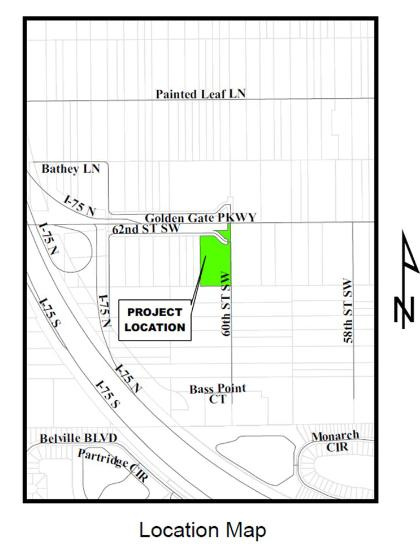
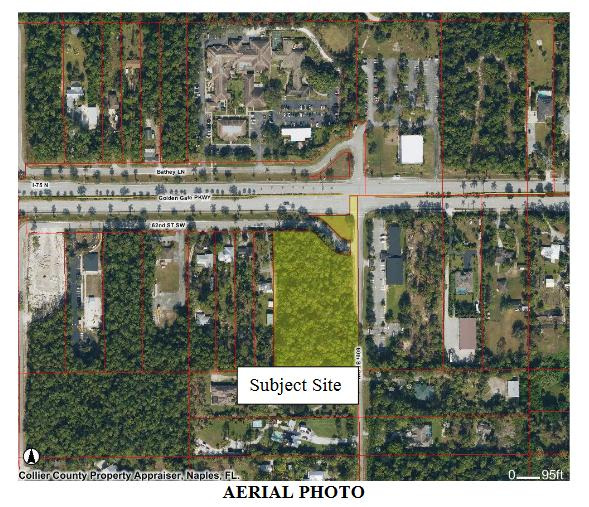
The chosen site is at the southwest corner of 62nd Street and 60th Street, sitting near Golden Gate Parkway, east of Interstate 75, not far from a church.
The project will require an amendment to the county’s Growth Management Plan and a rezoning to a residential planned unit development (RPUD), allowing for increased density.
The property now has Estates zoning, limiting it to a single residence.
At the public hearing, neighbors and their representatives raised concerns about the availability of public water and sewer services for the new development and about the development’s impacts on traffic, safety, and privacy in the surrounding community. Several argued the development would be incompatible and inconsistent, potentially hurting property values.
The development team defended the project, saying it’s not unusual for single-family and multifamily residences to peacefully co-exist, with examples of it all over the county, and contending that affordable housing doesn’t devalue surrounding homes.
Proposed development is a ‘pilot project’
Michael Puchalla, executive director of the Collier County Community Land Trust, told the planning commission the site is an ideal location for affordable housing, central to many of the county’s major employers.
He assured the commission the development would be well-maintained and professionally managed — and vacation rentals would not be allowed.
“This is a pilot project,” he said. “The importance of getting it right and showing the proof of concept, and it being a very credible development, is going to be of utmost importance to the land trust and our board.”
He added that he had a “significant amount of accountability and oversight.”
The Collier County Community Land Trust partnered on an affordable rental development for seniors in the county, but this would be its first opportunity to create a unique opportunity for homeownership well below market rates, Puchalla said.
“We feel like we’ve got a very strong team to make sure this is all done in the absolute right way,” he said.
The land trust proposes 30 years of restricted pricing for rentals and sales.
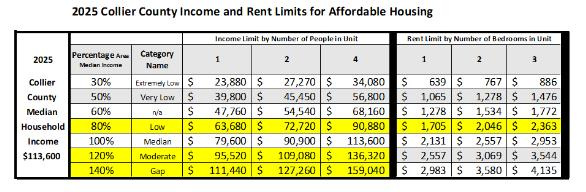
Initially, the townhomes would be available for rent, with 19 reserved for households making no more than 80% of the area’s median income, and 17 capped at 120%. Based on income and household size, rents could range from $1,705 to $3,544 a month.
A good portion of the rent would be applied to the eventual purchase of the home. The goal would be for renters to transition to homeownership within three years.
At the time of transition, a household could earn up to 140% of the area’s median income. Future sales would be restricted to those making no more than 120%, Puchalla said.
The county’s median income is now at $113,600 for a family of four, with a growing divide between the rich and the poor.
County staff supports the affordable housing development
County staff is recommending approval of the development.
Mike Bosi, the county’s planning and zoning director, told the planning commission that county staff worked with Puchalla to “find a comfort level” with the project. It would provide a “unique attribute,” he said, with the opportunity for homeownership that few developers, other than Habitat for Humanity, can provide to struggling households.
Bosi reiterated that the site is ideal, close to public transit and I-75, and situated near Golden Gate Parkway, a major six-lane divided arterial road. Most important, he said, is its proximity to a “high number of economic opportunities” — or jobs.
Neighbors speaking out against the project included Cindy Brown, who lives on 60th Street, a few houses down from where the townhomes would be built. She questioned whether there would be adequate capacity for water and sewer hookups to public utilities, with the Golden Gate Worship Center recently informed it could not convert a house into a church in the neighborhood because there wasn’t adequate sewer capacity.
In answer, Bosi said the Collier County Community Land Trust would have to “pay their proportionate share of any system expansions.”
Chiming in, Joe Schmitt, the planning commission’s chairman, stressed that even if the property is rezoned, the affordable housing project couldn’t move forward if it couldn’t meet all of the county’s infrastructure requirements.
“The fact of the matter is that they have to have adequate public facilities,” he said. “Or the units will not be built.”
Traffic is a big concern among neighbors
Neighbor Cindy Brown shared other concerns, including about added traffic and congestion in the neighborhood.
To help improve road safety, the county has already proposed putting barriers at the end of 60th Street so that drivers can no longer turn left onto Golden Gate Parkway because it’s “too dangerous.” The barriers would force drivers to make a U-turn at next street, clogging up the left-hand turn lane, and it would only be worse with more residents living there, Brown said.
“It’s not going to be a 15-minute drive to go to Naples,” she said. “It’s going to be a 45-minute drive, and you’re going to have more accidents, with people trying to get into Naples.”
She also fears more flooding.
“The other issue is, if you’re going to clear that lot and do all this building, when you have rain, where is that water going to go? Is that going to go in our cute little culvert that runs right in front of my front yard?”
The culvert, she said, already fills to the brim when there is a storm.
“Am I going to have to put a speed bump across my front yard? So, I’m not flooded,” Brown lamented.
Through the review and approval process for the project, Schmitt explained that the applicant would have to verify that any stormwater would be retained on site, in order to move ahead. An environmental resource permit would be required from the South Florida Water Management District.
Additionally, Brown pointed out that there have been a lot of new projects going up in the area, including the David Lawrence Centers’ new behavioral health center, off Golden Gate Parkway.
While she liked the idea of a build-to-rent-to-own project as a way to provide more affordable housing, she said: “I think this is the wrong site for it, because the infrastructure is not there yet.”
Neighbor argues proposed development would be incompatible
Among the other residents opposing the project: Kelly Turner, who lives on 60th Street, and whose single-family home would be on the southern border of new development. She and her husband share the single-family house with their three children, and her mother lives in a separate home on the same property.
“Growth is inevitable, but it must be planned for responsibly,” she said. “The question before you today is not whether housing is needed. It is whether this specific proposal is appropriate for this specific location under the county’s adopted planning framework, the growth management plan, and the land development code.”
She argued the answer is clear.
“This property is located within an established estates pattern, an area that has long been defined by low-density residential use,” she said. “The intent of that designation is not ambiguous. It is to preserve a rural, low-intensity character that is fundamentally different from higher-density residential development. The proposal before you introduces a level of density and intensity that is not consistent with that pattern.”
Turner also raised concerns about the project’s impact on roads, as well as on water and sewer and other public services.
Should the project move forward, she said it should be improved to better protect the neighbors, especially those bordering the site, including by adding more buffering to provide privacy, to manage safety and to reduce the noise and visual impacts, including the shine from more headlights at night.
She also suggested that the primary access to the development should not be on 60th Street. However, county staff directed that it be there, seeing it as the best and most suitable option.
Positive vote by planning commission came with conditions
With its vote to recommend approval, the planning commission directed staff to work with the applicant to improve the entry and exit for the new community, potentially aligning it differently and moving it farther north. The commission also asked for more buffering, to which the applicant agreed, including the installation of a 6-foot wall across the southern boundary, and on a swath of the western boundary.
The majority of commissioners supported the application due to the public benefit of affordable housing.
Commissioner Michael Petscher was the only one to vote against the project, seeing it as incompatible and inconsistent with the neighborhood, the growth management plan and the Golden Gate Area Master Plan. He said there are rules for a reason, and the county should stick by them.
Since the project faces opposition, it will not be on the county commission’s consent or summary agendas, where items are approved with a single motion without discussion.
So, there will be another public hearing before a final decision is made. The final hearing is scheduled for May 26.
Laura Layden is a business and government reporter. Reach her by email at laura.layden@naplesnews.com.
This article originally appeared on Marco Eagle: Collier County panel OKs plan for townhomes, but it faces opposition
Reporting by Laura Layden, USA TODAY NETWORK – Florida / Marco Eagle
USA TODAY Network via Reuters Connect