Last summer, after multiple invitations, I finally joined my friend Ann Maloney for sunrise on Cocoa Beach. I’d put her off because, well, sunrise happens so early.
“It’s worth it,” she promised. She was right.

We walked in the surf as the sun stained the water pink and orange, bathed in the morning’s rosy glow. I couldn’t think of a more perfect way to start the day.
But Mother Nature could.
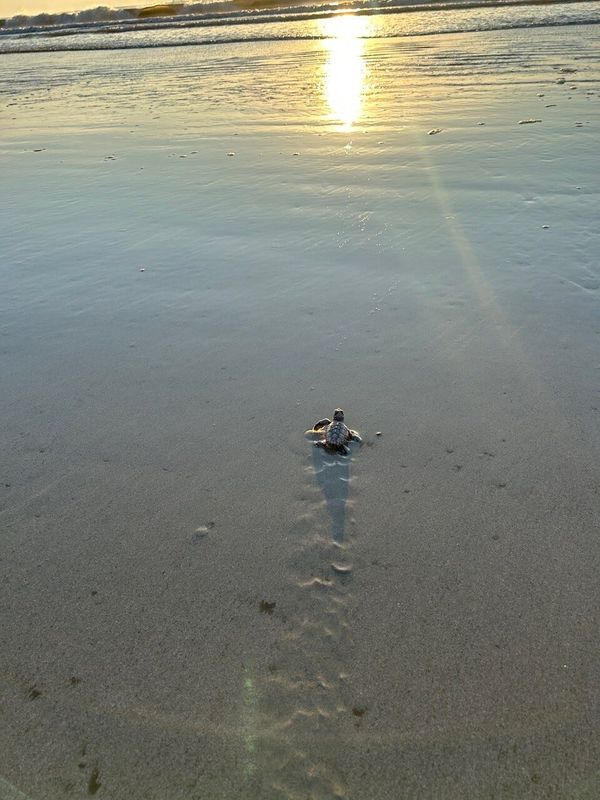
As the sun peeked over the horizon, we saw something wiggling in the sand. A loggerhead, smaller than the palm of my hand, was scampering toward the ocean.
It took determined steps, its tiny flippers propelling it forward. Every few feet, it would stop, as if to rest. Several times, a gentle wave picked up the hatchling, but then deposited it back on the beach.
The process was heartbreaking.
I wanted to help, to pick up the little turtle and release it into the surf, but Ann stopped me.
The turtle needs to get there on its own, she said.
The little fellow’s stronger siblings already had crawled down from their dune-side nest, leaving this and a few other stragglers to take their chances alone. Other early-risers joined our vigil. If we couldn’t help the creature to the water, at least we could keep hungry birds and crabs away.
Finally, after several tries, a wave lapped the beach, lifting the turtle off the sand. I held my breath and said a silent prayer. Swim, little guy. Please swim.
And it did.
Those of us watching its progress cheered.
Love and care await injured sea turtles
About 90 percent of sea turtle eggs in the United States are laid in Florida, and with 72 miles of coastline, Brevard County is an important nursery for loggerhead, green and leatherback turtles, according to the Sea Turtle Preservation Society’s website. Three other species, the Kemp’s Ridley, which occasionally nests on our shores, and the Hawksbill and Olive Ridley, call the Atlantic Ocean home as well.
May through October are prime turtle nesting months, and with an army of volunteers, including Ann and her husband Colley Charpentier, the STPS works to monitor where mama turtles lay their eggs, doing their best to ensure that nests remain undisturbed and that the hatchlings are undeterred in their trip to the ocean.
Unfortunately, making it into open water doesn’t guarantee survival. That’s where the Sea Turtle Rehabilitation Center at the Brevard Zoo comes into play. About 100 turtles a year are brought to the facility, suffering from injuries caused by boat strikes or from ingesting debris. The veterinarians and nurses also treat turtles infected with fibro papillomatosis virus, which causes benign tumors to grow on and inside the turtles’ bodies.
Ann and I recently got the chance to chat with Shanon Gann, sea turtle program manager at the zoo. She told us about Sophia, a loggerhead who was rescued from the Indian River near the Eau Gallie Causeway.
She was suffering from excess gas and was too buoyant to dive. She expelled the gas, but veterinarians determined she had swallowed 18 fishhooks and fishing line. She can pass the hooks, Gann said. Sea turtles are used to eating sharp things like crab shells. The fishing line, however, is more problematic. She’s hanging out in a tank at the center so they can keep an eye on her.
Sir Hooks A Lot, a green turtle currently in residence at the center, arrived with six hooks embedded in his leathery skin, including one in his eyelid.
Santa, another green turtle, was rescued from the Banana River. He was missing a front flipper and a chunk of his shell.
The goal is to get these turtles healthy enough to return the waters where they were found.
More than 200 turtles have been rehabbed and released since the center opened in 2014, Gann said.
I feel lucky to live in a place that’s home to such natural wonders, and I’m grateful to the pros and volunteers who have dedicated their lives to protecting these amazing creatures.
I’ll never know what became of that little hatchling from last summer. Getting to the water was only the first in many obstacles it will face. But the Sea Turtle Preservation Society and the Brevard Zoo are working to give them all a fighting chance.
Here’s what you can do to help
Suzy Fleming Leonard is a retired journalist who spent 25 years as a writer, editor and columnist at FLORIDA TODAY. Reach her at suzy@321creates.com. Lyn Dowling contributed to this column.
This article originally appeared on Florida Today: Brevard’s the perfect place to learn more about (and from) sea turtles
Reporting by Suzy Leonard, For FLORIDA TODAY / Florida Today
USA TODAY Network via Reuters Connect