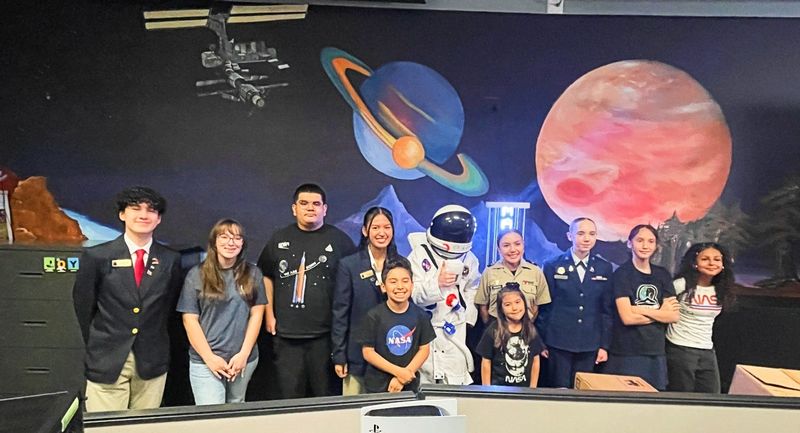
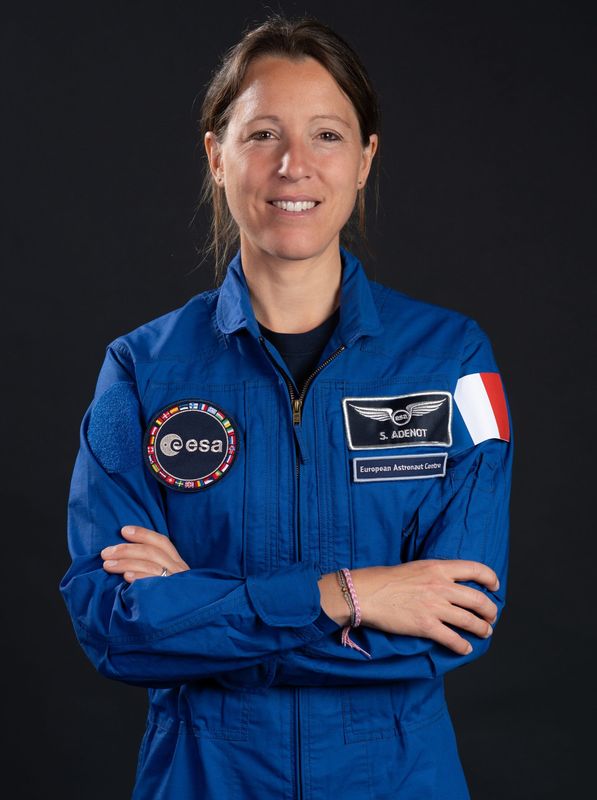
Nearly 250 miles above the Earth, International Space Station astronaut Sophie Adenot chatted with students at The Lewis Center for Educational Research in Southern California.
The European Space Agency astronaut from France fielded questions from nearly a dozen elementary through high school students via the Amateur Radio on the International Space Station program.

Some of the students asked Adenot about her work, the wonders of space and the possible dangers aboard the ISS, which has been in orbit for over 25 years.
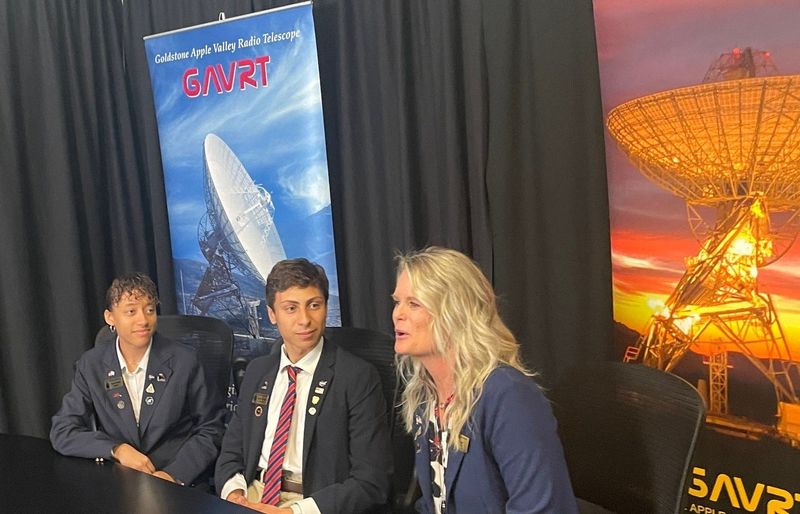
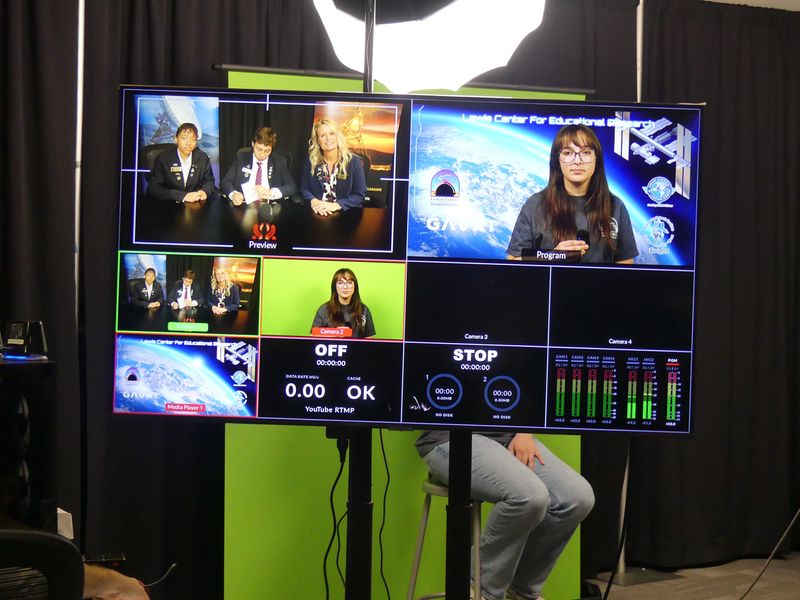
Hosted online by student ambassadors Sahara Dawson and Maximilian Goodley, the student-led event happened at the Lewis Center, on the campus of the Academy for Academic Excellence in Apple Valley. Students from Academy for Academic Excellence and sister campus, the Norton Science and Language Academy in San Bernardino, took part in the nearly 90-minute event on March 19 at the Mojave Desert-based school.
Asking technical and ‘scary’ questions
From the on-campus “Mission Control Center,” an elementary student asked Adenot, “What are some of the current experiments that you are working on?”
“We work on a lot of experiments in many different fields,” Adenot said. “The one that I prefer is the medical field.”
Adenot told students that astronauts are investigating how the human body functions in space and “how we can find solutions to diseases that are on earth.”
Another student asked Adenot about the use of Artificial Intelligence during missions aboard the International Space Station.
Adenot explained that while engineers on the ground might use AI to design programs, the astronauts do not utilize AI, but use “technological hardware.”
A student asked Adenot, “What is the scariest alarm that can go off and how do you prepare for it?”
“What a scary question,” Adenot said. “I like it because we want to be prepared for the worst all the time as astronauts.”
Adenot said the three scariest alarms are: “fire” aboard the space station; “depress,” when there is a hole in the craft and the station begins to lose air; and a “toxic atmosphere” alarm caused by gas entering the station and interfering with breathing conditions.
With the space station traveling at about 17,500 miles per hour, it’s estimated that Adenot and her crew orbited the Earth once during the STEM-themed event.
Industry experts say the International Space Station is one of the most complex international scientific collaborations ever built, bringing together space agencies from the United States, Europe, Canada, Japan and Russia.
Some of the participating Academy for Academic Excellence students were part of the U.S. Space Force Junior ROTC, with the school transitioning from JROTC in January 2022.
At that time, the Academy for Academic Excellence was the fourth school to transfer from JROTC to Space Force Junior ROTC Program, and the only charter school to do so, the Daily Press reported.
Who is Sophie Adenot?
Adenot was born in 1982 in France. She is a colonel in the French Air and Space Force and was selected in 2022 as part of the European Space Agency’s newest astronaut class from more than 22,000 applicants from across the continent.
Adenot became France’s first female helicopter test pilot in 2018, accumulating more than 3,000 flight hours with over 20 types of helicopters during her aviation career.
Adenot studied engineering and graduated from ISAE-SUPAERO in Toulouse, France, where she specialized in spacecraft and aircraft flight dynamics.
She completed a Master of Science in human factors engineering at the Massachusetts Institute of Technology in Boston in 2004.
She was part of the “Man-Vehicle Laboratory,” and her master’s thesis was to investigate how the vestibular system adapts to artificial gravity in order to design a centrifuge training for astronauts.
A lot of moving parts
During the ARISS event, Lewis Center President Lisa Lamb beamed with enthusiasm as she encouraged everyone inside “mission control.”
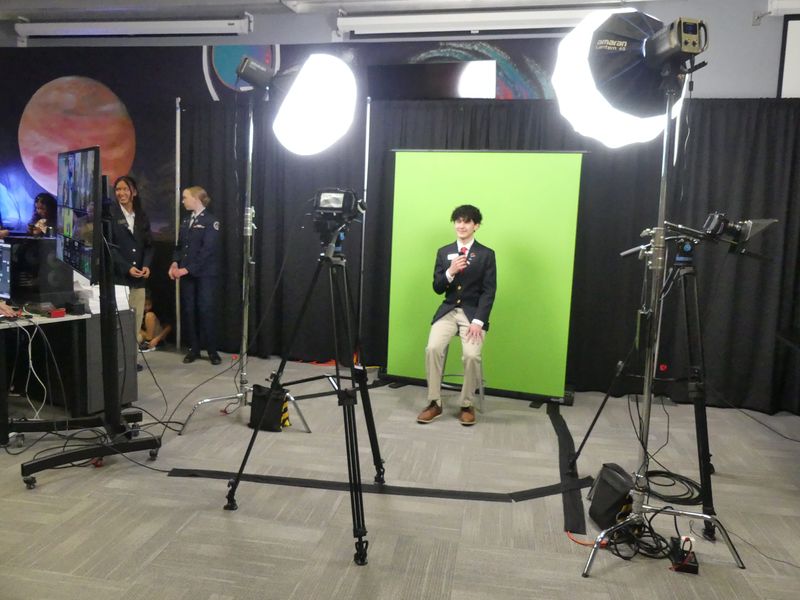
Meanwhile, AAE’s Technology Director Seth Dorcey orchestrated the event, as he reviewed data from Europe, ARISS, the space station and the control room, while receiving Adenot’s radio transmission relayed from a ground control station nearly 7,000 miles away in Italy. He also monitored audio levels and cameras inside the mission control studio, as school staff and students assisted in instructing the students when each camera went live.
The live-streamed presentation included a number of pre-recorded segments and students asking questions as they sat in front of a green screen.
“There were a lot of moving parts to this production, but it was a team effort, and we made it,” said Dorcey, who stayed after the event to share the technicalities of the audio/visual setup with his video three class.
How did students prepare for the event?
Prior to the ARISS-themed event, both schools offered hands-on, “pop-up” activities, which familiarized the students with ARISS and how astronauts live and work aboard the space station.
Additionally, over 200 students submitted questions for the astronauts, while many students submitted hand-drawn logos during the “Design a Mission Patch” contest.
Spokesperson Jisela Corona said the Lewis Center was among a small group of schools worldwide to be selected to host the “rare educational event” through the ARISS program.
‘Over the moon’
After the event, Lamb said she felt “over the moon” with pride and joy as she watched the finishing touch of the student-led project that concluded with her students interacting with Adenot.
She said she was inspired as she watched nearly 3,000 Lewis Center students from TK to 12th grade prepare for the event.
“Adults can do these things, but the fact that our students were the ones that led this, and created this, and that it was just so flawless—I’m just over the moon,” Lamb said.
The March event was the second time in the Lewis Center’s history that Amateur Radio on the International Space Station had chosen the Lewis Center for the rare opportunity. Fewer than 1% of schools worldwide ever experience the event once, let alone twice, the school added.
The Lewis Center said the conversation between its students and Adenot reflects this spirit of cooperation, showing students that space exploration and scientific discovery transcend borders.
“Experiences like this inspire students to imagine themselves as part of the next generation of explorers, engineers, scientists, and innovators,” the Lewis Center stated.
International Space Station facts
To learn more about Amateur Radio on the International Space Station program, visit ariss.org.
Daily Press reporter Rene Ray De La Cruz may be reached at RDeLaCruz@VVDailyPress.com. Follow him on X @DP_ReneDeLaCruz
This article originally appeared on Victorville Daily Press: California students chat with a space station astronaut
Reporting by Rene Ray De La Cruz, Victorville Daily Press / Victorville Daily Press
USA TODAY Network via Reuters Connect